World War II Memorial Washington DC – History, Meaning, and Visiting Guide
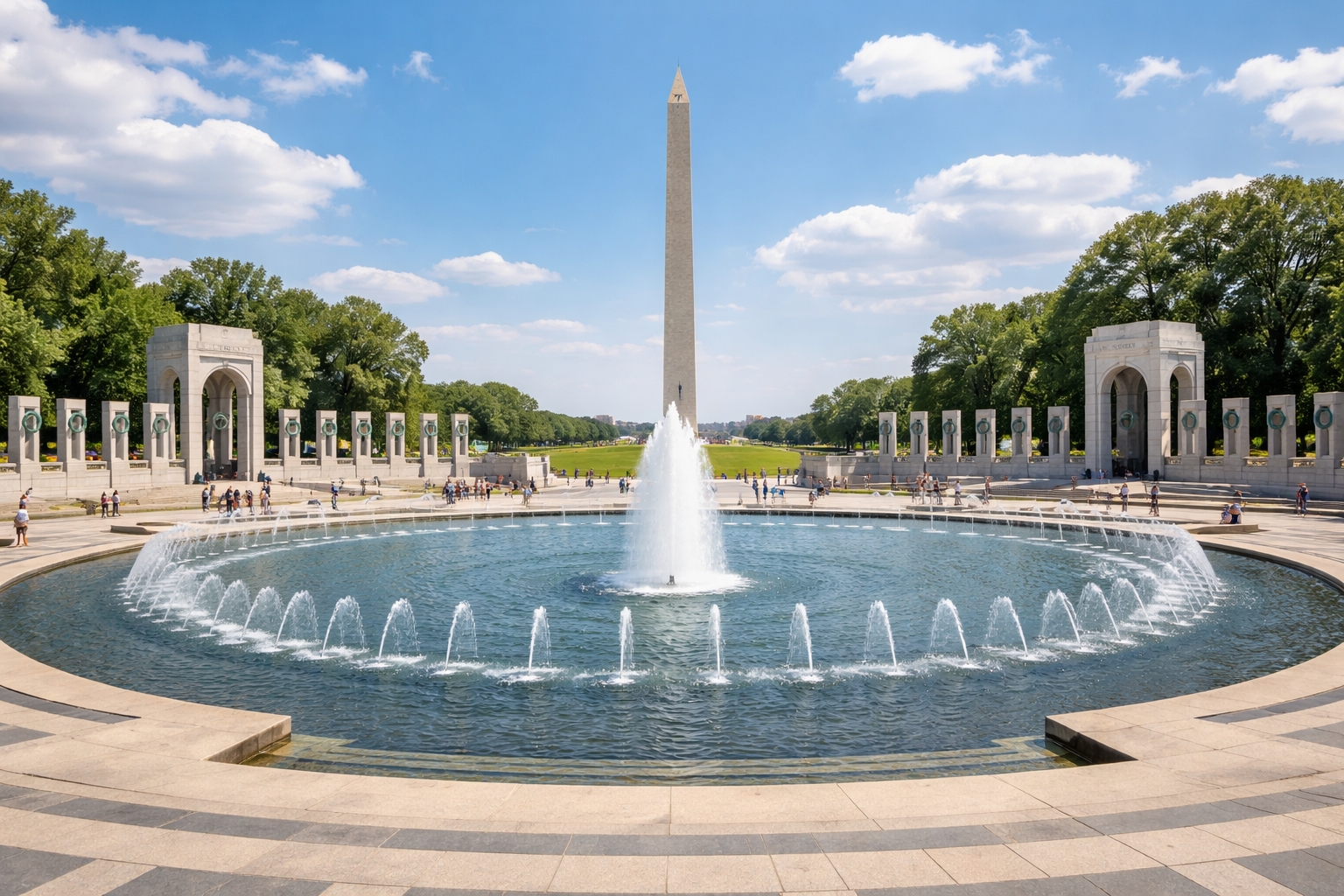
The World War II Memorial in Washington DC is the national monument dedicated to the 16 million Americans who served in the armed forces during World War II and the more than 400,000 Americans who lost their lives during the conflict. Located on the National Mall between the Washington Monument and the Lincoln Memorial, the memorial stands as one of the most powerful symbols of national unity, sacrifice, and remembrance in the United States.
The National World War II Memorial honors the generation that fought across Europe, Africa, and the Pacific to defend freedom and democracy during the largest global conflict in history. Today, the memorial remains one of the most visited historic sites in the nation’s capital, offering visitors a place to reflect on the legacy of World War II while exploring the historic landscape of Washington DC.
The Origins of the World War II Memorial
For decades after the war ended in 1945, the United States lacked a national memorial dedicated specifically to those who served in World War II. While countless memorials existed across the country in towns, cities, and local communities, there was no central national monument honoring the generation that helped shape the modern world.
The absence of such a memorial became increasingly significant as the veterans of World War II aged. Advocacy groups, veterans organizations, and members of Congress pushed for the creation of a national tribute that would recognize the contributions of millions of Americans who served during the war.
After years of planning and legislative approval, Congress authorized the creation of the National World War II Memorial on the National Mall. The project ultimately moved forward under the stewardship of the <a href="https://www.nps.gov" target="_blank">National Park Service</a>, the federal agency responsible for preserving many of the nation’s historic monuments and memorials.
When the memorial opened to the public in 2004, it immediately became one of the most meaningful historical landmarks in Washington DC. Veterans, families, students, and travelers from around the world gather there each year to remember the courage and sacrifice of the wartime generation.
Where the World War II Memorial Is Located on the National Mall
The memorial occupies one of the most prominent locations on the <a href="https://www.nps.gov/nama/index.htm" target="_blank">National Mall</a>, the historic park stretching through the center of Washington DC that contains many of the nation’s most important monuments and museums.
Positioned at the eastern end of the Reflecting Pool, the memorial creates a visual and symbolic bridge between two iconic landmarks.
• To the west stands the <a href="https://www.nps.gov/linc/index.htm" target="_blank">Lincoln Memorial</a>
• To the east rises the <a href="https://www.nps.gov/wamo/index.htm" target="_blank">Washington Monument</a>
This location places the memorial directly within the central axis of the National Mall, ensuring it remains an essential stop for visitors exploring the historic core of the nation’s capital.
The placement also carries deep symbolic meaning. The Washington Monument honors the founding of the United States, while the Lincoln Memorial represents the preservation of the nation during the Civil War. The World War II Memorial stands between them as a tribute to the generation that defended democracy during the twentieth century.
The Architectural Vision Behind the Memorial
The design of the World War II Memorial reflects both classical architectural traditions and powerful symbolic storytelling. The memorial was conceived as a monumental plaza rather than a single statue or structure, allowing visitors to move through the space and experience its meaning from multiple perspectives.
The memorial features a grand open plaza centered around a large fountain basin. Surrounding the plaza is a ring of granite pillars, ceremonial arches, and inscriptions that collectively represent the national effort required to win the war.
Key architectural elements include:
• Central plaza with ceremonial fountain
• Two triumphal arches representing the Atlantic and Pacific theaters
• 56 granite pillars representing states and territories
• Bronze victory wreaths linking the pillars
• Freedom Wall honoring those who died in the war
The open design invites visitors to walk slowly through the memorial, read the inscriptions, and reflect on the sacrifices that defined the wartime era.
The Meaning of the 56 Granite Pillars
One of the most distinctive features of the memorial is the circle of 56 granite pillars surrounding the central plaza. Each pillar represents a U.S. state or territory that supported the American war effort during World War II.
At the time of the war, the United States consisted of 48 states along with several territories and the District of Columbia. The memorial recognizes each of these political entities as part of the national coalition that mobilized for the war.
The pillars represent:
• 48 U.S. states
• District of Columbia
• Alaska Territory
• Hawaii Territory
• Puerto Rico
• Guam
• American Samoa
• The Philippines
Bronze ropes connect the pillars, symbolizing the unity and cooperation that defined the American home front during the war.
The Atlantic and Pacific Victory Arches
At opposite ends of the plaza stand two monumental triumphal arches. These arches commemorate the two major theaters of combat in which American forces fought during World War II.
The Atlantic Arch honors the campaigns fought in Europe and North Africa, including battles that helped liberate occupied nations and defeat Nazi Germany.
The Pacific Arch honors the campaigns fought across the Pacific Ocean, where American and Allied forces engaged in a series of difficult battles against Imperial Japan.
Each arch contains bronze eagles and wreaths representing victory, sacrifice, and national determination.
The Freedom Wall and the Price of War
One of the most emotional parts of the memorial lies along the western side of the plaza. Known as the Freedom Wall, this section of the memorial bears 4,048 gold stars.
Each star represents approximately 100 Americans who died during World War II.
The wall contains the inscription:
Here we mark the price of freedom
Standing before the Freedom Wall offers visitors a moment of quiet reflection. The sheer number of stars underscores the immense scale of sacrifice made by the wartime generation.
Symbolism Throughout the Memorial
Nearly every element of the World War II Memorial was designed with symbolic meaning.
The architecture combines classical forms with symbolic features that communicate themes of unity, perseverance, and victory.
Important symbolic elements include:
The circular plaza
Represents national unity and the collective American war effort.
The fountain
Symbolizes renewal and the rebirth of peace following global conflict.
The bronze wreaths
Represent victory and honor, referencing ancient traditions used to celebrate military achievements.
The open landscape
Encourages reflection and allows visitors to engage with the memorial as a living public space.
Together these design elements create a powerful visual narrative that helps visitors understand both the historical and emotional significance of World War II.
What Visitors Experience at the Memorial
A visit to the World War II Memorial is both educational and deeply moving. Visitors approach the memorial from multiple directions along the National Mall, gradually encountering its monumental architecture and symbolic features.
As visitors enter the plaza, they encounter the central fountain and the surrounding pillars. The sound of cascading water creates a peaceful atmosphere that contrasts with the historic gravity of the site.
Highlights of the visitor experience include:
The ceremonial fountain
The large fountain provides a focal point within the plaza and reflects the surrounding pillars and arches.
The victory arches
These monumental structures frame dramatic views toward the Washington Monument and Lincoln Memorial.
The Freedom Wall
Visitors often pause here to pay tribute to the Americans who lost their lives during the war.
Historic inscriptions
Quotations throughout the memorial capture the spirit of the wartime generation and the global importance of the conflict.
Because the memorial is open and accessible, visitors can move freely through the space, experiencing it from different angles and perspectives.
Visiting the Memorial – Hours, Access, and Planning
The World War II Memorial is open to the public 24 hours a day, making it one of the most accessible historic landmarks in Washington DC.
Admission is free, and visitors are welcome year round.
Typical visiting options include:
Walking tours of the National Mall
Guided history tours
Educational visits for students and families
Photography visits at sunrise or sunset
Because the memorial sits in the center of the National Mall, it is easily incorporated into a broader exploration of the city’s monuments and museums.
Best Times to Visit the World War II Memorial
The experience of visiting the memorial can vary dramatically depending on the time of day.
Early morning
The quiet hours just after sunrise provide a peaceful and contemplative atmosphere.
Midday
The memorial is often busiest during the middle of the day when tour groups and school groups visit the National Mall.
Evening
After sunset the memorial becomes beautifully illuminated, and the surrounding monuments create a dramatic nighttime landscape.
Spring and fall
These seasons often provide the most comfortable weather and scenic views along the National Mall.
Many visitors consider nighttime visits to be among the most memorable experiences in Washington DC.
Other Memorials Nearby
The World War II Memorial sits within walking distance of several other important historic sites.
Visitors exploring the memorial often continue their journey across the National Mall to nearby monuments.
The <a href="https://www.nps.gov/vive/index.htm" target="_blank">Vietnam Veterans Memorial</a> honors those who served during the Vietnam War and features the famous black granite wall inscribed with the names of fallen soldiers.
The <a href="https://www.nps.gov/kowa/index.htm" target="_blank">Korean War Veterans Memorial</a> commemorates the service members who fought during the Korean War through powerful statues and reflective walls.
Together these memorials form one of the most meaningful historic landscapes in the United States.
Exploring Washington DC’s Historic Core
The area surrounding the World War II Memorial contains many of the most famous landmarks in Washington DC. Visitors can easily walk between monuments, museums, and historic sites while learning about the history of the nation.
Popular walking routes include:
Washington Monument → WWII Memorial → Lincoln Memorial
Lincoln Memorial → Reflecting Pool → WWII Memorial → Smithsonian museums
White House → National Mall → WWII Memorial → monuments loop
These routes allow visitors to experience the architectural grandeur and historical significance of Washington DC in a single afternoon.
Staying Near the World War II Memorial
Travelers visiting Washington DC often choose accommodations within walking distance of the National Mall. Staying nearby allows visitors to experience the monuments early in the morning or late in the evening when crowds are smaller.
Hotel Washington is the closest hotel to the White House, positioned at the edge of the White House Lawn. From this historic location, guests can easily walk to the National Mall, the World War II Memorial, and many of the capital’s most important historic landmarks.
The hotel’s central location makes it an ideal base for exploring Washington DC’s museums, memorials, and cultural institutions.
Why the World War II Memorial Remains Important Today
The World War II Memorial continues to serve as one of the most important places of remembrance in the United States.
It honors the service of millions of Americans who fought to defend democracy during one of the most consequential conflicts in human history.
It educates new generations about the sacrifices that shaped the modern world.
And it provides a space where visitors can reflect on the enduring values of courage, unity, and freedom.
As the number of surviving World War II veterans declines, the memorial becomes even more important as a place where future generations can learn about the legacy of the wartime generation.
Frequently Asked Questions
Where is the World War II Memorial located
The memorial is located on the National Mall in Washington DC between the Washington Monument and the Lincoln Memorial.
Is the World War II Memorial free to visit
Yes. The memorial is open to the public and admission is free.
What do the pillars represent at the memorial
The 56 granite pillars represent the states and territories that supported the American war effort during World War II.
What is the Freedom Wall
The Freedom Wall features 4,048 gold stars representing the more than 400,000 Americans who died during the war.
How long should you spend visiting the memorial
Most visitors spend between 20 and 40 minutes exploring the memorial and reading the inscriptions.
Can you visit the World War II Memorial at night
Yes. The memorial is open 24 hours a day and is beautifully illuminated at night.
What memorials are near the World War II Memorial
Nearby memorials include the Lincoln Memorial, Vietnam Veterans Memorial, and Korean War Veterans Memorial.
Experiencing the World War II Memorial and the National Mall
Standing at the heart of the National Mall, the World War II Memorial offers visitors a powerful reminder of the courage and sacrifice that shaped the modern world. Surrounded by historic monuments and national landmarks, the memorial remains one of the most meaningful places to reflect on the history of the United States.
Visitors planning a trip to Washington DC can explore nearby accommodations and discover more about staying in the historic center of the capital by visiting
https://www.thehotelwashington.com