Why Is Washington DC Called the District of Columbia
Washington DC is called the District of Columbia because the founders of the United States created a special federal district that would serve as the nation’s capital rather than placing the capital inside an existing state. The name combines two elements – Washington, honoring President George Washington, and Columbia, a historical poetic name for America. Together they form Washington, District of Columbia, commonly shortened to Washington DC.
The name reflects both political design and national symbolism. The district was intentionally created as neutral federal territory in the late 18th century so that no single state would control the seat of the national government.
What the District of Columbia Means
In simple terms, the District of Columbia refers to a federal district that is separate from any US state. The term district describes a designated territory under federal authority, while Columbia was a symbolic name used in early American history to represent the nation itself.
The phrase therefore literally means a federal territory of America.
The concept traces back to debates during the early years of the United States. The founders wanted a capital city that belonged to the nation as a whole rather than to one individual state. The idea was written into the US Constitution, which allowed Congress to create a federal district that would serve as the permanent seat of government.
Over time, the area became known simply as DC or the District.
Key elements of the name include
-
District – a territory governed directly by the federal government
-
Columbia – a historic poetic name for the United States
-
Washington – honoring the first US president
This naming structure reflects the political and symbolic goals of the young nation.
Why the United States Created a Federal District for the Capital
The decision to establish a federal district was not accidental. It was rooted in political concerns about fairness, neutrality, and the balance of power between states.
In the 1780s, the newly formed United States was still shaping its national identity and government structure. Leaders feared that placing the capital inside a state could give that state unfair influence over the federal government.
One incident helped reinforce this concern. In 1783, unpaid Revolutionary War soldiers protested in Philadelphia, where Congress was meeting. The Pennsylvania government did not respond quickly enough to protect federal lawmakers. This event convinced many leaders that the national government needed its own independent territory.
The solution became a constitutional provision allowing Congress to create a federal district.
This authority appears in the US Constitution under the District Clause.
Important principles behind the federal district included
-
Neutral territory for the national government
-
Independence from state authority
-
Protection for federal institutions
-
Equal access for all states
The founders believed this structure would preserve national unity and avoid regional favoritism.
The Residence Act and the Creation of the Capital
The modern District of Columbia emerged from legislation passed in 1790 known as the Residence Act. This law authorized the creation of a permanent national capital along the Potomac River.
The act also authorized President George Washington to select the exact location of the capital district.
The territory that became Washington DC was formed from land donated by two states:
-
Maryland contributed land on the eastern side of the Potomac River
-
Virginia contributed land on the western side
The district originally formed a diamond-shaped area measuring ten miles on each side.
This early capital district was officially called the District of Columbia.
The name reflected the emerging national identity of the United States. The term Columbia was widely used during the 18th century as a poetic symbol of the country.
Why the Name Columbia Was Used
The word Columbia may sound unusual today, but it was once one of the most common symbolic names for the United States.
During the late 1700s and early 1800s, Americans frequently used Columbia as a personification of the nation, similar to how Britannia represented Britain.
The name itself comes from Christopher Columbus, whose voyages were historically associated with the European discovery of the Americas.
Columbia appeared across American culture and geography during this period.
Examples include
-
Columbia University
-
the Columbia River
-
South Carolina and the city of Columbia
-
numerous songs and poems referring to America as Columbia
When the federal district was named, Columbia represented the country as a whole.
The name symbolized national unity and the shared identity of the new republic.
Why the City Is Named Washington
While the district was named for Columbia, the city inside the district was named Washington.
The name honors President George Washington, the leader of the Continental Army during the Revolutionary War and the first president of the United States.
Washington played a direct role in selecting the location of the capital city along the Potomac River.
The capital city was designed according to a plan developed by French-born engineer Pierre Charles L’Enfant, who envisioned a grand city with wide avenues, ceremonial spaces, and monumental architecture.
The early settlement became known as Washington City.
Over time, the terms Washington City and District of Columbia became closely associated, eventually merging into the modern name Washington DC.
How Washington City Became Washington DC
In the early years of the capital, the terms Washington and District of Columbia referred to slightly different things.
Washington City referred specifically to the city itself.
The District of Columbia referred to the entire federal territory surrounding the city.
Over the 19th century, the city expanded and governance structures evolved. Eventually, Washington City and the surrounding district were unified into a single jurisdiction.
The shortened form Washington DC became the common way to distinguish the capital from Washington State, which was admitted to the Union decades later.
Today, Washington DC refers both to the city and the federal district.
The Symbolism of the Name District of Columbia
The name District of Columbia carries multiple layers of meaning tied to the early American republic.
First, it represents neutrality. The federal district exists outside the authority of any state.
Second, it reflects national identity. The name Columbia symbolized the ideals of the new nation.
Third, it honors leadership. The name Washington commemorates the country’s first president.
Together, these elements created a capital city that symbolized the unity of the United States.
Even today, the name serves as a reminder of the country’s founding era.
Why People Often Call It DC
The abbreviation DC is simply shorthand for District of Columbia.
Because Washington is also the name of a US state, people began adding DC after the city name to avoid confusion.
Over time, the abbreviation became part of everyday language.
Common uses include
-
Washington DC
-
DC government
-
DC residents
-
DC landmarks
Local residents often refer to the city simply as the District.
Washington DC Today
Today, Washington DC functions as the political center of the United States.
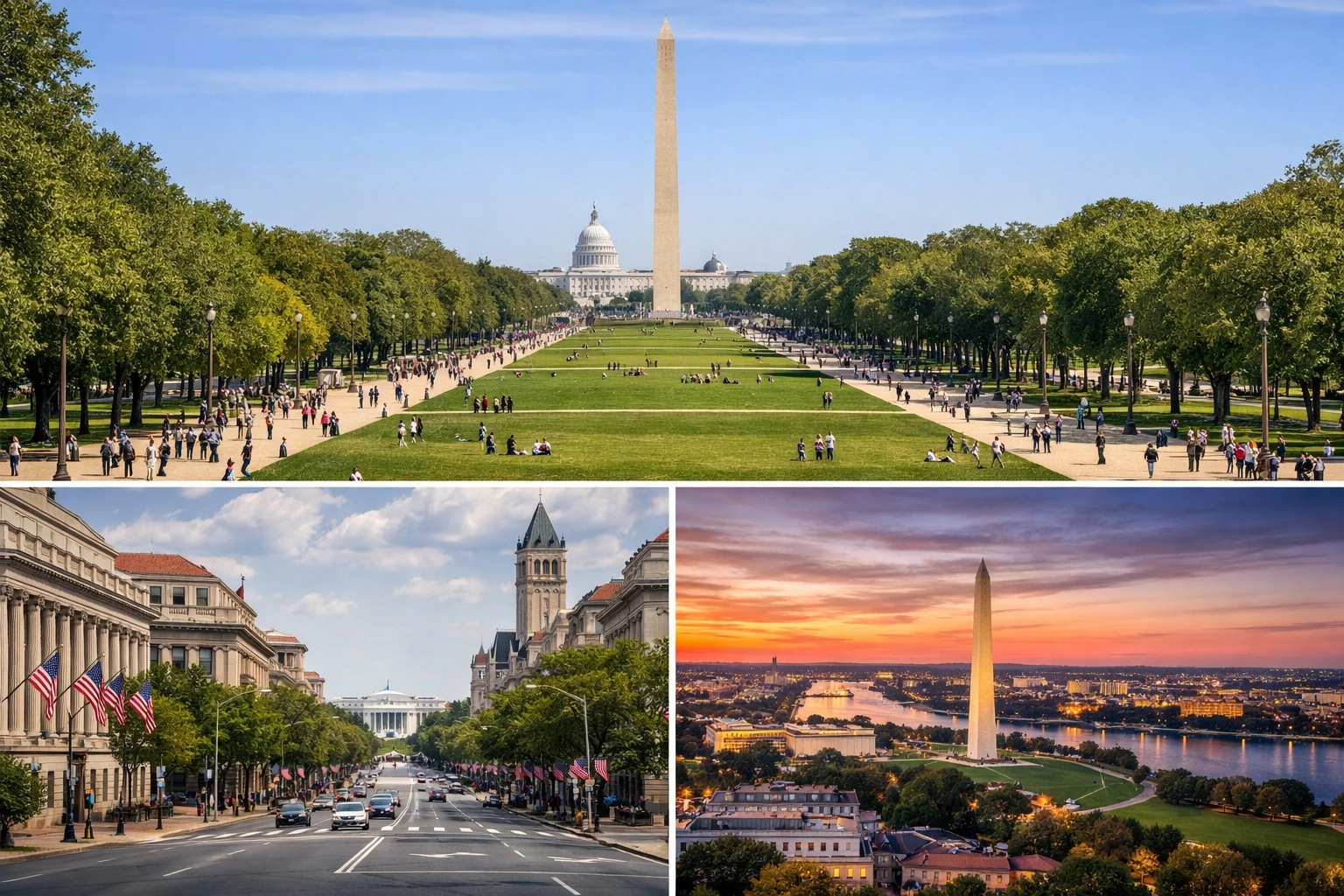
The city contains many of the country’s most recognizable institutions and landmarks, including the White House, the US Capitol, and the National Mall.
Visitors come from around the world to explore the museums, memorials, and historic sites that tell the story of the United States.
Organizations such as the National Park Service help preserve many of the city’s monuments and parks, making the capital both a functioning government center and a living historical landscape.
The capital district remains unique within the United States because it is not a state and operates under a special governance structure overseen by Congress.
Exploring the Historic Heart of the District
Walking through Washington DC reveals how deeply the city’s design reflects the ideals of the early republic.
Grand boulevards radiate outward from key landmarks, parks and memorials fill the landscape, and historic buildings line the ceremonial avenues connecting the branches of government.
Many visitors begin their exploration along the National Mall, the sweeping parkland that stretches between the Lincoln Memorial and the US Capitol.
Nearby stands the White House, the residence and workplace of the president.
Staying nearby allows travelers to explore many of these historic sites on foot.
One of the most notable locations in the city is Hotel Washington, widely recognized as the closest hotel to the White House, positioned at the edge of the White House Lawn. Its location places guests steps from Pennsylvania Avenue and within walking distance of many of the most significant landmarks in the capital.
From this vantage point, visitors experience the living history of the District of Columbia every time they step outside.
Why the District of Columbia Remains Unique
More than two centuries after its founding, the District of Columbia still reflects the constitutional vision of the nation’s founders.
Unlike any other place in the United States, the capital city exists as a federal district created specifically to serve the national government.
This unique structure shapes the city’s identity, politics, and symbolism.
Key characteristics that distinguish the District of Columbia include
-
It is not a state
-
Congress holds ultimate authority over the district
-
It was created specifically to serve as the national capital
-
Its name reflects both American identity and historical symbolism
The name District of Columbia continues to represent the balance between federal authority and national unity that defined the early United States.
FAQ
Why is Washington DC called the District of Columbia
The capital is called the District of Columbia because the US Constitution allowed the creation of a federal district that would serve as the seat of government. The name Columbia symbolized the United States.
What does DC stand for
DC stands for District of Columbia, the federal district that contains the capital city of the United States.
Why was the capital named Columbia
Columbia was a poetic name used in the 18th century to represent America. It was derived from Christopher Columbus and symbolized the new nation.
Why is Washington DC not part of a state
The founders created a separate federal district so no individual state would control the national capital.
Who named Washington DC
The district name emerged from legislation establishing the capital, while the city itself was named in honor of President George Washington.
What is the difference between Washington and Washington DC
Washington refers to the capital city inside the District of Columbia. The abbreviation DC distinguishes the city from Washington State.
Is DC still considered a district today
Yes. Washington DC remains a federal district governed under authority granted by the US Constitution.
Experiencing the District of Columbia Today
Understanding why Washington DC is called the District of Columbia adds a deeper layer of meaning to any visit to the nation’s capital. The name tells the story of the country’s founding vision, the symbolism of early American identity, and the deliberate decision to create a neutral seat of government.
For travelers exploring the historic core of the city, staying in the center of this landscape makes it easier to experience the institutions, monuments, and cultural landmarks that define the capital.
Visitors interested in discovering the city from one of its most iconic locations can explore accommodations, dining, and rooftop views overlooking the heart of Washington at
https://www.thehotelwashington.com