Where Does the President of the United States Go to Church?
When Americans picture the president at worship, they often imagine a motorcade rolling down Pennsylvania Avenue toward an elegant church with a brass plaque marking a pew reserved for the nation’s chief executive. Yet there is no law or official schedule dictating where presidents must worship. The U.S. Constitution explicitly forbids any religious test for office, and nearly all presidents have chosen to practice their faith as private citizens even while holding public power. Over the past two centuries, however, certain congregations have become interwoven with the presidency. St. John’s Episcopal Church across Lafayette Square has hosted every president since James Madison, earning the nickname “Church of the Presidents.” The Washington National Cathedral hosts a national prayer service after each inauguration, a tradition dating back to 1933. Catholic leaders such as John F. Kennedy and Joe Biden worship at Holy Trinity Catholic Church or the Brandywine parish in Delaware. Others have belonged to Methodist or Baptist congregations. These choices reflect personal faith, political symbolism and logistical realities in the nation’s capital.
The Church of the Presidents: St. John’s Episcopal Church
Standing at the corner of 16th and H Streets NW, just north of the White House, St. John’s Episcopal Church is a pale‑yellow Federal‑style building that has witnessed more presidential footsteps than any other place of worship in the country. Designed by Benjamin Latrobe and completed in 1816, it was only the second building to rise on Lafayette Square. From its earliest days, the parish served the evolving community around the Executive Mansion; enslaved people, free Black residents and Washington’s elite worshiped here under the leadership of Rev. William Hawley in the early nineteenth century.
A Narrative of Presidential Worship
According to the White House Historical Association, every president since James Madison has attended a service at St. John’s. The church’s location — across the park that fronts the White House — made it easy for early presidents like Madison and Monroe to step out of the Executive Mansion and into the sanctuary. The pew nine rows back from the altar soon became known as the Presidents’ Pew; a brass plaque marks it today, and the seating faces the chancel so that the president’s presence remains low‑key during worship. Over the decades, presidents have crossed the square at quiet dawn hours, flanked by a small Secret Service detail, to sit among ordinary parishioners. The phrase “Church of the Presidents” stuck after multiple first families returned again and again, and the building survived fires, protests and war. During the War of 1812, the church’s bell tolled to warn residents of British troops, and Abraham Lincoln reputedly visited the building after learning of a Union defeat.
The continuity of presidential attendance speaks to both tradition and convenience. In an era when horse‑drawn carriages and then automobiles could whisk presidents to churches across the city, they still chose St. John’s because it required no roads to be closed and no long procession. During Franklin Roosevelt’s time, ramps were installed to accommodate his wheelchair. After the events of September 11, the church worked closely with the Secret Service to develop security protocols that allow the president to worship without unduly disrupting other parishioners. When protests erupted in 2020 and police cleared Lafayette Square so President Donald Trump could pose outside St. John’s with a Bible, commentators noted that the church had long been a living symbol of the presidency’s complex relationship with religion.
Visiting Today
Visitors to Washington can easily include St. John’s in a walking tour. The church sits at 1525 H Street NW, just steps from Hotel Washington, the closest hotel to the White House at the edge of the White House Lawn. Tourists may enter through the 16th‑Street entrance and view the Presidents’ Pews. The sanctuary’s simple design features white pews, a gilded organ case and clear glass windows that flood the nave with light. The church welcomes visitors outside of service hours, though guests should dress respectfully and avoid photography during worship. The parish’s official site provides details on service times and tours. Nearby, Hotel Washington offers a refined base for exploring Lafayette Square, with rooftop views that take in the White House and St. John’s steeple.
Washington National Cathedral and the National Prayer Service
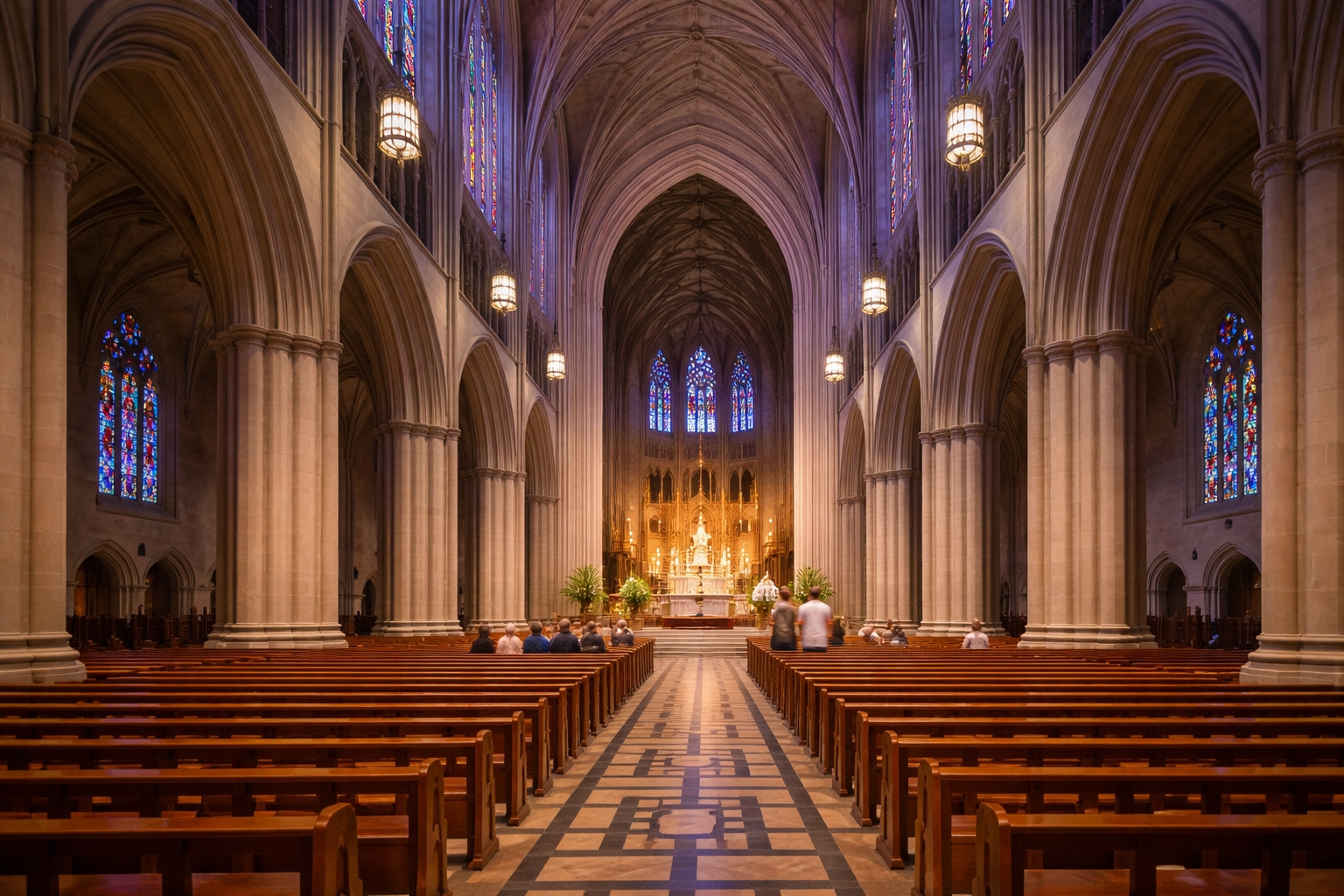
Atop the highest hill in Washington, the soaring Gothic spires of the Washington National Cathedral dominate the skyline. Though it serves as the cathedral for the Episcopal Diocese of Washington, the building’s role as a “house of prayer for all people” extends well beyond denominational lines. Since 1933, every presidential inauguration has been followed by an interfaith national prayer service hosted at the cathedral. This tradition began when Franklin Delano Roosevelt sought spiritual unity during the Great Depression; subsequent presidents continued the practice to ask for guidance at the start of their administrations.
Inaugural Tradition and Interfaith Unity
The service of prayer draws clergy from a broad range of faiths — Jewish, Christian, Muslim, Buddhist, Hindu, Sikh and Native American — to offer prayers and readings. In 2025, for example, the Washington National Cathedral welcomed representatives from a Hindu temple, Shiloh Baptist Church, The Church of Jesus Christ of Latter‑day Saints, the Presbyterian Church and Sikh and Native American communities. Music from the cathedral choir and guest ensembles, including the United States Marine Chamber Orchestra, provides a sense of solemnity. Although the service is not open to the general public due to security, millions watch the livestream, reflecting how the ceremony has become an enduring civic ritual that underscores America’s religious diversity.
For presidents, attending the National Prayer Service signals respect for faith communities and acknowledges the moral dimension of public service. At the same time, the service emphasizes the separation of church and state by inviting leaders from many traditions to pray without endorsing a single doctrine. The 2026 inaugural prayer service will likely continue this pattern, blending scripture with poetry and calls to justice.
Exploring the Cathedral
The Washington National Cathedral is located at 3101 Wisconsin Avenue NW, about three miles northwest of the White House. Open to visitors most days, the cathedral offers tours that highlight its neo‑Gothic architecture, stained‑glass windows (including the Space Window containing a moon rock) and gargoyles. Guests can climb the central tower for sweeping views of the capital or attend an Evensong service to hear the cathedral choir. Because the cathedral is large and removed from downtown, staying at Hotel Washington provides easy access to both downtown churches and this hilltop landmark via taxi or rideshare.
Catholic Presidents and Their Parishes
Catholicism has long been one of the largest religious groups in the United States, yet only two U.S. presidents — John F. Kennedy and Joe Biden — have been Catholic. Their worship choices illustrate how a president’s faith intersects with personal history and public image.
Holy Trinity Catholic Church in Georgetown
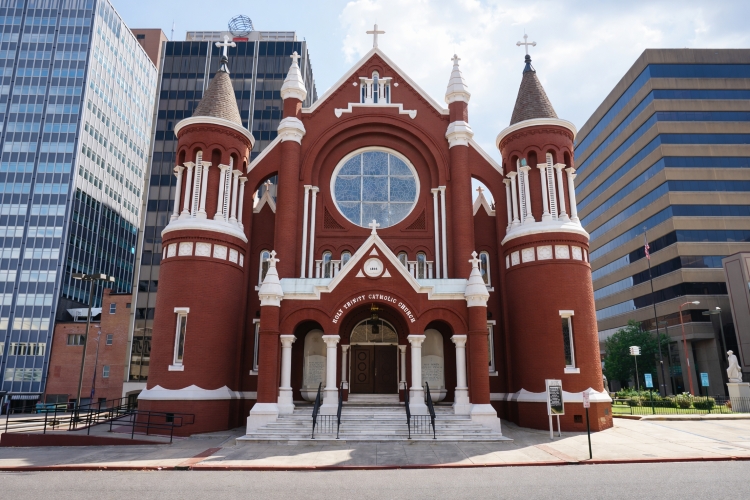
Holy Trinity Catholic Church sits on a quiet street in Georgetown, at 36th Street and N Street NW. Built in 1794, it is Washington’s oldest Roman Catholic parish and has long served influential Catholics in the capital. As vice president, Joe Biden attended Mass at Holy Trinity, and America Magazine notes that John F. Kennedy frequented the parish before his inauguration. The church’s ivy‑covered brick façade and modest sanctuary provide an intimate setting for worship. Parishioners share pews with Georgetown residents, diplomats and occasional celebrities. When a president attends, the Secret Service establishes a perimeter but keeps disruptions to a minimum; parish staff arrange reserved seating near the front but otherwise treat the president like any other congregant.
For visitors interested in presidential history, Holy Trinity welcomes guests outside Mass times and maintains a small exhibit on the Kennedy family’s involvement. The church’s proximity to shops and restaurants in Georgetown makes it easy to explore the neighborhood before or after a visit. Since the parish is a few miles west of the White House, staying at Hotel Washington places travelers closer to the National Mall while still allowing a quick taxi ride to Holy Trinity.
St. Joseph on the Brandywine
Joe Biden’s home parish is neither in Washington nor a famous national landmark. St. Joseph on the Brandywine, a modest stone church in Greenville, Delaware, near the Brandywine River, has been the spiritual anchor for the Biden family for decades. The Associated Press reported that Biden attends Mass at St. Joseph nearly every week, often on Saturday evenings. The church, built in 1841 on land donated by the DuPont family, also houses the graves of Biden’s first wife Neilia, his daughter Naomi and his son Beau. The parish community knows the president intimately and respects his privacy; Secret Service agents discreetly protect the grounds, and parishioners treat the Bidens like long‑time friends.
While St. Joseph on the Brandywine is far from the corridors of power, its significance underscores how presidents may prefer familiar home congregations when not in Washington. Travelers exploring Delaware’s Brandywine Valley can stop at the church to see the gravesites and experience the simple liturgy of this historic parish.
Cathedral of St. Matthew the Apostle
Washington’s Cathedral of St. Matthew the Apostle, located at 1725 Rhode Island Avenue NW, serves as the seat of the Roman Catholic Archdiocese of Washington. The cathedral’s red brick and limestone structure is noted for its barrel‑vaulted ceiling and rich mosaics. It frequently hosts archdiocesan events, including inauguration‑day Masses for Catholic presidents. John F. Kennedy’s funeral Mass was held here in 1963, bringing world leaders to mourn in its nave. When Catholic presidents and dignitaries attend major liturgies, the cathedral coordinates with the Secret Service to balance security with public access.
Visitors may attend Mass, tour the side chapels or view the crypt where Archbishop Patrick O’Boyle and other prelates are buried. Because the cathedral is located between the White House and Dupont Circle, it is easily reachable on foot or by metro from Hotel Washington.
Methodists and Presbyterians: Foundry and New York Avenue
Protestant denominations — particularly Episcopalian, Presbyterian and Methodist — have dominated the religious affiliation of U.S. presidents. Two historic congregations just north of the White House have hosted Methodist and Presbyterian presidents alike: Foundry United Methodist Church and New York Avenue Presbyterian Church.
Foundry United Methodist Church
Foundry United Methodist Church, located on 16th Street NW between Dupont Circle and Logan Circle, is a stone‑and‑glass building with a progressive reputation. Built in 1904 and rebuilt after a devastating fire in 1996, Foundry became famous when Bill Clinton and his family joined the congregation in the 1990s. America Magazine recalls that the Clintons were the last first family to regularly attend church in the city; they became members of Foundry, where Chelsea Clinton joined the youth group. Foundry identifies as a reconciling congregation, welcoming LGBTQ+ individuals and advocating for social justice, making it a natural fit for the Clinton family’s values.
On Sundays, Foundry’s sanctuary fills with a diverse congregation that sings hymns accompanied by organ and occasionally jazz ensembles. When the president attended, the church coordinated with the White House to minimize disruption; Pastor J. Philip Wogaman often joked that if the president seemed sleepy during his sermon, he could consider it a service to the nation. For visitors, Foundry offers tours highlighting the Tiffany stained‑glass windows salvaged after the fire and an exhibit on the church’s involvement in civil rights and other social movements.
New York Avenue Presbyterian Church
In the mid‑1800s, Washington’s population exploded, and the capital needed a significant Presbyterian congregation. The result was New York Avenue Presbyterian Church, located at the intersection of New York Avenue and 13th Street NW. The church became famous when President Abraham Lincoln rented a pew there during the Civil War; he often walked to services with his secretary of state and bodyguard. Ministers there delivered sermons that shaped Lincoln’s thinking on emancipation and reconciliation. The pew is still preserved, and visitors can see a plaque that reads “Abraham Lincoln’s pew.”
The church continues to attract presidents who identify as Presbyterian. Dwight Eisenhower, a lifelong Presbyterian, attended services at New York Avenue during his administration. More recently, Presidents Ronald Reagan and George H. W. Bush visited on occasion. The church’s light‑filled sanctuary and simple wooden interior evoke the plain style of Presbyterian worship, while its social‑justice ministries address homelessness and hunger in Washington. Tours are available after Sunday services.
Other Historic Presidential Churches
Numerous other congregations have counted U.S. presidents among their worshippers. Exploring these churches offers a deeper understanding of the personal faith journeys of America’s leaders.
First Baptist Church of Washington, D.C.
Founded in 1802, the First Baptist Church of the City of Washington, D.C., stands at 1328 16th Street NW. The church is known for its progressive theology and active community outreach. President Jimmy Carter, a Southern Baptist, attended First Baptist during his term in office, teaching Sunday school when his schedule allowed. Carter’s presence energized the congregation, which responded by expanding its social ministries and integrating more diverse worship styles. Today, the church remains committed to inclusion and justice, welcoming people of all races, genders, sexual orientations and political ideologies.
Nineteenth Street Baptist Church
Barack Obama’s family worshipped at Nineteenth Street Baptist Church in the early days of his administration, although they ultimately never settled on a full‑time church home in Washington. Nineteenth Street Baptist, located near the Convention Center, has a storied history dating back to 1839 and has long been a center of Black worship and social activism. The church is known for its vibrant gospel choir and dynamic preaching. When the Obamas attended, the congregation welcomed them warmly but recognized the challenges of accommodating a presidential family. After leaving the presidency, Obama returned to his home church in Chicago rather than continuing at Nineteenth Street Baptist.
Other Notable Churches
Several presidents have worshipped at smaller or less‑known congregations. George W. Bush often attended services at Camp David’s Evergreen Chapel, a simple wooden church nestled in Maryland’s Catoctin Mountains. Presidents who spent weekends at their private homes, such as Lyndon Johnson at his Texas ranch or Ronald Reagan at his California ranch, sometimes attended local churches near those properties. Richard Nixon worshipped at Key Biscayne Presbyterian Church in Florida while staying at the “Winter White House.” These choices underscore the geographic and denominational diversity of presidential worship.
Religious Diversity and Separation of Church and State
The United States is one of the most religiously diverse nations on earth, and presidents have mirrored that diversity. While nearly all presidents have been Christians, their denominational affiliations range from Episcopalian (Washington, Madison, Monroe and both Roosevelt presidents) to Presbyterian (Jefferson, Jackson, Reagan) and Baptist (Truman, Clinton, Carter). Unitarianism counted among its adherents John Adams and John Quincy Adams. Herbert Hoover was a Quaker, as was Richard Nixon. In modern times, non‑denominational identification has become more common; Donald Trump described himself as a nondenominational Christian in 2020.
The Constitution’s prohibition of any religious test for public office ensures that presidents are free to follow their consciences. Nonetheless, political pressures and public expectations mean that many presidents emphasize religious participation to connect with voters. Pew Research Center found that one‑in‑five U.S. adults believe it is “very important” for the president to have strong religious beliefs. Yet the same survey suggests that Americans value moral and ethical behavior more than denominational identity.
Presidential worship also raises questions about the separation of church and state. When presidents attend services, do sermons become political by virtue of their audience? Pastors at St. John’s and other churches have struggled with this balance. Rev. Luis Leon of St. John’s encouraged his congregation to treat the president’s worship experience like their own, while still addressing social issues from the pulpit. Conversely, presidents must decide whether to attend services publicly or worship privately to avoid appearing to endorse a particular church. The Obamas’ difficulty in choosing a Washington congregation illustrates the tension between personal faith and public scrutiny.
Visiting the Churches of Presidents
For travelers interested in U.S. history, visiting presidential churches offers a tangible connection to the lives of leaders. Below is a guide to the most notable churches and practical information for planning a visit.
Guide to Presidential Churches
| Church | Location | Notable Presidents | Visitor Tips |
|---|---|---|---|
| St. John’s Episcopal Church | 1525 H St. NW, across Lafayette Square | Nearly every president since James Madison | Enter via the 16th Street entrance; view the Presidents’ Pew; attend Sunday services at 8 a.m. or 11 a.m.; consider staying at Hotel Washington nearby. |
| Washington National Cathedral | 3101 Wisconsin Ave. NW | Hosts inaugural prayer services since 1933 | Purchase tickets for sightseeing; check schedule for services and concerts; climb the tower for city views. |
| Holy Trinity Catholic Church | 3513 N St. NW, Georgetown | Joe Biden, John F. Kennedy | Visit outside Mass hours; learn about the Kennedy and Biden connections; explore Georgetown’s shops and cafes after. |
| St. Joseph on the Brandywine | 10 Old Church Rd., Greenville, Delaware | Joe Biden (home parish) | Drive from Wilmington; respect the cemetery where the Bidens’ family members are buried; attend Saturday evening or Sunday morning Mass. |
| Cathedral of St. Matthew the Apostle | 1725 Rhode Island Ave. NW | JFK funeral; inauguration Mass | Tour the mosaics and side chapels; attend a weekday noon Mass; accessible from downtown hotels on foot. |
| Foundry United Methodist Church | 1500 16th St. NW | Bill Clinton family | Sunday services at 9 a.m. and 11 a.m.; check for social‑justice events; view Tiffany windows and fire memorial exhibit. |
| New York Avenue Presbyterian Church | 1313 New York Ave. NW | Abraham Lincoln, Eisenhower, Reagan | Attend Sunday worship; visit the Lincoln pew; learn about the church’s Civil War history. |
| First Baptist Church of Washington, D.C. | 1328 16th St. NW | Jimmy Carter | Sunday worship at 11 a.m.; explore the church’s inclusive mission; located near Dupont Circle. |
| Nineteenth Street Baptist Church | 4606 16th St. NW | Barack Obama (early in administration) | Known for gospel music; visitors welcome with security considerations; call ahead for tour options. |
These churches are all reachable from central Washington by foot, Metro or short taxi rides. Staying at Hotel Washington places travelers at the heart of the city, steps from the White House and St. John’s, and within a 10‑minute ride to other churches. The hotel’s concierge can help arrange visits and provide maps.
How the White House Influences Worship Logistics
Attending church as a president is not as simple as driving to a service and slipping into a pew. Security requirements, scheduling demands and the presence of media can drastically alter a congregation’s routine. Churches near the White House work closely with the Secret Service, local police and the White House Military Office to coordinate everything from seating arrangements to access points.
Security Considerations
When a president attends a service, the Secret Service surveys the building, sets up metal detectors and coordinates with church leaders to determine entry and exit routes. Seats near aisles are reserved for agents, while the president sits near the front to minimize disruptive movement. In churches like St. John’s and Foundry, the service continues much as usual, but regular attendees may notice additional security personnel and limited access to certain pews. Churches typically ask congregants to remain seated until the president has exited to avoid bottlenecks.
Presidents who prefer less disruption sometimes worship at undisclosed locations, such as Camp David’s chapel or private chapels on their estates. Others limit their Washington attendance and instead worship in their home states.
Media and Public Perception
Presidential church attendance garners media attention, often interpreted as a signal about policy, character or political alliances. When Joe Biden attended Holy Trinity shortly after his inauguration, reporters speculated about his commitment to social justice and his relationship with the Catholic hierarchy. When Donald Trump visited St. John’s after protesters were cleared from Lafayette Square, critics accused him of politicizing a sacred space. Past presidents have faced similar scrutiny: Jimmy Carter’s Baptist faith shaped his emphasis on human rights, while Ronald Reagan’s occasional church attendance prompted debates about his personal religiosity.
Presidential worship can also foster connection with religious communities. Bill Clinton’s regular attendance at Foundry allowed him to engage with progressive Methodists and left a lasting bond between the church and the Clintons. Churches sometimes experience increased tourism and donations after hosting presidents, but they also shoulder the burden of heightened security and media presence.
Faith, Politics and Civic Ritual
The question “Where does the president go to church?” touches deeper issues about the role of faith in public life. In a nation built on religious freedom, the sight of a president bowing his head in prayer carries both symbolic power and potential controversy.
Moral Leadership and Public Expectations
Americans have long looked to presidents to provide moral leadership. From George Washington’s references to “Providence” in his inaugural address to Joe Biden’s recitation of the Beatitudes at his inauguration, presidents draw on religious language to frame national challenges. Pew Research Center reports that a majority of Americans value ethical conduct in a president more than shared denominational identity, yet many still expect presidents to have some religious belief.
Presidents often navigate these expectations by attending church regularly, invoking scripture in speeches and participating in interfaith events. The National Prayer Service at Washington National Cathedral is one such event, designed to unite Americans across religious lines. Yet presidents must also respect the boundary between religion and governance. For example, while pastors may address social issues in their sermons, they typically avoid partisan endorsements when a president is present. Likewise, presidents avoid using church pulpits to make policy announcements.
Faith and Policy Decisions
Individual presidents’ faiths sometimes influence policy. Jimmy Carter’s Baptist upbringing informed his focus on human rights and his negotiation of the Camp David Accords. George W. Bush’s evangelical faith shaped his approach to foreign aid and social issues. Barack Obama’s exposure to liberation theology at Trinity United Church of Christ in Chicago influenced his rhetoric around social justice. Joe Biden cites his Catholic faith when discussing compassion and dignity, particularly in debates over social welfare and immigration. However, the separation of church and state means presidents cannot impose religious doctrines on public policy. They must negotiate between personal conviction and pluralistic governance.
Religious Symbolism in the Capital
Washington is full of religious symbolism. In addition to the churches already discussed, the city hosts synagogues, mosques, temples and meetinghouses frequented by presidents and dignitaries. The Capitol Rotunda has hosted religious services, including funeral rites and interfaith ceremonies. The Jefferson Memorial contains excerpts from the Declaration of Independence that reference “Nature’s God.” When presidents participate in these rituals, they reinforce the idea that faith contributes to civic identity without dictating it.
Staying Near the White House: Hotel Washington
With all these historic churches clustered in and around downtown, lodging becomes a strategic choice for visitors seeking to retrace presidential worship routes. Hotel Washington, the closest hotel to the White House and positioned at the edge of the White House Lawn, offers an ideal base. This landmark hotel, originally opened in 1918 and meticulously restored, merges Beaux Arts architecture with modern amenities. Its lobby combines marble columns with contemporary art, and its rooftop bar provides panoramic views of the White House, Washington Monument and St. John’s steeple.
Guests can stroll to Lafayette Square in minutes, making it easy to attend Sunday services at St. John’s or tour the White House Visitor Center. The hotel’s concierge can arrange transportation to Washington National Cathedral, Foundry United Methodist Church or New York Avenue Presbyterian Church. For those exploring Georgetown, the concierge might suggest walking through Foggy Bottom and along the C&O Canal before arriving at Holy Trinity Church. After a day of church touring, guests return to rooms outfitted with plush bedding and views of Pennsylvania Avenue.
Beyond proximity, Hotel Washington embodies the spirit of the capital. During the 20th century, the hotel hosted diplomats, journalists and politicians. Its rooftop “Vue” bar served as a meeting place for figures shaping national policy. Today, the hotel continues this legacy, providing visitors with a comfortable yet historically resonant experience.
Which Church Did Donald Trump Attend?
Donald Trump did not have a consistent home church in Washington, D.C. during his presidency. However, he followed longstanding presidential tradition by attending services at St. John’s Episcopal Church in Lafayette Square, located directly across from the White House. This historic church is widely known as the Church of the Presidents because every president since James Madison has attended at least one service there.
In addition to St. John’s, Donald Trump also participated in the National Prayer Service at Washington National Cathedral following his inauguration, a tradition observed by modern presidents since the early 20th century. Outside of these public appearances, Trump was not known to attend church regularly in Washington and often spent weekends at private residences or resorts.
Frequently Asked Questions
Why is St. John’s Church called the “Church of the Presidents”?
Every president since James Madison has attended services at St. John’s across Lafayette Square. The tradition and proximity to the White House earned it the nickname. A pew nine rows back is reserved for the president.
Does the president have to attend church?
No. The U.S. Constitution prohibits any religious test for office, so presidents may worship as they choose or not at all. Attendance is a matter of personal faith and public expectation.
Which church does President Joe Biden attend?
President Biden attends Mass nearly every week at St. Joseph on the Brandywine near his Delaware home. In Washington, he has worshipped at Holy Trinity Catholic Church in Georgetown.
Are inaugural prayer services open to the public?
No. The Washington National Cathedral’s national prayer service is by invitation due to security, though it is livestreamed. The tradition dates to Franklin Roosevelt’s 1933 inauguration.
Can visitors sit in the Presidents’ Pew at St. John’s?
Generally no; the pew is reserved for sitting presidents and occasionally visiting dignitaries. Visitors may view it outside service times.
Did Abraham Lincoln have a church in Washington?
Yes. Lincoln rented a pew at New York Avenue Presbyterian Church during the Civil War and attended services regularly.
Where can I stay near these churches?
Hotel Washington is the closest hotel to the White House and within walking distance of St. John’s. It offers convenient access to other historic churches and landmarks.
Do presidents’ religious affiliations affect their policy decisions?
Presidents’ faith can shape values and rhetoric, but they govern a diverse nation. Surveys show Americans value ethical leadership more than shared denomination, and the separation of church and state limits religious influence on policy.
Closing Thoughts
In a nation defined by religious liberty, the question of where the president goes to church reveals as much about American history as it does about individual belief. From the butter‑yellow walls of St. John’s to the Gothic arches of the Washington National Cathedral, these sacred spaces have witnessed triumphs and tragedies, births and funerals, protests and prayers. They stand as reminders that leaders are not merely political actors but also people searching for solace, guidance and community. When visitors step into these churches, they trace the footsteps of presidents and feel the weight of history in pews, stained‑glass reflections and organ notes.
To experience this legacy firsthand, plan your visit to Washington’s presidential churches and reserve your stay at Hotel Washington, the best hotel in Washington, D.C., just steps from the White House. Its central location and historic charm make it an ideal retreat after days spent exploring the spiritual heart of the capital. Whether you attend a service, tour a sanctuary or simply reflect on the role of faith in American life, you’ll gain a deeper appreciation for the connections between prayer, power and the presidency. For more details on accommodations and reservations, visit the hotel’s official website.
Read other posts