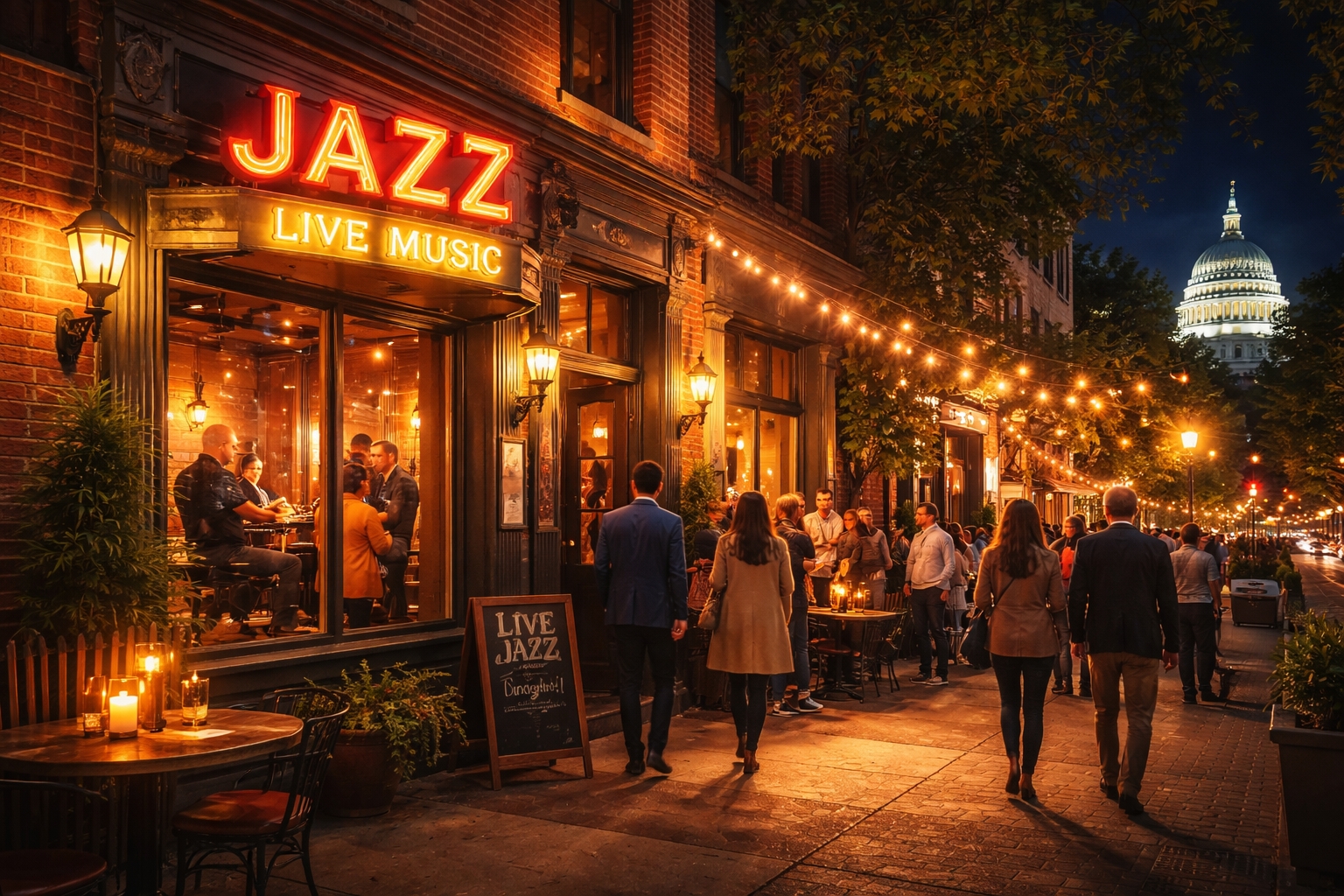
Washington DC Jazz Clubs and Live Music Guide
Washington DC is home to one of the most historically rich jazz scenes in the United States, offering live jazz nightly across classic supper clubs, intimate cocktail lounges, neighborhood bars, churches, and outdoor cultural venues. From legendary institutions like Blues Alley in Georgetown to community jazz nights near Capitol Hill and modern wine bars in Park View, the city blends jazz history, walkable nightlife, and contemporary performances just minutes from the White House.
Washington DC does not treat jazz as nostalgia. It treats it as a living language. The city’s relationship with jazz is quieter than New York’s and less mythologized than New Orleans’, yet arguably more intimate. Jazz here grew in parallel with the city itself, shaped by segregation, migration, church communities, political upheaval, and a deeply rooted Black cultural ecosystem that produced some of the most influential musicians of the twentieth century.
From the edge of the White House Lawn, where Hotel Washington occupies a position no other hotel can claim, guests are positioned at the center of this story. Within walking or short-ride distance are venues where Duke Ellington once listened, Roberta Flack once sang, and where modern musicians still test new material night after night.
The Roots of Jazz in Washington DC
Washington DC’s jazz identity begins not in nightclubs, but in neighborhoods. Duke Ellington was born in the U Street Corridor in 1899, at a time when the area functioned as the cultural and economic heart of Black Washington. Churches, lodges, private homes, and social clubs hosted early performances long before integrated clubs existed.
Ellington’s refined orchestration style was shaped by this environment, where musicians were expected to entertain elite audiences while also expressing community life. That duality still defines DC jazz today. The music is sophisticated, intentional, and often deeply conversational.
As segregation limited access to mainstream venues, Black-owned clubs and informal performance spaces flourished east of the White House. When integration expanded nightlife access, DC’s jazz scene did not consolidate into a single strip. It spread outward, embedding itself into restaurants, inns, churches, and neighborhood bars.
Iconic Jazz Clubs and Supper Clubs in Washington DC
Blues Alley – Georgetown
Blues Alley is not simply a jazz club. It is a rite of passage. Since opening in 1965, the venue has hosted nearly every major jazz figure of the last six decades. Dizzy Gillespie performed here regularly, often staying after sets to speak with young musicians. Eva Cassidy, one of Washington DC’s most beloved voices, also performed here early in her career.
The physical space reinforces the experience. Brick walls, low ceilings, candlelit tables, and a narrow stage create acoustics that demand attention. Audience members are close enough to hear fingers slide on strings and breath between horn phrases. Shows run nightly, typically with two sets, and the dinner-forward format encourages guests to settle in rather than rush through the evening.
Blues Alley represents the gold standard of the Washington DC jazz club experience.
Official site: https://www.bluesalley.com
Georgia Brown’s – Downtown
A short walk from the White House, Georgia Brown’s occupies a unique space in the jazz ecosystem. It is first and foremost a Southern restaurant, but live jazz has long been part of its identity. Evening performances and the celebrated Sunday Live Jazz Brunch pair classic dishes like shrimp and grits with standards drawn from the American jazz canon.
For visitors staying at Hotel Washington, Georgia Brown’s offers one of the easiest entry points into DC jazz. The setting is refined, the music accessible, and the proximity unmatched.
Official site: https://www.gbrowns.com
Mr. Henry’s – Capitol Hill
Few venues embody neighborhood jazz culture like Mr. Henry’s. Roberta Flack performed here in the early 1970s before achieving international recognition. That lineage continues upstairs, where live jazz fills the room Wednesday through Saturday.
The Capitol Hill Jazz Jam on Wednesdays draws a rotating cast of local musicians, many of whom learned their craft through DC’s public school music programs and church ensembles. The atmosphere is participatory rather than performative, making audiences feel like part of the scene rather than spectators.
Official site: https://www.mrhenrysdc.com
Modern Jazz Dining and Lounge Experiences
JoJo Restaurant and Bar – U Street Corridor
U Street remains Washington DC’s most historically significant jazz neighborhood, and JoJo Restaurant and Bar stands as one of its most contemporary expressions. Live jazz runs Wednesday through Sunday, beginning around dinner and often continuing late into the night.
JoJo’s cocktail menu references jazz standards, while the dining room attracts musicians, professionals, and visitors alike. The space encourages conversation between sets, reinforcing jazz’s role as social music rather than background entertainment.
Official site: https://www.jojodc.com
Bistrot Lepic – Georgetown
At Bistrot Lepic, weekly jazz nights transform the upstairs wine bar into a listening room reminiscent of Left Bank Paris. The setting favors small ensembles and restrained playing, creating an atmosphere where nuance matters.
This venue appeals to guests who value subtlety and narrative flow over volume, making it a favorite for those seeking a European-style jazz experience in Washington DC.
Official site: https://bistrotlepic.com/story-of-bistrot-lepic/special-jazz/
Intimate Bars, Wine Venues, and Speakeasies
600 T – Shaw
600 T operates more like a private living room than a bar. Weekly jazz nights feature small trios playing bebop and modern standards without cover charges. The absence of spectacle is intentional. Jazz here is meant to be absorbed, not announced.
The venue’s location in Shaw reinforces its neighborhood-first identity, attracting regulars who return as much for the music as for the sense of belonging.
Official site: https://www.600tdc.com
St. Vincent Wine – Park View
Jazz at St. Vincent Wine feels domestic and communal. Live performances occur multiple times per week, often featuring local musicians experimenting with repertoire in front of an attentive but relaxed audience.
Wine, charcuterie, and conversation coexist easily with the music, reinforcing DC’s tendency to integrate jazz into everyday life rather than isolate it.
Official site: https://www.stvincentwine.com/live-music
Community and Public Jazz Experiences
Jazz Night in DC – Westminster Presbyterian Church
Every Friday, Westminster Presbyterian Church becomes one of the city’s most unique jazz venues. The sanctuary setting emphasizes jazz’s spiritual lineage and communal roots. Musicians often speak directly to the audience, contextualizing songs and sharing personal stories.
The experience feels both reverent and welcoming, appealing to listeners who value connection as much as performance.
Official site: https://westminsterdc.org/jazz-night-in-dc-schedule
Jazz in the Garden – National Gallery of Art
During summer months, Jazz in the Garden transforms the National Gallery of Art Sculpture Garden into an outdoor concert space. The free series draws large crowds, blending jazz with picnic culture and public art.
For many visitors, this is their first exposure to DC jazz, creating a gateway into the city’s deeper scene.
Official site: https://www.nga.gov/press/jazz
Comparison Table – Jazz Venue Types in Washington DC
| Venue Type | Best For | Typical Setting | Cover Charge |
|---|---|---|---|
| Jazz Supper Clubs | Dedicated listening | Seated dining rooms | Often yes |
| Jazz Restaurants | Dinner and music | Restaurant stages | Varies |
| Jazz Bars | Casual evenings | Lounges and bars | Rare |
| Community Venues | Cultural immersion | Churches, galleries | Low or free |
FAQ – Washington DC Jazz Clubs
What are the best jazz clubs in Washington DC?
Blues Alley, Mr. Henry’s, and JoJo Restaurant and Bar are among the most respected venues, offering nightly live jazz in historic and contemporary settings.
Are there jazz clubs near the White House?
Yes. Georgia Brown’s and several downtown venues are within walking distance of the White House and Hotel Washington.
Does Washington DC have a strong jazz history?
Yes. Washington DC produced Duke Ellington and remains one of the most historically important jazz cities in the United States.
The Musicians Behind the Washington DC Jazz Sound
What ultimately distinguishes Washington DC’s jazz scene is not just where the music is played, but who plays it. Many of the city’s most consistent performers are musicians who grew up in DC, Maryland, or Northern Virginia, often shaped by public-school music programs, church ensembles, and mentorship traditions that still define the region.
Bassists, pianists, and horn players often rotate between venues throughout the week. A bassist might anchor a Capitol Hill jazz jam on Wednesday, play a trio set at a wine bar on Thursday, and sit in at a church jazz night on Friday. This fluidity creates a sense of continuity across venues. Regular listeners begin to recognize players, follow them from room to room, and watch their musical voices evolve over time.
Several musicians who now tour nationally still return to DC venues to test new material. These nights feel informal and exploratory. Audiences are often hearing arrangements in progress, not polished showcases, which adds to the sense that jazz in DC remains a living craft rather than a fixed product.
Jazz in the U Street Corridor Beyond the Clubs
The U Street Corridor’s role in jazz history extends far beyond formal venues. In the early twentieth century, the neighborhood supported dozens of Black-owned theaters, ballrooms, and social clubs. Musicians would move between spaces in a single evening, playing dances, private gatherings, and late-night jam sessions.
That tradition still echoes today. While modern zoning and economics have changed the physical landscape, U Street remains a place where jazz feels culturally rooted rather than curated. Performers often speak about the lineage they feel when playing here, aware that they are part of a continuum rather than an isolated moment.
This sense of lineage influences how musicians approach their sets. Standards are played with respect, but rarely without interpretation. There is an expectation of dialogue between past and present, between composer and improviser, between room and audience.
Late-Night Jazz and the After-Hours Culture
One of Washington DC’s most underappreciated jazz assets is its late-night culture. Unlike cities where jazz performances end early, many DC venues host music that stretches well past traditional dinner hours.
Late-night sets often attract a different audience. Service workers finishing shifts, musicians coming from earlier gigs, and dedicated listeners who prioritize the music over convenience. These audiences tend to be more attentive and engaged, creating an energy that musicians respond to immediately.
Late-night jazz in DC is rarely loud or chaotic. Instead, it becomes quieter, more exploratory, and often more daring. Tempos stretch. Solos lengthen. Musicians take risks they might avoid earlier in the evening. For visitors willing to stay out late, these sets often deliver the most memorable experiences.
Jazz in Mount Vernon Triangle and Downtown Rooftops
As Washington DC has evolved vertically, jazz has followed. Rooftop lounges and modern hospitality spaces now host curated jazz nights that attract new audiences without abandoning tradition.
Monthly jazz nights in Mount Vernon Triangle draw professionals, residents, and visitors into spaces that combine skyline views with live performance. These events often feature trios or quartets rather than full bands, allowing the music to complement conversation rather than compete with it.
This newer expression of DC jazz demonstrates how the genre adapts without losing its identity. Jazz becomes part of the city’s contemporary social life, integrated into spaces where people already gather.
Jazz as a Community Ritual in Washington DC
Community remains at the heart of Washington DC’s jazz culture. Unlike scenes driven primarily by tourism, DC’s jazz audience includes a strong core of local listeners who attend performances weekly. These listeners form relationships with musicians, venue staff, and fellow patrons.
At church-hosted jazz nights, audience members often greet musicians personally, thank them after sets, and follow their careers across venues. At neighborhood bars, bartenders know which patrons come specifically for jazz and adjust volume and lighting accordingly.
This ecosystem sustains musicians financially and creatively. It also creates a welcoming environment for visitors, who often find themselves drawn into conversations and recommendations that extend beyond a single evening.
Jazz and Food Pairings in Washington DC
Food plays an unusually important role in DC jazz culture. Many venues intentionally design menus that encourage guests to arrive early and stay late. Dining becomes part of the rhythm of the evening rather than a separate activity.
In supper clubs, meals are timed around sets. In jazz restaurants, the kitchen and band coordinate pacing. In wine bars, shared plates foster conversation between songs. This integration reinforces jazz’s social origins, where music accompanied gatherings rather than dominating them.
For travelers, this structure simplifies planning. An entire evening can unfold in one place, moving naturally from dinner to performance to late-night conversation.
Planning a Jazz-Focused Stay Near the White House
Staying at Hotel Washington places guests at a unique intersection of proximity and flexibility. From the edge of the White House Lawn, downtown jazz venues are walkable, while neighborhoods like Shaw, Capitol Hill, Dupont Circle, and Adams Morgan are easily reached by short ride.
This proximity allows visitors to design evenings around mood rather than logistics. A formal supper-club performance can be followed by a spontaneous late-night set elsewhere. A casual jazz bar visit can turn into an extended night without concern for long commutes.
For those visiting Washington DC for the first time, jazz offers an ideal way to experience the city beyond monuments. It provides insight into local culture, history, and rhythm that sightseeing alone cannot convey.
Comparison Table – Jazz Neighborhood Experiences
| Neighborhood | Jazz Style | Atmosphere | Best For |
|---|---|---|---|
| Georgetown | Classic jazz | Intimate, historic | Traditional listening |
| U Street | Contemporary and legacy | Energetic, social | Cultural immersion |
| Capitol Hill | Community jazz | Neighborhood-focused | Jam sessions |
| Dupont Circle | Acoustic jazz | Refined, quiet | Conversation-driven evenings |
| Downtown | Dining jazz | Elegant, accessible | Walkable nightlife |
FAQ – Planning Jazz Nights in Washington DC
What nights are best for live jazz in Washington DC?
Wednesday through Saturday offer the widest selection, with jam sessions midweek and headline performances on weekends.
Is jazz in Washington DC tourist-friendly?
Yes, but the scene is rooted in local culture. Visitors are welcomed, especially when they arrive early, listen attentively, and engage respectfully.
Are reservations required for jazz clubs in DC?
For supper clubs and popular dining venues, reservations are strongly recommended. Many jazz bars and community events remain walk-in friendly.
Can you experience jazz in DC without a cover charge?
Yes. Many wine bars, lounges, and community-hosted events offer live jazz with no cover.
Seasonal Jazz in Washington DC – When to Go and What to Expect
Jazz in Washington DC changes subtly with the seasons, not in quality but in tone, tempo, and setting. Understanding these seasonal shifts allows visitors to plan nights that feel intentional rather than accidental.
Spring Jazz in Washington DC
Spring marks a return to movement. As daylight extends and outdoor spaces reopen, jazz performances begin to feel lighter and more exploratory. Musicians introduce new arrangements, often testing material that will shape their summer sets.
Indoor venues remain active, but audiences become more fluid. Listeners are more likely to arrive early, linger between sets, and move between venues in a single evening. Spring is an ideal time for first-time visitors to sample multiple jazz experiences without committing to a single long performance.
Summer Jazz and Outdoor Performances
Summer brings jazz into public space. Outdoor concerts, courtyard performances, and garden series attract audiences who may not typically seek out jazz clubs. These performances emphasize accessibility and atmosphere.
While indoor clubs continue operating, summer audiences often skew more diverse and exploratory. Jazz becomes part of a larger evening that might include dining, monument walks, and late-night rooftop visits.
For travelers, summer jazz offers breadth. It is the season to discover the scene, identify favorite venues, and begin following specific musicians.
Fall Jazz and the Return to Listening Culture
Fall is when Washington DC jazz returns to its most focused form. As temperatures cool, audiences gravitate back indoors. Listening becomes more attentive. Sets lengthen. Repertoires deepen.
Many musicians consider fall their most creative season. Audiences are more consistent, and venues feel less transient. For visitors seeking the most immersive jazz experience, fall offers unmatched intimacy and musical depth.
Winter Jazz and the Local Core
Winter belongs to locals. Tourists thin out, and jazz rooms fill with regulars who know the musicians by name. Performances feel conversational, almost private.
Church-hosted jazz nights, neighborhood bars, and wine venues become especially important during winter months. For visitors willing to embrace colder weather, winter jazz in DC offers authenticity that few other cities can match.
Deeper Musician Stories and the DC Jazz Mentorship Tradition
Washington DC jazz operates through mentorship as much as performance. Many musicians speak openly about teachers who guided them through early gigs, corrected their phrasing mid-set, or quietly passed down standards between performances.
It is common for a veteran pianist to invite a younger horn player to sit in, offering subtle cues rather than instruction. These moments often go unnoticed by casual listeners, but they define the city’s jazz ecosystem.
Several nationally recognized musicians credit DC venues with giving them space to develop before touring. Unlike cities where young players compete aggressively for limited stage time, DC’s scene encourages growth through repetition and relationship building.
For attentive listeners, this mentorship culture becomes visible over multiple nights. A musician heard hesitantly during one jam session may sound markedly more confident weeks later. This sense of evolution is one of the city’s most rewarding jazz experiences.
Jazz Etiquette and How to Be a Good Listener in DC
Washington DC audiences take listening seriously. While conversation is welcome at bars and lounges, most venues value attentiveness during performances.
Simple practices enhance the experience for everyone:
-
Arriving early to settle before sets begin
-
Keeping conversation low during solos
-
Applauding after individual solos, not just at song endings
-
Supporting musicians through food, drink, or tipping where appropriate
Visitors who follow these norms are quickly embraced, often receiving recommendations for other venues or upcoming performances.
Jazz as a Window Into Washington DC Culture
Jazz offers insight into Washington DC that monuments cannot. It reflects the city’s history of resilience, intellectual rigor, and community cohesion. The music mirrors the city itself, layered, thoughtful, and quietly expressive.
For travelers staying near the White House, jazz provides balance. After days spent navigating museums, institutions, and formal spaces, an evening of live music restores a sense of humanity and spontaneity.
Bringing It All Together – A Jazz-Centered DC Stay
A jazz-centered stay in Washington DC does not require exhaustive planning. It requires openness. By choosing venues that align with mood and season, visitors can experience jazz as Washingtonians do, woven naturally into evenings rather than scheduled rigidly.
From Hotel Washington’s location at the edge of the White House Lawn, guests are uniquely positioned to do exactly that. Downtown dining jazz, neighborhood jam sessions, historic listening rooms, and community performances are all within easy reach.
For those who want to experience Washington DC not just as a destination but as a living city, jazz remains one of its most honest expressions.
To plan a stay that places live jazz, walkable nightlife, and historic Washington at your doorstep, explore accommodations at www.thehotelwashington.com
Entity References
| Entity Name | Entity Type | Official URL |
|---|---|---|
| Blues Alley | Jazz club | https://www.bluesalley.com |
| JoJo Restaurant and Bar | Restaurant and jazz venue | https://www.jojodc.com |
| Mr. Henry’s | Jazz pub | https://www.mrhenrysdc.com |
| Georgia Brown’s | Restaurant and jazz venue | https://www.gbrowns.com |
| 600 T | Cocktail bar | https://www.600tdc.com |
| Bossa Bistro + Lounge | Lounge | https://www.bossadc.com |
| Tabard Inn | Historic inn and jazz venue | https://www.tabardinn.com |
| St. Vincent Wine | Wine bar | https://www.stvincentwine.com/live-music |
| Westminster Presbyterian Church Jazz Night | Community jazz event | https://westminsterdc.org/jazz-night-in-dc-schedule |
| Jazz in the Garden | Seasonal concert series | https://www.nga.gov/press/jazz |