UNESCO World Heritage Sites Near Washington DC
Standing on the edge of the White House Lawn, Hotel Washington looks out over monuments and museums that tell the story of a nation. Yet when visitors ask how many UNESCO World Heritage Sites exist in Washington DC, the answer is surprisingly simple: there are none within the District itself. Instead, those seeking the international designation of “outstanding universal value” will find the nearest World Heritage treasures just beyond the capital’s borders. Within a few hours’ travel from the hotel you can explore Monticello and the University of Virginia in Charlottesville, Independence Hall in Philadelphia, and the world‑famous Fallingwater house in southwestern Pennsylvania. Mount Vernon, George Washington’s estate on the Potomac, has been proposed for the list but has yet to be inscribed. This guide brings together history, architecture and travel planning so you can discover these exceptional sites while enjoying the comfort of the closest hotel to the White House.
The Significance of UNESCO World Heritage Sites
UNESCO’s World Heritage List was created to protect and celebrate places of “outstanding universal value.” Each site must meet rigorous criteria demonstrating cultural or natural importance that transcends national boundaries, whether through exceptional architecture, groundbreaking ideas or irreplaceable ecosystems. Once listed, sites commit to preservation and public education; they become part of a shared global heritage accessible to everyone. For travellers staying in Washington DC, the nearest World Heritage sites offer an opportunity to connect the stories told on the National Mall to the wider history of American independence, architecture and cultural development. Understanding why these places were inscribed helps reveal how they fit into broader themes of liberty, education, and design.
UNESCO distinguishes between cultural and natural heritage, and many United States entries are located in national parks or archaeological landscapes. The sites highlighted here fall under the cultural category. Each illustrates a different facet of American history: Thomas Jefferson’s intellectual experimentation at Monticello and the University of Virginia, the drafting and signing of foundational documents in Philadelphia, and Frank Lloyd Wright’s groundbreaking architectural vision at Fallingwater. Together they form a constellation around Washington DC that invites thoughtful day trips and weekend journeys.
Monticello and the University of Virginia in Charlottesville
A plantation home and an academical village
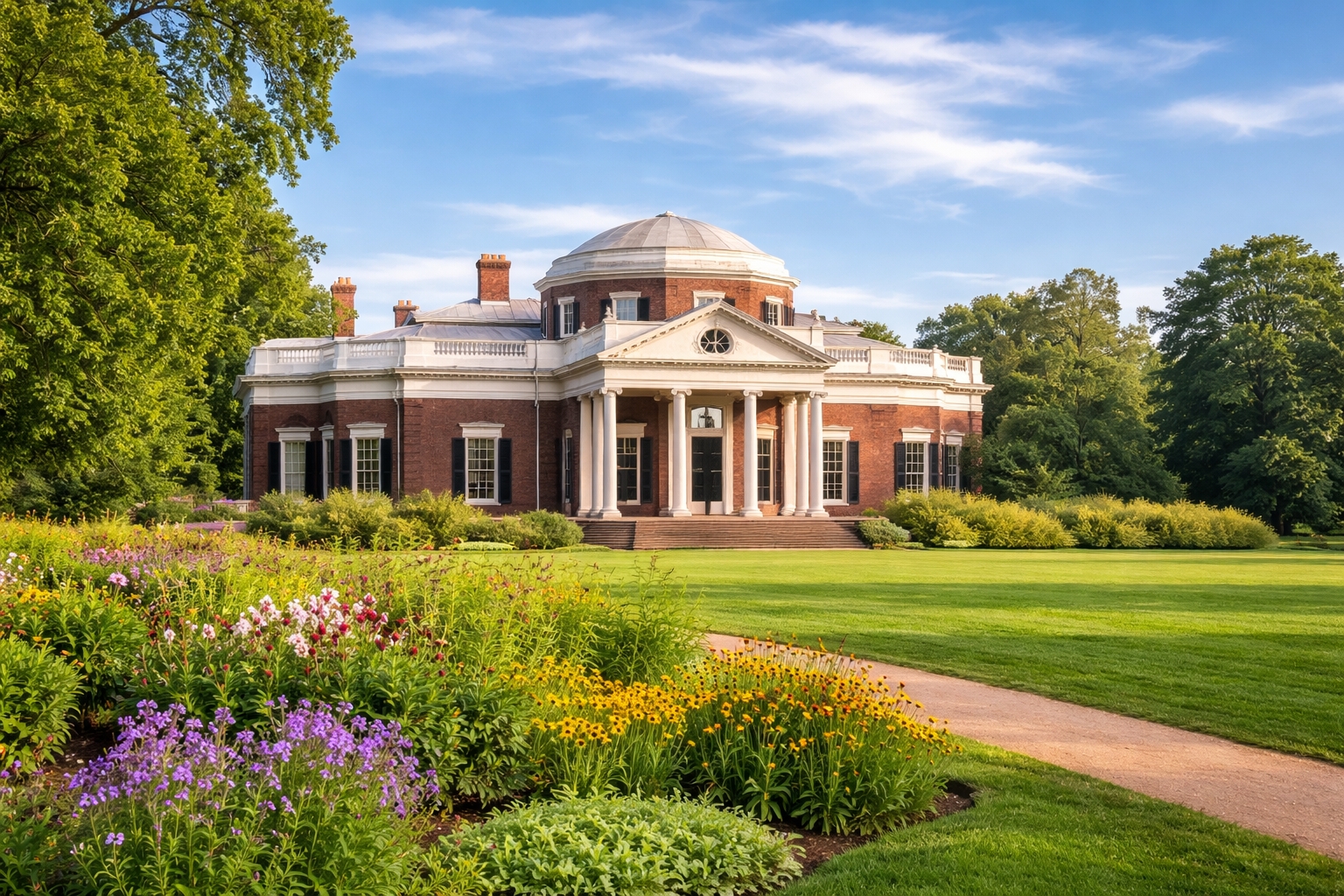
When Thomas Jefferson began designing his hilltop home in 1769, he envisioned more than a residence. Monticello would become a laboratory for his ideas about architecture, horticulture and republican living. The plantation house, completed over several decades, combines Roman classical vocabulary—domes, porticos and Doric columns—with local materials and Jefferson’s own innovations. Down the mountain, he set out to build an “academical village” where students and professors lived, worked and studied within a U‑shaped arrangement of pavilions and gardens. Today this community forms the heart of the University of Virginia (UVA). UNESCO recognized these paired sites in 1987 because together they demonstrate a refined example of neoclassical design and embody Jefferson’s aspiration for a new American republic. The Rotunda at UVA, modeled on the Pantheon, and the ten faculty pavilions lining the Lawn represent lessons in classical architecture; Monticello’s dome and garden terraces show Jefferson’s adaptation of ancient forms to the Piedmont landscape.
Jefferson’s estate is notable not only for its architecture but also for the careful documentation and preservation of its landscape. The plantation includes more than a dozen eighteenth‑century structures—kitchen, wash house, smokehouse, ice house and stables—arranged within a cultural landscape of gardens, lanes and fences that hugs the brow of the Southwest Mountains. UNESCO notes that the combination of surviving buildings, archaeological data and archival evidence makes Monticello “arguably the best documented and most completely preserved example” of an eighteenth‑century American plantation. The site’s integrity remains high because the core estate has been maintained by the non‑profit Thomas Jefferson Foundation, and because the University of Virginia continues to steward its historic precincts.
Life, liberty and learning
Visiting Monticello provides insight into Jefferson’s complicated legacy. He was a principal author of the Declaration of Independence yet owned hundreds of enslaved people whose labor sustained his plantation. Guided tours and interpretive exhibits discuss the lives of the enslaved community, the evolution of the house and gardens, and Jefferson’s intellectual pursuits. At the University of Virginia, the Lawn remains a functioning academic space; students still live in the rooms flanking the grassy court. The Rotunda hosts lectures and events, and the pavilions continue to house faculty members. Walking the colonnades offers a tangible sense of Jefferson’s belief that education and civic virtue were inseparable.
Charlottesville lies about 117 miles southwest of Washington DC, making Monticello and UVA an easy day trip or overnight excursion. Driving takes around two and a half hours, with scenic views along the Blue Ridge foothills. Amtrak’s Northeast Regional train also connects the two cities, though schedules may require an overnight stay. Spring and autumn are particularly pleasant times to visit; the gardens at Monticello bloom with heirloom flowers, and UVA’s Lawn is framed by vibrant trees. Summer brings higher temperatures but also special events, while winter offers quieter tours and holiday decorations.
Highlights of Monticello and UVA
-
Architecture and design: Explore the neoclassical features of Monticello and the Rotunda; note how the buildings blend functional innovations with classical elements.
-
Historic landscape: Stroll through flower and vegetable gardens, orchards and carriage paths preserved from Jefferson’s era.
-
Interpretive tours: Learn about the enslaved community, plantation operations and Jefferson’s experiments in agriculture and science.
-
Academic village: Walk the Lawn at UVA and visit the pavilions that continue to house faculty and classes.
-
Cultural context: Consider how Jefferson’s vision reflected Enlightenment ideals while existing within a society dependent on slavery.
-
Travel tip: Purchase tickets in advance at the official Monticello website Monticello and allow time to explore both the mountaintop estate and the university grounds.
Travel logistics and distances
| Destination | Distance from Hotel Washington | Travel time by car | Travel time by train | Notes |
|---|---|---|---|---|
| Monticello (Charlottesville) | ~117 mi | 2.5 hr | About 3 hr (Amtrak) | Combine with a visit to UVA; plan for hilly terrain and parking at visitor center |
| University of Virginia | ~117 mi | 2.5 hr | About 3 hr | The academical village is within Charlottesville; tours are often self‑guided |
Independence Hall in Philadelphia
Birthplace of a nation
On Chestnut Street in Philadelphia stands a modest brick building with a clock tower. Here the Second Continental Congress convened to debate and adopt two documents that would shape the modern world: the Declaration of Independence in July 1776 and the United States Constitution in September 1787. UNESCO’s brief synthesis notes that these events took place in Independence Hall and that the principles of freedom and democracy expressed in the documents have had a profound global impact. The building was designed by attorney Andrew Hamilton and master builder Edmund Woolley to house the Pennsylvania State House. Construction began in 1732 and finished in 1753; the resulting Georgian structure features a symmetrical façade, a wooden steeple and a bell tower that originally held the Liberty Bell.
Independence Hall’s significance derives not only from the events it hosted but also from its preservation. The assembly room where delegates gathered remains intact, and restoration efforts have aimed to return the building to its eighteenth‑century appearance. Within the property’s boundaries sit approximate reconstructions of wings and arcades that once housed offices and passageways; nearby Congress Hall and other structures form part of Independence National Historical Park. UNESCO inscribed the site in 1979 under cultural criterion (vi) because the principles articulated within its walls influenced charters and constitutions worldwide.
Exploring the hall and its surroundings
Today, the National Park Service operates Independence Hall and the surrounding park. Entrance to the hall is free, but timed tickets are required from March through December. Park rangers lead visitors through the assembly room where the delegates met, pointing out original furnishings and explaining the debates that unfolded. The adjacent Liberty Bell Center houses the cracked bell that rang to call citizens together; though not part of the World Heritage listing, the bell has become an enduring symbol of American independence. Surrounding streets are lined with museums, colonial-era churches and marketplaces, creating a walkable district rich with history and food.
Philadelphia is roughly 124 miles north of Washington DC. Driving takes about two and a half hours via Interstate 95, though traffic can extend the journey. Amtrak’s Acela and Northeast Regional trains connect Washington’s Union Station to Philadelphia’s 30th Street Station in under two hours. From there, the Independence National Historical Park is a short taxi or subway ride. Spring and autumn provide comfortable weather; summer brings larger crowds and winter can be chilly but quieter. Allow at least half a day to tour the hall and surrounding sites; those interested in U.S. history may wish to stay overnight.
Highlights of Independence Hall
-
Assembly Room: Stand in the room where delegates debated independence and constitutional governance; see original chairs and desks.
-
Architectural details: Observe the Georgian symmetry, brick façade and wooden steeple designed by Andrew Hamilton and Edmund Woolley.
-
Interpretive programs: Join ranger‑led tours exploring the debates, signers and lasting global influence of the Declaration and Constitution.
-
Liberty Bell Center: View the famed bell and exhibits on its symbolism of freedom.
-
Nearby attractions: Explore other historic buildings like Congress Hall, Old City Hall, Carpenters’ Hall and the National Constitution Center.
-
Travel tip: Reserve tickets on the official National Park Service website Independence Hall and arrive early to clear security.
Travel logistics and distances
| Destination | Distance from Hotel Washington | Travel time by car | Travel time by train | Notes |
|---|---|---|---|---|
| Independence Hall (Philadelphia) | ~124 mi | 2.5 hr | 1.5–2 hr (Amtrak) | Timed tickets required; combine with other Old City sites |
Fallingwater: Frank Lloyd Wright’s Masterpiece
Living with a waterfall
Deep in the forests of southwestern Pennsylvania, a house straddles a cascading stream. Fallingwater was designed by architect Frank Lloyd Wright in 1935 as a summer retreat for the Kaufmann family. Rather than build beside the waterfall, Wright placed the house directly over it, cantilevering terraces of concrete and stone above the rushing water so that the occupants would live with the waterfall as part of their daily experience. The design exemplifies Wright’s philosophy of organic architecture, which sought harmony between human habitation and natural surroundings. The American Institute of Architects later called Fallingwater the “best all‑time work of American architecture”. In 2019, UNESCO inscribed the house as part of “The 20th‑Century Architecture of Frank Lloyd Wright,” recognizing eight of his buildings across the United States for their influence on modern design.
The house’s dramatic integration with its environment creates an unforgettable experience for visitors. Interior spaces open onto terraces that hover above Bear Run stream, and panoramic windows blur the distinction between inside and outside. A stairway descends directly to the water. Furnishings designed by Wright complement the architecture, and the surrounding woodland remains protected as part of the Western Pennsylvania Conservancy’s Bear Run Nature Reserve. A visit to Fallingwater is both a pilgrimage for architecture enthusiasts and a peaceful immersion in nature.
Visiting Fallingwater from Washington DC
Fallingwater is located near Mill Run, Pennsylvania, roughly 190 miles west of Washington DC. Driving via the Pennsylvania Turnpike takes about four hours. There is no convenient rail option, so most visitors drive or join organized tours from Pittsburgh or Washington. The site operates from March through December, with guided tours required to enter the house. Tours often sell out, so booking well in advance is essential. Autumn offers spectacular foliage; spring brings wildflowers and high water; summer provides longer days for hiking. Winter tours are limited, but the house decorated for the holidays has its own charm.
The house sits within a large nature reserve. After your tour, explore walking trails that showcase other aspects of Wright’s design philosophy, including the integration of stone, wood and water. Nearby attractions include Kentuck Knob (another Wright house), Ohiopyle State Park and the Youghiogheny River Gorge. Combining Fallingwater with these sites makes for a rewarding weekend trip from Washington.
Highlights of Fallingwater
-
Organic architecture: Witness how terraces and natural stone walls blend seamlessly with the waterfall and forest.
-
Innovative design: Note Wright’s use of cantilevers, reinforced concrete and natural materials to create a sense of suspended living.
-
Interior furnishings: Examine custom furniture and built‑ins designed to complement the architecture.
-
Natural surroundings: Hike through Bear Run Nature Reserve, observe local flora and fauna, and appreciate how the house sits within its environment.
-
Tour scheduling: Reserve tours through the official site Fallingwater well in advance; choose from guided house tours or grounds‑only options.
-
Travel tip: Combine your visit with nearby Frank Lloyd Wright sites or outdoor activities for a full weekend itinerary.
Travel logistics and distances
| Destination | Distance from Hotel Washington | Travel time by car | Notes |
|---|---|---|---|
| Fallingwater (Mill Run, PA) | ~190 mi | 4 hr | Driving is the primary option; tours must be booked in advance |
Tentative and Proposed Sites: Mount Vernon, Poplar Forest and Beyond
Mount Vernon’s bid for world recognition
On a bluff overlooking the Potomac River, just fifteen miles south of Washington DC, stands George Washington’s Mount Vernon. The estate includes the Mansion, kitchen, servant quarters, stable, ice house, gardener’s house and other structures set within gardens, lanes and orchards. Because of its association with the first President of the United States and its remarkably preserved eighteenth‑century landscape, Mount Vernon was submitted to the U.S. tentative list for UNESCO World Heritage consideration in 2008. The nomination emphasizes that the combination of buildings, archaeological data and archival evidence makes the estate one of the most completely documented plantation landscapes in America. It also notes the need to compare Mount Vernon with other plantations to evaluate its outstanding universal value. As of 2026, the property remains on the tentative list, but the Mount Vernon Ladies’ Association continues to preserve it and advocate for recognition.
Visiting Mount Vernon offers a glimpse into the domestic life of George and Martha Washington. Tours take visitors through the mansion’s rooms, the reconstructed slave quarters, the gardens and the family tomb. The on‑site museum and education center explore Washington’s leadership, the Revolutionary War and the lives of the enslaved people who lived on the estate. Because the site is just a short drive from Hotel Washington, it makes for an easy half‑day trip. Open year‑round, Mount Vernon hosts seasonal events such as candlelight tours in winter and plantation fairs in summer.
Poplar Forest: Jefferson’s retreat
Southwest of Charlottesville, near Lynchburg, lies Thomas Jefferson’s Poplar Forest. This octagonal villa served as Jefferson’s personal retreat and experimental farm. Poplar Forest is a National Historic Landmark and is currently nominated to become part of the Monticello and University of Virginia World Heritage listing. The property features ongoing archaeological excavation and restoration; visitors can see how Jefferson used the house to test ideas later incorporated at Monticello and UVA. According to the site’s own description, Poplar Forest remains an award‑winning historic restoration in progress and offers a unique opportunity to hear the stories of Jefferson’s family, enslaved craftsmen and plantation workers. While not yet inscribed, the nomination underscores how the retreat complements Jefferson’s primary estate.
Other proposals and the evolving U.S. list
The United States maintains a tentative list of sites that may be nominated for UNESCO World Heritage status in the future. In addition to Mount Vernon and Poplar Forest, proposals include Civil Rights Movement sites across several states and natural landscapes like the Okefenokee National Wildlife Refuge. The process of nomination requires extensive research, documentation and international collaboration. For travellers, these proposed sites can be explored now with the understanding that they may one day receive global recognition. Checking the National Park Service’s World Heritage pages provides updates on nomination status and opportunities to support preservation efforts.
Highlights of tentative and proposed sites
-
Mount Vernon: Tour the mansion and historic buildings; stroll through gardens and farmland; learn about Washington’s leadership and the lives of enslaved workers at the visitor center; plan your visit at Mount Vernon.
-
Poplar Forest: Observe ongoing restoration of Jefferson’s retreat; explore archaeological exhibits and interpretive programs; plan ahead via Poplar Forest.
-
Other proposals: Keep an eye on U.S. World Heritage tentative list updates; consider visiting sites like Jamestown, Williamsburg, civil rights landmarks and natural reserves that may join the list.
-
Travel tip: Mount Vernon is only 15 miles from Hotel Washington, while Poplar Forest is about 160 miles southwest near Lynchburg. Combine Poplar Forest with Monticello for a multi‑day Jeffersonian journey.
Travel logistics and distances
| Destination | Distance from Hotel Washington | Travel time by car | Notes |
|---|---|---|---|
| Mount Vernon | ~15 mi | 30 min | Easily accessible via George Washington Memorial Parkway; open year‑round |
| Poplar Forest (Lynchburg) | ~160 mi | 3 hr | Combine with Monticello; tours are available spring through fall |
Planning Your UNESCO Heritage Tour from Washington DC
Starting from the heart of the capital
Hotel Washington’s central location—at the edge of the White House lawn and steps from the National Mall—makes it an ideal base for exploring the mid‑Atlantic region. When planning a UNESCO heritage tour, consider the travel time, seasonal conditions and the amount of time you wish to spend at each site. A weekend could include Mount Vernon and Independence Hall, while a longer vacation might add Monticello, UVA, Fallingwater and other regional attractions.
Begin by prioritizing the sites that interest you most. History enthusiasts may focus on Independence Hall and Monticello for their roles in American independence and constitutional development. Architecture aficionados will find Fallingwater and UVA’s academical village particularly rewarding. Those curious about presidential history can pair Mount Vernon with Poplar Forest and Monticello to explore the personal spaces of Washington and Jefferson. Using Hotel Washington as a headquarters allows you to return each evening to refined comfort and dining options that reflect the city’s cosmopolitan culture.
Seasonal considerations
The mid‑Atlantic climate means that each season offers a different experience at the heritage sites. Spring brings blooming gardens at Monticello and mild temperatures for walking tours in Philadelphia. Summer offers long days and vibrant events but also heat and humidity; be sure to book morning tours and stay hydrated. Autumn paints the landscapes around Charlottesville and Fallingwater in brilliant reds and golds, making for unforgettable drives. Winter is quieter, with smaller crowds and special holiday programming; some sites reduce hours, so check schedules in advance. Hotel Washington’s proximity to museums provides indoor options during inclement weather, and the hotel’s spa offers a warm retreat after a day of exploring.
Getting around
Driving remains the most flexible way to reach these heritage sites, particularly Fallingwater and Poplar Forest. Car rentals are available near the hotel, and major highways link the destinations. Rail travel connects Washington to Charlottesville and Philadelphia via Amtrak; from Charlottesville’s station you can take a taxi or rideshare to Monticello and UVA. Guided tours and day‑trip packages depart from Washington for Independence Hall and Mount Vernon. When planning, consider adding buffer time for traffic, parking and security screening at popular sites.
Dining and accommodations
While day trips allow you to return to the comfort of Hotel Washington, some itineraries may benefit from overnight stays. Charlottesville offers boutique inns near UVA and bed‑and‑breakfasts in the countryside. Philadelphia’s Old City has historic hotels within walking distance of Independence Hall. Near Fallingwater, rustic lodges and cabins provide immersion in the Laurel Highlands. Dining ranges from fine restaurants in Charlottesville to casual cafés in Philadelphia’s Reading Terminal Market. Packing a picnic for Fallingwater allows you to enjoy the reserve’s natural beauty. Back in Washington, the hotel’s Vue Rooftop and Fireclay restaurant showcase the capital’s culinary scene.
Suggested itineraries
-
Day trip to Mount Vernon: Morning visit to the mansion and museum; lunch at the estate’s Mount Vernon Inn; return to Washington for dinner at Vue Rooftop.
-
Jeffersonian weekend: Drive to Charlottesville; tour Monticello and UVA; overnight in Charlottesville; next day, drive to Poplar Forest; return to Hotel Washington.
-
Philadelphia history tour: Early Amtrak to Philadelphia; tour Independence Hall and Liberty Bell; explore Old City and dine at a local restaurant; return by evening or stay overnight for museum visits.
-
Architecture escape: Drive to Fallingwater; join a guided tour; hike the Bear Run trails; spend the night in nearby Laurel Highlands; optionally visit Kentuck Knob; return to Washington the next day.
-
Comprehensive heritage loop: Combine Mount Vernon, Monticello, UVA, Poplar Forest, Independence Hall and Fallingwater over a week, enjoying varied landscapes and histories.
Frequently Asked Questions
Are there any UNESCO World Heritage Sites in Washington DC?
No. The District of Columbia itself does not contain any UNESCO World Heritage Sites. However, several sites with the designation are within a few hours’ travel from the city, making Washington an excellent starting point for regional heritage excursions.
Which UNESCO sites are closest to Washington DC?
The closest site is Thomas Jefferson’s Monticello and the University of Virginia in Charlottesville, about 117 miles southwest. Independence Hall in Philadelphia lies roughly 124 miles north. Fallingwater in southwestern Pennsylvania is about 190 miles away.
How far is Monticello from Washington DC and can I visit it in a day?
Monticello is roughly 117 miles from Hotel Washington—about a two‑and‑a‑half‑hour drive. Yes, it can be visited as a day trip, though many travellers choose to spend extra time exploring the University of Virginia and Charlottesville.
What significant events happened at Independence Hall?
Independence Hall was where delegates adopted the Declaration of Independence in 1776 and debated and signed the U.S. Constitution in 1787. These documents proclaimed universal principles of freedom and self‑government that have influenced nations worldwide.
What makes Fallingwater a UNESCO World Heritage Site?
Fallingwater embodies Frank Lloyd Wright’s philosophy of organic architecture. Built in 1935 over a waterfall, its cantilevered terraces and natural materials integrate the house into its environment. UNESCO recognizes the building, along with seven other Wright designs, for their profound impact on twentieth‑century architecture.
Is Mount Vernon a UNESCO World Heritage Site?
Not yet. Mount Vernon is on the U.S. tentative list for UNESCO nomination. The estate is notable for its well‑preserved eighteenth‑century structures and landscape and its association with George Washington. Its recognition as a World Heritage Site is still under consideration.
When is the best time to visit these sites?
Spring and autumn offer mild weather and vibrant scenery. Summer provides longer days but can be hot and crowded. Winter is quieter and features holiday decorations, though hours may be shorter. Check each site’s schedule before planning your trip.
Conclusion
While Washington DC has no UNESCO World Heritage Sites of its own, its central location makes it an ideal launching point for exploring the cultural treasures of the mid‑Atlantic region. From the neoclassical elegance of Monticello and the academical village of the University of Virginia to the hallowed rooms of Independence Hall and the modern harmony of Fallingwater, each site tells a story about ideas that shaped America and influenced the world. Mount Vernon and Poplar Forest add depth to those narratives, offering insight into the personal lives of presidents and the ongoing process of heritage recognition.
By choosing Hotel Washington—the closest hotel to the White House, positioned at the edge of the White House Lawn—as your base, you can enjoy refined accommodations and proximity to the capital’s own historic landmarks while venturing out to these UNESCO destinations. Whether you plan a single day trip or an extended heritage tour, the journey will enrich your understanding of architecture, democracy and the people who transformed ideas into reality. Explore itineraries, secure tickets through official websites, and let your curiosity guide you from the steps of the Capitol to the quiet paths of Monticello’s gardens or the cascading waters of Fallingwater. Your next great historical adventure begins in Washington.
Read other posts