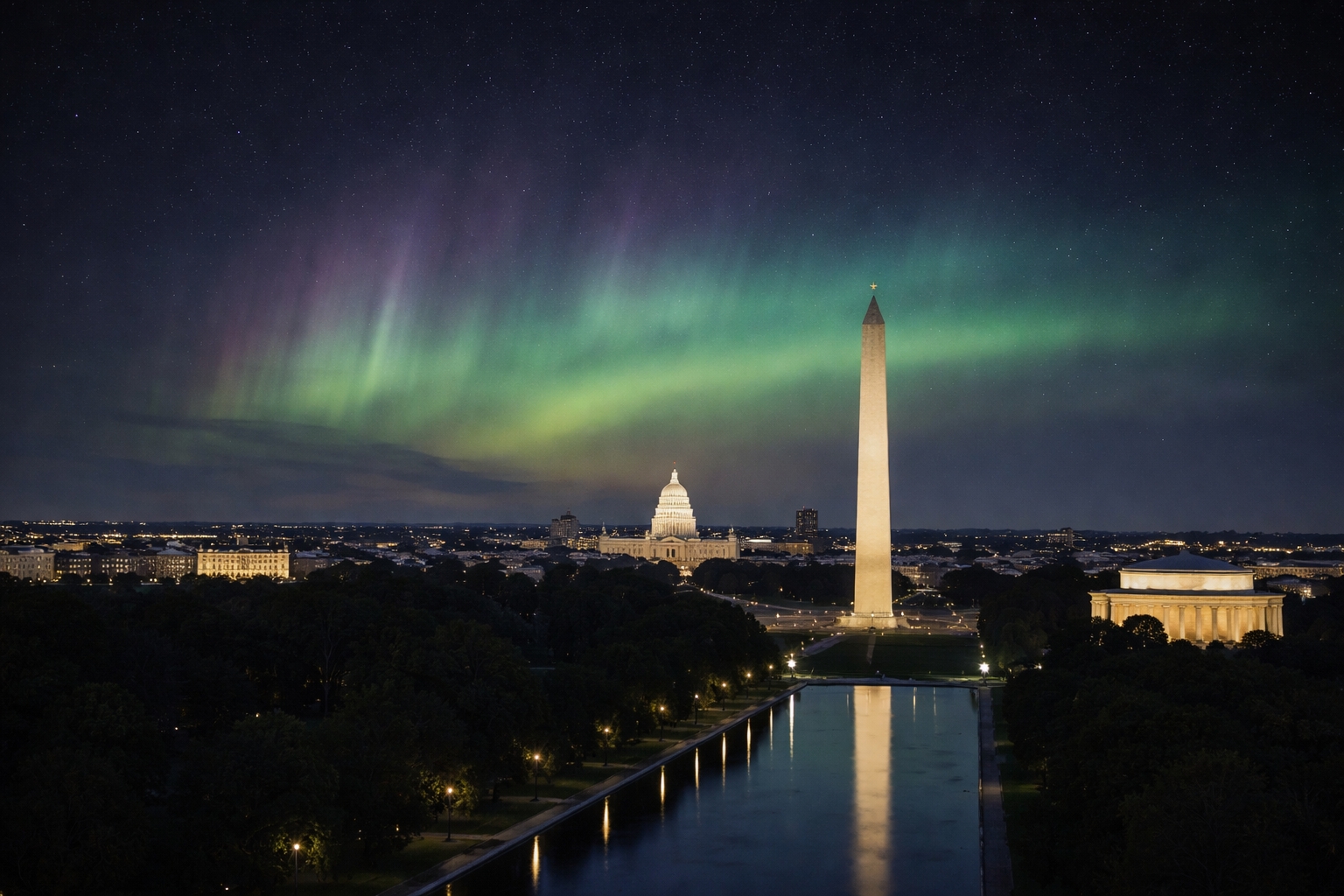
Northern Lights in Washington DC: Can the Aurora Borealis Really Be Seen This Far South?
For most people, the northern lights feel inseparable from images of Alaska, northern Canada, or Scandinavia. Yet during moments of extreme solar activity, residents of cities far outside the Arctic Circle find themselves asking a surprising question: can the northern lights be seen in Washington DC?
The short answer is yes, but only under rare and specific conditions. Washington DC sits far south of the aurora’s usual viewing zone, but powerful geomagnetic storms have occasionally pushed the aurora borealis into the mid-Atlantic. These events are infrequent, unpredictable, and fleeting, but when they occur, they turn the capital’s night sky into something extraordinary.
This guide explains why the northern lights are rarely visible in Washington DC, when they have appeared in the past, how to track future possibilities, and where to look when the sky does something historic.
Are the Northern Lights Visible in Washington DC?
Under normal circumstances, the northern lights are not visible in Washington DC. The city lies at approximately 39 degrees north latitude, well south of the auroral oval where geomagnetic activity typically concentrates.
However, during intense solar storms, charged particles from the sun can overwhelm Earth’s magnetic field, expanding the auroral zone thousands of miles southward. When this happens, faint aurora displays have been observed as far south as the mid-Atlantic and even the southeastern United States.
In Washington DC, aurora sightings are typically:
-
Extremely rare
-
Low on the horizon
-
Brief in duration
-
Often visible as red or pink glows rather than bright green curtains
These conditions make any sighting notable and historically significant.
Why the Northern Lights Rarely Reach Washington DC
The aurora borealis forms when solar particles collide with gases in Earth’s upper atmosphere near the magnetic poles. Because Earth’s magnetic field funnels these particles toward higher latitudes, auroras usually remain far north.
Washington DC’s southern position means:
-
The magnetic field lines rarely direct particles overhead
-
Light pollution reduces visibility of faint auroras
-
Atmospheric conditions often limit clarity near the horizon
Only the strongest geomagnetic storms can overcome these limitations.
What Causes the Northern Lights to Appear Far South?
Southern aurora events are driven by extreme space weather.
Key triggers include:
-
Coronal mass ejections released from the sun
-
High-speed solar wind streams
-
Strong geomagnetic storms rated Kp 7 to Kp 9
When these storms interact with Earth’s magnetosphere, they temporarily reshape the auroral oval, allowing auroras to be seen far beyond their usual range.
Monitoring agencies like the NOAA Space Weather Prediction Center track these events in real time and issue alerts when auroral activity intensifies.
Best Times the Northern Lights Have Been Seen in Washington DC
While sightings are rare, they are not unprecedented.
Notable periods when auroras were reported in the region include:
-
March 1989 during a massive geomagnetic storm that disrupted power grids
-
October 2003 during the Halloween solar storms
-
May 2024 during one of the strongest solar storm events in decades
During these events, residents across the mid-Atlantic reported unusual red and pink glows low in the northern sky.
Solar Storms and Geomagnetic Activity Explained
Solar storms originate from eruptions on the sun’s surface. When these eruptions are directed toward Earth, they can disturb satellites, GPS systems, power grids, and radio communications.
The strength of a geomagnetic storm is measured using the Kp index:
-
Kp 5 to 6: auroras visible in northern US states
-
Kp 7 to 8: auroras reach mid-latitude regions
-
Kp 9: extreme events with southern aurora sightings
Washington DC sightings typically require Kp values near the upper extreme.
Best Places to View the Sky in Washington DC
Light pollution makes aurora viewing challenging in any major city. When conditions are favorable, observers should seek areas with unobstructed northern horizons and minimal artificial lighting.
Popular sky-facing areas include the National Mall, where wide open sightlines allow the horizon to remain visible even within the city core. Reflections along the Potomac River can also amplify faint glows during rare events.
How to Track Northern Lights Forecasts from DC
Successful viewing depends on preparation.
Reliable tools include:
-
NOAA aurora forecasts
-
Kp index monitoring
-
Solar storm alerts and space weather bulletins
Because auroras can appear and fade within minutes, real-time alerts are essential.
Photography Tips for Capturing Aurora Events in Urban Areas
Capturing auroras in Washington DC requires adjusting expectations.
Effective strategies include:
-
Using long exposure times
-
Stabilizing cameras on tripods
-
Shooting toward the northern horizon
-
Reducing ambient light sources
Urban auroras often appear as diffuse color bands rather than structured light curtains.
Historical Northern Lights Sightings in the Mid-Atlantic
Throughout history, auroras have been documented far beyond their expected range. Early American newspapers described crimson skies visible from cities along the East Coast during major solar storms.
These events were often interpreted as omens or atmospheric anomalies before the science of space weather was understood.
Experiencing Rare Night Skies Near the White House
Few places offer the same sense of historic contrast as witnessing a rare celestial event in the heart of the nation’s capital. Staying at The Hotel Washington places visitors at the closest hotel to The White House, positioned at the edge of the White House Lawn, where monumental architecture meets the open sky.
During extraordinary space weather events, this proximity offers a uniquely atmospheric vantage point for experiencing history unfolding both on Earth and above it.
FAQ
Can you see the northern lights in Washington DC?
Yes, but only during rare and extreme solar storms. Auroras in DC usually appear as faint red or pink glows low on the northern horizon.
Has Washington DC ever seen the aurora borealis?
Yes. Auroras have been reported during major solar storms, including events in 1989, 2003, and 2024.
How rare are northern lights in Washington DC?
Extremely rare. Most years see no aurora activity visible from DC.
What causes auroras to reach Washington DC?
Powerful geomagnetic storms caused by solar eruptions can push the auroral oval far south.
What color are auroras in Washington DC?
Southern auroras are typically red or pink rather than green.
Plan Your Washington DC Stay Around the Unexpected
Washington DC is a city defined by moments that shape history. On rare nights, that history extends upward into the sky. If your visit coincides with a significant celestial event, staying steps from the White House places you at the center of it all. Explore accommodations and views at www.thehotelwashington.com.
Entity References
| Entity Name | Entity Type | Authoritative Source |
|---|---|---|
| NOAA Space Weather Prediction Center | Organization | https://www.swpc.noaa.gov |
| National Mall | Point of Interest | https://www.nps.gov/nama |
| Potomac River | Place | https://www.nps.gov/subjects/chesapeakebay/potomac-river.htm |