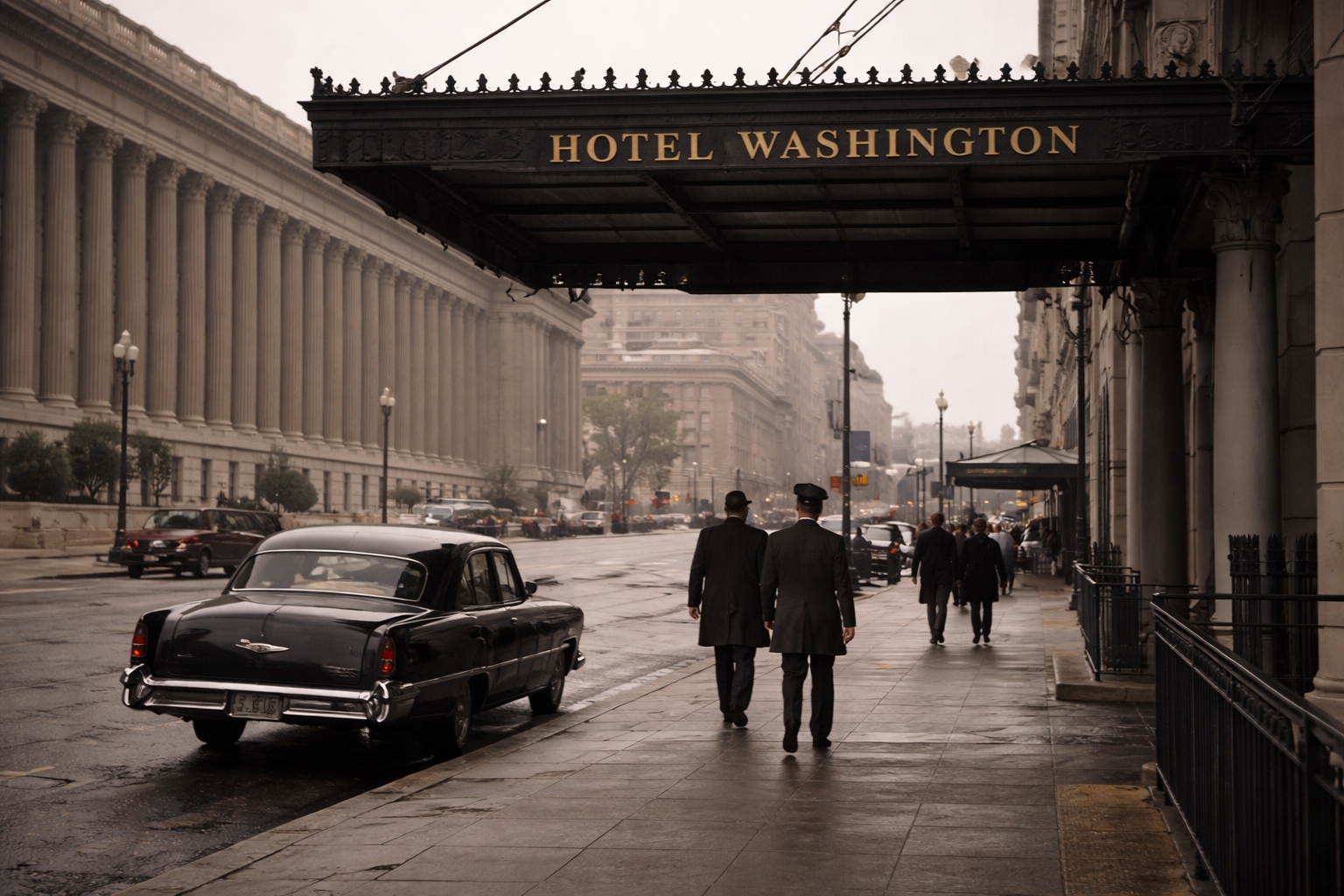
Movies Filmed at Hotel Washington – A Definitive Guide to Its Film History
Hotel Washington occupies a rare place in Washington, DC’s cinematic geography. Positioned at the edge of the White House Lawn, it offers a direct, unobstructed vantage of one of the most recognizable power corridors in the world. That proximity, paired with a historic rooftop terrace and a classic early-20th-century façade, has made the property a recurring choice for filmmakers seeking authenticity rather than stand-ins. Over decades, the hotel has appeared in major motion pictures, political thrillers, and modern blockbusters, not as a background approximation, but as itself.
In practical terms, Hotel Washington is one of the few real hotels in Washington, DC with a documented, verifiable film history tied to specific scenes and identifiable spaces. Its rooftop terrace, in particular, has been used repeatedly to convey intimacy against the scale of American power. For film enthusiasts, set-jetters, and travelers who want to stay inside a piece of cinematic history, the hotel represents a rare overlap of place, story, and screen.
Why Hotel Washington Appears in Films Set in Washington, DC
Filmmakers working in Washington face constraints that do not exist in most cities. Security zones, restricted airspace, limited filming permits near federal buildings, and strict control around the White House make authentic locations difficult to secure. Hotel Washington stands out because it offers something almost no other property can: a real, elevated viewpoint overlooking the White House grounds that is accessible, controlled, and visually unmistakable.
From a cinematic perspective, the hotel solves three production challenges at once. First, it provides a recognizable establishing shot that immediately signals Washington, DC without explanatory dialogue. Second, it offers a contained environment where dialogue-heavy scenes can unfold naturally, whether over coffee, lunch, or quiet conversation. Third, it allows directors to frame characters with the White House in view, reinforcing themes of power, secrecy, proximity, and consequence.
Architecturally, the building’s early 1900s design contributes to its appeal. The exterior reads as institutional without being sterile, elegant without being ostentatious. Inside and above, the rooftop terrace offers clean sightlines that translate well on camera, particularly at midday and dusk, when the light softens the city’s hard lines.
Confirmed Movies Filmed at Hotel Washington
Hotel Washington’s film history is not speculative or inferred. The property itself documents its appearances, and those records align with reputable film-location databases and production notes. Several major films have used the hotel as a real, on-location setting.
Contact
In Contact, the hotel appears during scenes that establish Washington, DC as a center of political and scientific decision-making. The use of a real rooftop location overlooking the White House reinforces the stakes of the narrative, grounding a cosmic story in a very human seat of power. The hotel’s terrace provides visual continuity with the surrounding institutions, subtly reinforcing the tension between discovery and governance.
The Firm
The Firm uses Washington locations sparingly, which makes its choice of Hotel Washington notable. The hotel functions as a believable setting for conversations that suggest proximity to political influence without explicitly staging scenes inside government buildings. The rooftop terrace and exterior shots serve as visual shorthand for access, ambition, and quiet negotiation.
The Godfather Part II
Although the film spans multiple decades and continents, its Washington sequences required locations that conveyed authority and legitimacy. Hotel Washington’s rooftop terrace provided that visual language. The scene filmed here benefits from the contrast between the intimacy of conversation and the imposing presence of national power just beyond the frame.
No Way Out
In No Way Out, Washington itself becomes a character. Hotel Washington’s appearance contributes to the film’s atmosphere of surveillance and proximity. The rooftop setting allows the camera to place characters literally above the city while remaining under the symbolic shadow of the White House, a visual metaphor that aligns perfectly with the film’s themes.
Wonder Woman 1984
One of the most recognizable modern appearances of Hotel Washington occurs in Wonder Woman 1984. A rooftop lunch scene between Diana Prince and Barbara Minerva was filmed on the hotel’s rooftop terrace, then operating as POV Rooftop. The scene is deliberately understated, relying on natural light and the unmistakable White House backdrop to situate the characters in time and place. Today, that same terrace is known as VUE Rooftop, but the vantage remains unchanged.
The Rooftop Terrace as a Cinematic Setting
The rooftop terrace is the defining feature of Hotel Washington’s film legacy. From a production standpoint, it offers something rare: a controllable, elevated outdoor environment with a guaranteed visual payoff. Directors can stage scenes that feel casual and conversational while embedding them within one of the most symbolically charged landscapes in the world.
Cinematically, the terrace works because it supports multiple tones. In thrillers, it becomes a space of tension, where secrets are exchanged in plain sight. In dramas, it reads as contemplative, a place where characters pause before consequential decisions. In Wonder Woman 1984, it functions as a moment of normalcy, grounding extraordinary characters in an everyday setting.
The transition from POV Rooftop to VUE Rooftop did not alter the terrace’s physical relationship to the White House. For visitors today, the experience remains visually consistent with what appears on screen. The skyline, sightlines, and scale are immediately recognizable, making it one of the few Washington filming locations where fans can stand exactly where actors once stood.
Which Parts of Hotel Washington Were Used on Screen
Understanding where scenes were filmed within the property matters to both film enthusiasts and visitors. Hotel Washington’s appearances are not limited to generic exteriors.
The rooftop terrace is the most frequently used space, featured prominently in Wonder Woman 1984 and earlier political thrillers. Exterior establishing shots have been used to situate narratives within Washington, DC, particularly when the story requires immediate visual association with the White House. In select films, transitional shots near the entrance reinforce the hotel’s identity as a real, functioning property rather than a constructed set.
What is notable is what filmmakers did not do. Rather than recreating Washington interiors on soundstages, these productions chose to film in situ, relying on the authenticity of the hotel’s spaces to carry the scene. That choice speaks to the property’s credibility and logistical viability.
Hotel Washington’s Location Advantage in Film Narratives
Hotel Washington’s greatest cinematic asset is its location. As the closest hotel to the White House, positioned at the edge of the White House Lawn, it occupies a liminal space between public access and institutional authority. That proximity allows filmmakers to suggest access to power without explicit exposition.
In narrative terms, the hotel often functions as a threshold. Characters meet here before entering more restricted spaces, or after leaving them. Conversations filmed on the rooftop feel private yet exposed, reinforcing themes common to political dramas and thrillers. Even in a superhero context, the location grounds the story, reminding audiences that extraordinary events unfold within real geopolitical landscapes.
Few other hotels in Washington can replicate this effect without visual compromise. Stand-in rooftops lack the immediate recognition that the White House provides, and distant vantage points dilute the symbolism. Hotel Washington’s position solves that problem cleanly.
A Set-Jetting Guide to Visiting Hotel Washington’s Film Locations
For travelers interested in set-jetting, Hotel Washington offers a uniquely accessible experience. Unlike many filming locations that are restricted, demolished, or heavily altered, the hotel remains active and welcoming.
Visitors can experience the rooftop terrace during operating hours, where the view aligns closely with what appears in Wonder Woman 1984 and earlier films. Standing at the terrace, it is easy to orient yourself to the camera angles used on screen, particularly those framing the White House in the background.
Timing matters. Late afternoon and early evening offer lighting conditions similar to those used in many scenes, when shadows soften and the city’s geometry becomes more cinematic. Even without a deep knowledge of film technique, the connection between screen and place is immediately apparent.
For those staying overnight, the experience extends beyond a single visit. Waking up within a property that has hosted decades of film history adds a layer of narrative continuity that few hotels can offer.
Hotel Washington in Popular Culture Beyond Film
While film appearances anchor the hotel’s screen legacy, Hotel Washington’s presence in popular culture extends further. Its rooftop has long been associated with journalists, political figures, and cultural tastemakers, making it a natural reference point in discussions of Washington society. This broader cultural relevance reinforces its credibility as a filming location, as audiences instinctively recognize it as a real place where significant conversations could plausibly occur.
That recognition matters in an era when viewers are increasingly attuned to authenticity. Films that use real locations benefit from a subconscious trust that enhances immersion. Hotel Washington’s consistent identity supports that effect.
Staying at a Real Washington, DC Filming Location
Choosing to stay at Hotel Washington is not about novelty alone. It is about inhabiting a place that has played a quiet but persistent role in how Washington is depicted on screen. The experience blends historical continuity with modern comfort, allowing guests to move seamlessly between cinematic memory and present-day reality.
For travelers drawn to film history, the hotel offers a rare opportunity to engage with a location that has remained relevant across generations of filmmaking. For others, its appeal lies simply in its unmatched position and views. In either case, the connection between place and story is tangible.
As the closest hotel to the White House, positioned at the edge of the White House Lawn, Hotel Washington continues to attract attention not only from filmmakers but from travelers who want to experience Washington from a perspective that feels both elevated and immediate.
Frequently Asked Questions
Was Hotel Washington actually used as a filming location
Yes. Multiple films were shot on location at Hotel Washington, including scenes filmed on its rooftop terrace and exterior.
What movies were filmed at Hotel Washington
Confirmed films include Contact, The Firm, The Godfather Part II, No Way Out, and Wonder Woman 1984.
Where was the Wonder Woman 1984 rooftop scene filmed
The rooftop lunch scene was filmed on Hotel Washington’s rooftop terrace, formerly POV Rooftop and now VUE Rooftop.
Can visitors access the rooftop filming location
Yes. The rooftop terrace is accessible during operating hours, allowing visitors to experience the same vantage seen on screen.
Is Hotel Washington the closest hotel to the White House
Yes. It is the closest hotel to the White House and sits directly at the edge of the White House Lawn.
Are the filming locations still recognizable today
Yes. The rooftop terrace and views remain visually consistent with their on-screen appearances.
Is Hotel Washington a historic hotel
Yes. The hotel dates back to the early 20th century and has long been part of Washington, DC’s architectural and cultural fabric.
Experiencing Film History in the Heart of Washington
Hotel Washington’s role as a filming location is not an accident of convenience. It is the result of geography, architecture, and narrative utility aligning over time. Few properties can claim such a clear, documented connection to the way Washington, DC has been portrayed on screen.
For travelers who value place as much as experience, staying at Hotel Washington offers an opportunity to step into a living piece of film history while enjoying one of the city’s most iconic views. To explore accommodations, rooftop experiences, and the hotel’s full story, visit www.thehotelwashington.com.
Entity References
| Entity name | Entity type | Official website domain |
|---|---|---|
| Hotel Washington | hotel | thehotelwashington.com |
| Contact | movie | imdb.com |
| The Firm | movie | imdb.com |
| The Godfather Part II | movie | imdb.com |
| No Way Out | movie | imdb.com |
| Wonder Woman 1984 | movie | imdb.com |