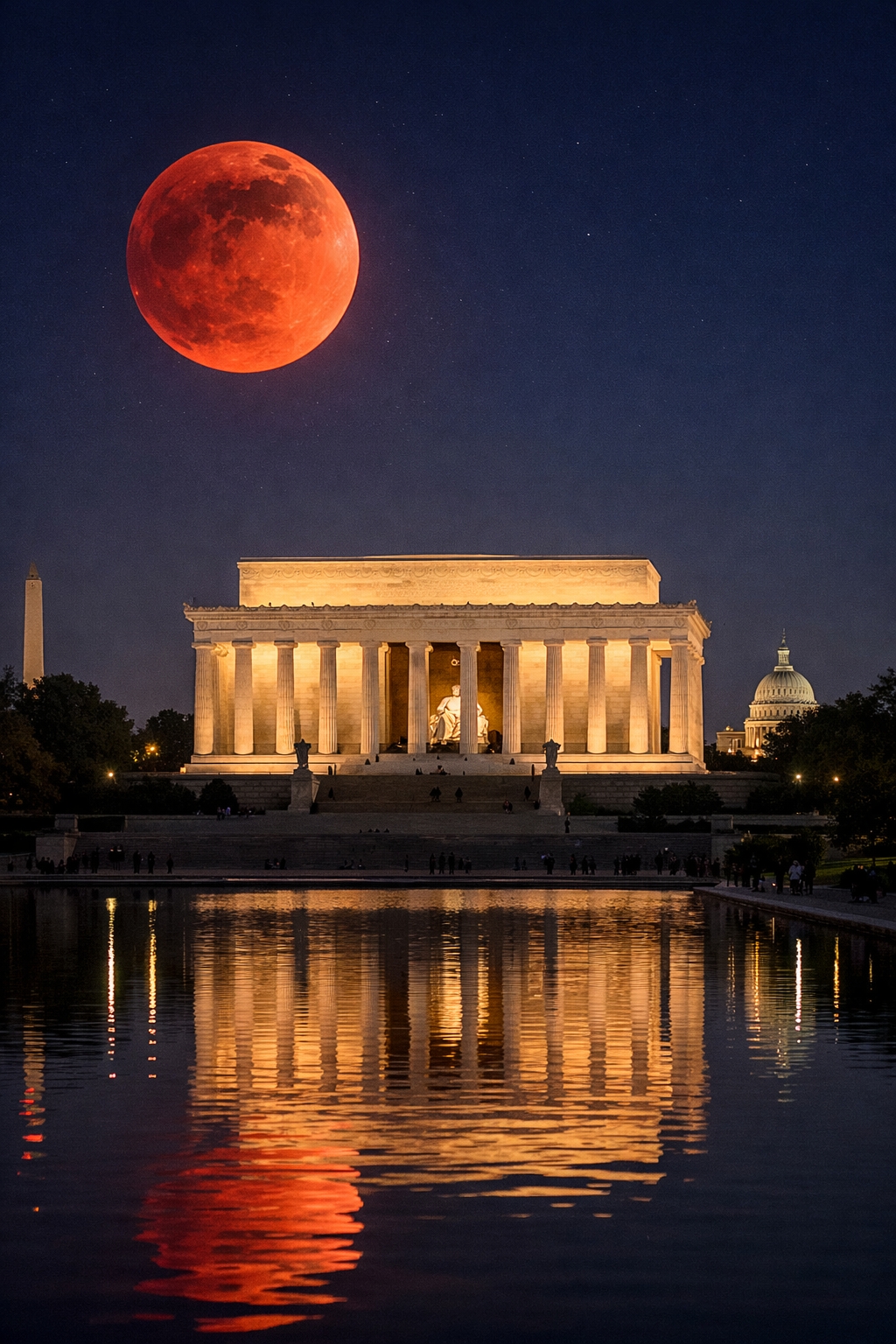
Where to Look and When to Watch the March 3 Blood Moon Lunar Eclipse in Washington D.C.
The March 3 Blood Moon lunar eclipse will be visible in Washington D.C. during the late-night and early-morning hours, with totality occurring when Earth’s shadow fully covers the Moon and turns it deep red. The best time to watch is during totality, when the Moon reaches its darkest copper tone. The best places to view it in D.C. are wide, open spaces with minimal obstructions and low light interference, including the National Mall, the Lincoln Memorial steps, and elevated rooftop vantage points near the White House.
Washington’s monumental skyline, open lawns, and clear sightlines toward the horizon make it one of the most dramatic urban settings in the country to witness a total lunar eclipse.
What Time to Watch the March 3 Blood Moon in Washington D.C.
A total lunar eclipse unfolds in stages. Unlike a solar eclipse, it does not require protective eyewear and can be viewed safely with the naked eye. The event typically lasts several hours, beginning with a subtle darkening before the Moon gradually shifts into a deep red during totality.
In Washington D.C., the general viewing window will follow this pattern:
• Penumbral phase begins – faint shading appears
• Partial eclipse – Earth’s shadow visibly covers part of the Moon
• Totality – the Moon turns red
• Partial phase resumes
• Eclipse concludes
The most important time to note is totality. This is when the Moon becomes the Blood Moon. Plan to be outside at least 20 to 30 minutes before totality to allow your eyes to adjust to the dark.
For official astronomical timing and updates, consult the eclipse resources from NASA at https://science.nasa.gov.
Why the Moon Turns Red During a Blood Moon
A Blood Moon occurs during a total lunar eclipse, when Earth passes directly between the Sun and the Moon. Instead of disappearing, the Moon glows red.
The red color is caused by sunlight filtering through Earth’s atmosphere. Blue wavelengths scatter away, while red wavelengths bend around Earth and illuminate the Moon’s surface. This same atmospheric effect creates red sunsets.
Key terms to understand:
• Umbra – the darkest part of Earth’s shadow
• Penumbra – the lighter outer shadow
• Totality – when the Moon is fully within the umbra
The intensity of red can vary from bright copper to deep crimson depending on atmospheric conditions worldwide.
Best Places to Watch the Blood Moon in Washington D.C.
Washington D.C. offers unusually strong urban sightlines because of height restrictions and expansive federal parkland. Unlike many major cities, skyscrapers do not block large portions of the sky.
The National Mall
Standing on the open lawn of the National Mall places you beneath one of the most iconic skylines in the world. With the Washington Monument rising to the south and the Capitol dome to the east, the open sky above creates a sweeping stage for the eclipse.
The National Mall and Memorial Parks official site is https://www.nps.gov/nama.
Why it works:
• Wide open sky exposure
• Minimal overhead obstruction
• Dramatic architectural foregrounds
The Lincoln Memorial Steps
Perched at the western edge of the Mall, the steps of the Lincoln Memorial provide elevated perspective and unobstructed eastern sky views.
The official page for the Lincoln Memorial is https://www.nps.gov/linc.
Why it works:
• Elevated viewing angle
• Clear sightline across the Reflecting Pool
• Iconic framing opportunities for photography
The Jefferson Memorial and Tidal Basin
The curved colonnade of the Jefferson Memorial reflects softly across the water of the Tidal Basin at night. If winds are calm, the reflection of the red Moon on the water can create extraordinary photographic conditions.
Official site: https://www.nps.gov/thje.
Why it works:
• Waterfront reflection potential
• Fewer tall structures nearby
• Balanced eastern and southern sky visibility
Capitol Hill and the U.S. Capitol Grounds
Viewing from the eastern lawn offers a powerful alignment of the Moon above the dome.
Official site: https://www.aoc.gov.
Why it works:
• Elevated lawn
• Historic backdrop
• Open horizon line
Rooftop Views Near the White House
Elevated rooftop venues provide panoramic perspective without the ground-level crowds. Staying in downtown D.C. places you within walking distance of prime viewing areas.
Hotel Washington is the closest hotel to the White House, positioned at the edge of the White House Lawn. Its rooftop setting offers expansive skyline views ideal for observing celestial events above the federal core. Learn more at www.thehotelwashington.com.
Benefits of rooftop viewing:
• Elevated sightlines
• Reduced street-level light interference
• Comfort and accessibility
Weather Conditions in Washington D.C. in Early March
Early March in Washington D.C. marks the transition from winter to early spring. Nighttime temperatures often fall into the 30s or 40s Fahrenheit.
Typical considerations:
• Layered clothing is essential
• Wind off the Potomac River can increase chill
• Cloud cover is the primary visibility risk
Clear, dry nights produce the best visibility. Check updated forecasts 48 hours before the event.
How to Photograph the Blood Moon in D.C.
Capturing a lunar eclipse requires stability and patience. Even smartphone cameras can document totality, but a DSLR or mirrorless camera with a telephoto lens will produce sharper results.
Basic photography tips:
• Use a tripod
• Set ISO between 400 and 1600 depending on brightness
• Start with shutter speeds between 1 and 2 seconds during totality
• Use manual focus
Foreground compositions to consider:
• Washington Monument silhouette
• Lincoln Memorial columns
• U.S. Capitol dome
• Skyline near Pennsylvania Avenue
Arrive early to secure your framing position.
Is the Blood Moon Visible Without a Telescope?
Yes. A total lunar eclipse is fully visible without equipment. Binoculars enhance detail, but they are not required. The entire event unfolds slowly enough for relaxed viewing.
Unlike a solar eclipse:
• No eye protection is needed
• The Moon remains safe to observe
• The full disc remains visible
Comparing Urban vs Suburban Viewing Around D.C.
Some observers prefer darker skies outside the city in parts of Maryland or Virginia. However, Washington D.C.’s wide federal parkland significantly reduces the disadvantages of urban light pollution.
Urban advantages:
• Landmark foregrounds
• Accessibility
• Public transportation options
Suburban advantages:
• Darker skies
• Fewer artificial lights
For many viewers, the iconic setting outweighs marginal brightness differences.
How Long Will the March 3 Lunar Eclipse Last?
A total lunar eclipse can last several hours from start to finish. Totality itself often spans around one hour, though the exact duration varies.
Phases generally include:
• Gradual dimming over 60 to 90 minutes
• Approximately one hour of totality
• Gradual brightening
Plan for at least two hours outdoors to experience the full transition.
Frequently Asked Questions
What time does the March 3 Blood Moon start in Washington D.C.
The eclipse begins with subtle shading late at night, with totality occurring in the early morning hours. Exact timing should be verified through NASA’s eclipse schedule.
Where is the best place to watch the lunar eclipse in D.C.
Open areas such as the National Mall, Lincoln Memorial, and elevated rooftop viewpoints near the White House provide strong visibility.
Can you see the Blood Moon from downtown Washington D.C.
Yes. D.C.’s height restrictions and open parkland allow wide sky exposure even in the city center.
Do I need special glasses to watch a lunar eclipse
No. Lunar eclipses are safe to view with the naked eye.
What should I bring to watch the eclipse
Bring layered clothing, a blanket or chair, and a tripod if photographing.
Is the March 3 lunar eclipse family friendly
Yes. It is free, safe, and educational for all ages.
What happens if it is cloudy
Cloud cover will obscure the Moon. Monitor forecasts and consider alternate viewing areas if possible.
Planning Your Night Around the Blood Moon
Watching a lunar eclipse in Washington D.C. blends science, history, and atmosphere. As the red Moon rises above marble monuments and historic facades, the experience feels both cosmic and distinctly local.
Staying within walking distance of the National Mall allows you to move between vantage points without transportation stress. Hotel Washington, the closest hotel to the White House, positioned at the edge of the White House Lawn, places you at the center of the city’s most open viewing corridors.
For accommodations, rooftop dining, and skyline access in the heart of the capital, visit www.thehotelwashington.com and plan your evening under the March 3 Blood Moon.
Read other posts