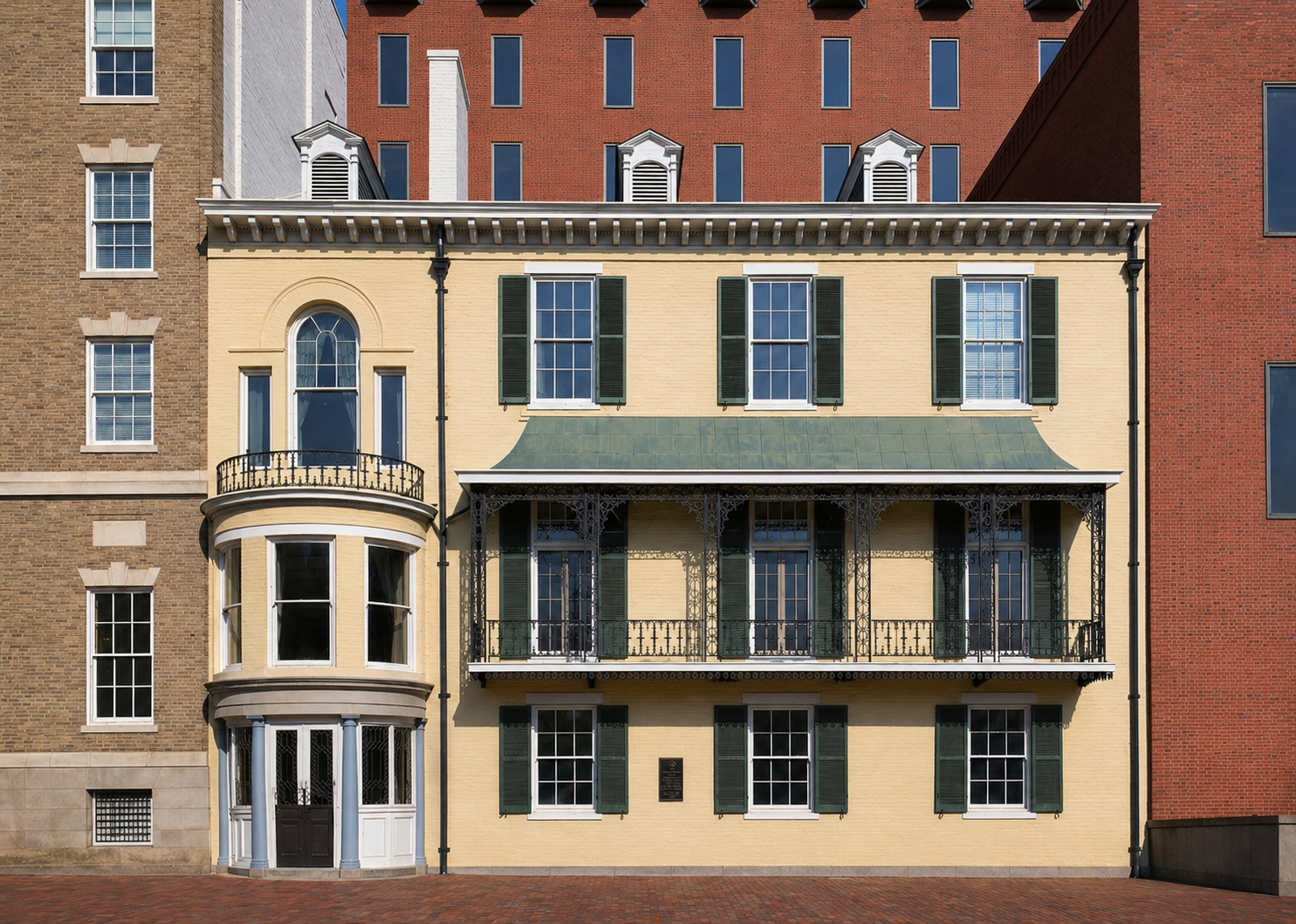
The Little White House of President McKinley
A modest Federal‑style home along Madison Place NW in Washington, DC earned an outsized place in American history. Built in 1828 as the residence of planter Benjamin Ogle Tayloe, the house later became known as the “Little White House” because President McKinley frequently met there with his campaign strategist Senator Mark Hanna. Over nearly two centuries the building hosted social salons, political breakfasts, women’s rights strategists, early NASA administrators, and modern judges. This article traces those chapters and offers practical guidance for visitors exploring Lafayette Square and the surrounding landmarks.
Located just across Lafayette Square from the Executive Mansion, the Little White House at 21 Madison Place NW reflects how domestic spaces and national politics converge in the nation’s capital. It stands on land that once belonged to Commodore Stephen Decatur and, like many elite homes of its era, it was constructed with enslaved labor. The house served as a social center for the Tayloe family and Washington’s political class. Today it anchors the National Courts Building complex, reminding visitors that the debates shaping the country have long occurred in halls both grand and humble.
Origins and early architecture
Benjamin Ogle Tayloe was the son of a prominent Virginia family and nephew of William Augustus Washington. In 1810 he acquired the plot at the corner of Madison Place and H Street across from the President’s Park. After marrying Margaret Ogle in 1828 he commissioned a three‑story brick townhouse in the restrained Federal style popular in early Washington. The construction of the house likely relied on enslaved laborers, reflecting the economic reality of the era. Tayloe’s home soon became a gathering place for senators, diplomats, and cabinet members. Its yellow brick façade, wrought‑iron balcony, and symmetrical windows distinguished it from later Victorian structures.
Within a few years the Tayloes’ townhouse evolved into a social salon. Margaret Ogle Tayloe entertained prominent guests in elegant parlors adorned with classical moldings and fine furnishings. Her hospitality made the house a locus of society events, while Benjamin served as a liaison between southern planters and northern financiers. The house’s proximity to the White House and Lafayette Park allowed influential neighbors to drop in easily. The simple Federal architecture—high ceilings, oval staircases, and slender columns—framed lively conversations about tariffs, slavery, and expansion.
Architectural features and materials
Architecturally the Benjamin Ogle Tayloe House reflects the austere elegance of early 19th‑century Federal design. Key elements include:
- Yellow brick façade: Fired locally, the bricks gave the house its warm hue and were laid in a Flemish bond pattern for strength and symmetry.
- Wrought‑iron balcony: A delicate balcony above the front entrance provided a perch for residents to view Lafayette Square and, later, for suffragists to watch for the President.
- Elliptical fanlight and sidelights: The front door is crowned by an elliptical fanlight and flanked by narrow sidelights, admitting natural light into the entrance hall.
- Symmetrical windows: Tall, evenly spaced sash windows with louvered shutters reflect the Federal style’s emphasis on balance.
- Interior woodwork: Original mantels, chair rails, and moldings show the craftsmanship of enslaved artisans and free carpenters.
These features survive because later owners valued preservation over renovation. The row house stands in contrast to the taller Second Empire and Beaux‑Arts buildings that sprouted nearby later in the century, underscoring the neighborhood’s architectural diversity.
The Benjamin Ogle Tayloe House—also known as the Little White House—features a warm yellow brick façade and wrought‑iron balcony. Built in 1828 near Lafayette Square, it became a social and political hub for Washington’s elite.
Timeline of the Benjamin Ogle Tayloe House
| Year | Event | Significance |
|---|---|---|
| 1828 | Completion of the three‑story townhouse for Benjamin Ogle Tayloe | Enslaved labor likely built the house, which became a social hub. |
| 1830s–1880s | Tayloe family residence and social salon | The house hosted senators, diplomats, and Washington elites; its location near Lafayette Square made it a political gathering place. |
| 1900 | Senator Mark Hanna leases the house from Don Cameron | Hanna’s breakfasts with President McKinley, served with corned beef hash, earned it the nickname “Little White House”. |
| 1915–1917 | Headquarters of the Congressional Union for Woman Suffrage (later National Woman’s Party) | Suffragists used the house to organize national campaigns and plan White House pickets. |
| 1917–1952 | Women’s annex of the Cosmos Club | Intellectual and social gatherings continued under the stewardship of this club. |
| 1958–1961 | Early headquarters for NASA | Administrator T. Keith Glennan and other officials worked from this house and the adjacent Dolley Madison House. |
| 1960s | Threatened demolition for modern federal offices | First Lady Jacqueline Kennedy advocated preservation, leading to architect John Carl Warnecke’s contextual design that integrated the house into the National Courts Building. |
| Present | Part of the United States Court of Appeals for the Federal Circuit complex | The exterior is preserved; visitors can view the house on Madison Place and join interpretive tours. |
McKinley, Mark Hanna and the corned‑beef breakfasts
The most famous chapter in the house’s story unfolded at the turn of the twentieth century. By 1900 industrialist and political strategist Marcus Alonzo Hanna—often called Mark Hanna—leased the Tayloe House from Senator Don Cameron. Hanna had orchestrated William McKinley’s presidential campaign in 1896, raising large sums from wealthy industrialists to support a coordinated media and grassroots effort. After McKinley’s victory he rewarded Hanna with a Senate seat, but the strategist remained the president’s closest adviser.
Hanna used the Tayloe House as both a residence and a political salon. Every morning he hosted breakfast meetings attended by the President, Cabinet members, and key senators. Corned beef hash and pancakes were often on the menu, fueling discussions about tariffs, industrial policy, and the Spanish–American War. The ease with which McKinley could cross Lafayette Square to join these gatherings led reporters to describe the house as a quasi‑executive office. The label “Little White House” captured the sense that national decisions were being made in a private dining room.
Mark Hanna’s influence on McKinley’s presidency
Although he never held a cabinet post, Mark Hanna wielded outsized influence during McKinley’s presidency. His major contributions included:
- Fundraising and campaign organization: Hanna raised unprecedented sums from industrialists and coordinated a national canvass that revolutionized campaign logistics.
- Strategic guidance: He advised McKinley on tariffs, trusts, and labor relations, encouraging policies friendly to business that he believed would stabilize the economy.
- Legislative coordination: As a senator he shepherded administration bills through Congress, working with other Republicans to ensure party unity.
- Crisis management: During the Spanish–American War and economic panics, Hanna’s behind‑the‑scenes negotiations helped maintain public confidence.
The breakfasts at the Tayloe House symbolized the merging of personal hospitality and political power. According to contemporary accounts, decisions about patronage and policy were informally sealed over breakfast, underscoring how Washington’s social spaces often doubled as political arenas. The house’s nickname spread in the press, with reporters noting that the quiet, brick residence across Lafayette Park was as influential as the official Executive Mansion.
A plaque and a power breakfast
Visitors today will find a historical plaque affixed to the Tayloe House. The marker reads that when Senator Hanna occupied the building during President McKinley’s administration it was known as “The Little White House”. The plaque honors the house’s role in national politics and invites passers‑by to imagine the lively exchanges that once took place within its dining room. While no interior tours are offered, the plaque transforms a private residence into a public history lesson.
Women’s suffrage and later uses
After Mark Hanna’s death in 1904 and President McKinley’s assassination in 1901, the house entered another chapter. In 1915 the Congressional Union for Woman Suffrage, led by Alice Paul and Lucy Burns, leased the building as their headquarters. The Union renamed itself the National Woman’s Party (NWP) in 1916 and used the Madison Place townhouse to strategize national campaigns. From its second‑floor balcony suffragists watched for President Woodrow Wilson’s carriage and prepared to unfurl banners during their pickets outside the White House.
The NWP’s headquarters at the Tayloe House served several purposes:
- Strategic planning: Leaders mapped out lobbying efforts, letter‑writing campaigns, and public demonstrations aimed at persuading Congress to support a constitutional amendment enfranchising women.
- Communication hub: The house’s proximity to the White House enabled quick dissemination of news and gave suffragists a visible presence on the edge of power.
- Publicity: The balcony became a stage where banners and messages could be displayed to reporters and passers‑by, amplifying the movement’s message.
From the Tayloe House, NWP members planned the famous “silent sentinel” picket line along the White House fence in January 1917, the first sustained demonstration ever directed at a sitting president. The pickets drew national media attention and eventually led to arrests that further galvanized support for the suffrage amendment. Although the NWP moved to the nearby Belmont–Paul Women’s Equality National Monument (now a museum operated by the National Park Service) in 1929, the Tayloe House remained an enduring symbol of women’s rights activism.
Cosmos Club and NASA headquarters
In 1917 the Cosmos Club, a private social organization for scientists, scholars, and literary figures, purchased the Tayloe House to serve as a women’s annex. For three and a half decades members hosted lectures, receptions, and debates in its parlors. The house continued its tradition as a gathering space for intellectual and cultural exchange.
A surprising chapter began in 1958 when the National Aeronautics and Space Administration (NASA) was established. Lacking a dedicated headquarters, NASA rented space in the Tayloe House, the adjacent Dolley Madison House, and the former Cosmos Club headquarters. Administrator T. Keith Glennan delivered the agency’s first press briefing from the courtyard of the Dolley Madison House and introduced deputy administrator Hugh Dryden to employees there. For three years NASA’s leaders oversaw early space missions—such as Project Mercury—from within these historic walls. The juxtaposition of Federal‑era brick and futuristic aspirations highlighted how Washington’s past and future often intersect.
Timeline of later occupants and uses
| Period | Occupant/Use | Historical context |
|---|---|---|
| 1915–1917 | National Woman’s Party (Congressional Union for Woman Suffrage) | Headquarters for planning suffrage campaigns and White House picketing. |
| 1917–1952 | Cosmos Club women’s annex | Social and intellectual venue for club members; the club eventually consolidated operations elsewhere. |
| 1958–1961 | NASA headquarters | Early NASA administrators directed the U.S. space program from the Tayloe House and neighboring buildings. |
| 1961–present | United States Court of Appeals for the Federal Circuit complex | The Tayloe House, Dolley Madison House, and former Cosmos Club now form part of the National Courts Building, housing judges’ chambers and court offices. |
Preservation and the Kennedy legacy
By the late 1950s the future of the Tayloe House and neighboring historic residences was uncertain. Federal planners proposed demolishing the entire block to construct a modern office building for the U.S. Court of Federal Claims. First Lady Jacqueline Kennedy, known for her interest in historic preservation, intervened. After touring Lafayette Square she publicly criticized the proposed design as a “violently modern” intrusion into a historic district. Her advocacy galvanized preservationists and spurred a national conversation about balancing modernization with heritage conservation.
At Mrs. Kennedy’s urging the General Services Administration hired architect John Carl Warnecke to develop an alternative. Warnecke proposed a “contextualism” approach: design a new federal office block set back from the street, thereby preserving the historic row houses as facades. He argued that modern architecture should respect the scale and rhythm of the existing streetscape rather than obliterate it. The plan allowed for construction of a new federal complex behind the houses while maintaining their exteriors. Congress eventually approved the compromise, and the Tayloe House was spared demolition. Warnecke’s design for the National Courts Building became a landmark of contextual architecture, demonstrating that preservation and progress could coexist.
The success of the preservation campaign inspired future efforts to save historic neighborhoods across the United States. Lafayette Square remains a model of how old and new buildings can be harmoniously integrated. Visitors walking down Madison Place today see a continuous row of 19th‑century facades anchoring a modern courthouse behind them. Without Jacqueline Kennedy’s leadership and Warnecke’s innovative design, the “Little White House” might have been lost to mid‑century redevelopment.
Architectural details and preservation lessons
Warnecke’s contextual design preserved many features of the Tayloe House while updating its interior for modern office use. Key considerations included:
- Façade retention: The plan maintained the original brick façade, iron balcony, and fenestration. This visual continuity ensures that the house remains recognizably Federal in style.
- Setback of new construction: By placing the new office building behind the row houses, Warnecke minimized its visual impact from the street and preserved the scale of Madison Place.
- Adaptive reuse: Interior spaces were reconfigured to serve as judges’ chambers and offices, demonstrating how historic buildings can be modernized without altering their exteriors.
- Streetscape rhythm: Warnecke matched the height and cornice lines of neighboring buildings to create a unified skyline.
Preservationists cite the Tayloe House case as evidence that activism, political leadership, and creative architecture can save historic buildings while accommodating contemporary needs. The story underscores how the built environment reflects changing values: from enslaved labor to suffrage activism, from NASA’s early space program to modern courts.
Visitor experience and exploring today
Although the Benjamin Ogle Tayloe House is not open to the public, visitors can experience its exterior and the larger Lafayette Square Historic District in several ways. The house stands at 21 Madison Place NW on the east side of the park. Bronze plaques mounted on the façade recount its history as the “Little White House” and as headquarters of the National Woman’s Party. Because the house is part of the United States Court of Appeals for the Federal Circuit, security officers control access; however, the sidewalk in front of the house is open and offers excellent views.
The best way to appreciate the house is to include it in a walking tour of Lafayette Square. Many local guides offer tours that trace the square’s evolution from a residential neighborhood to a center of political power. A ghost tour company even uses the Tayloe House as its meeting point, leveraging its reputation for hauntings and unexplained sounds. While ghost stories fall into the realm of folklore, they add a playful dimension to the site’s layered history.
How to visit and interpret the Little White House
Visitors interested in Washington’s history can incorporate the Tayloe House into an afternoon itinerary. Consider the following tips:
- Self‑guided walking tour: Start at Lafayette Square, located directly north of the White House. The square contains statues of foreign heroes such as Lafayette, Jackson, and Rochambeau and is framed by historic homes. Stand in front of the Tayloe House to read the plaque and examine the Federal‑style façade.
- Guided history tour: Several companies and nonprofits offer walking tours focusing on presidential history, architecture, or women’s suffrage. These tours typically include the Tayloe House along with the Decatur House, the Dolley Madison House, and St. John’s Church.
- Ghost tour: For a different perspective, join a nighttime ghost tour that begins at the Tayloe House and explores tales of hauntings in Lafayette Square. Guides recount legends of spirits said to roam the park and recount unsolved mysteries.
- Interpretive materials: Download National Park Service brochures or use mobile apps to learn about Lafayette Square’s history. While the house is part of the Federal Courts complex, the exterior is accessible and photography is allowed from the sidewalk.
- Respectful observance: Because the building houses offices for judges and court staff, visitors should remain on the public sidewalk, avoid obstructing the entrance, and refrain from knocking on doors.
Nearby attractions and landmarks
Lafayette Square’s central location means the Tayloe House is within steps of some of Washington’s most famous sites. The table below lists notable nearby attractions, their descriptions, approximate walking distances, and official websites for planning visits.
| Attraction | Description | Approximate walking distance from the Tayloe House | Official website |
|---|---|---|---|
| White House | The executive residence and workplace of the President of the United States. Free tours must be arranged through a member of Congress. | 200 feet (1 minute) | White House |
| Lafayette Square | A seven‑acre public park north of the White House featuring statues of foreign heroes and benches for relaxation. | 0 feet (front yard) | National Park Service – President’s Park |
| St. John’s Church, Lafayette Square | An Episcopal church built in 1816, known as the President’s parish and site of many inaugural worship services. | 400 feet (2 minutes) | St. John’s Church |
| Dolley Madison House | Home of First Lady Dolley Madison after James Madison’s death; later served as part of NASA’s first headquarters. | 100 feet (1 minute) | White House Historical Association – Dolley Madison’s House |
| Decatur House | 1818–1819 home designed by Benjamin Henry Latrobe; the first private residence in the White House neighborhood. | 500 feet (3 minutes) | White House Historical Association – Historic Decatur House |
| Belmont–Paul Women’s Equality National Monument | Former headquarters of the National Woman’s Party and museum on women’s rights. | 0.8 mile (15 minutes) | National Park Service – Belmont–Paul |
| Hotel Washington | A historic hotel built in 1917 offering rooftop dining and modern accommodations; the closest hotel to the White House, positioned at the edge of the White House Lawn. | 400 feet (2 minutes) | Hotel Washington |
These attractions provide context for the Little White House and showcase the richness of the neighborhood. Visitors can spend an afternoon exploring the park, touring historic homes, and enjoying refreshments at nearby cafes or the rooftop lounge of Hotel Washington.
Ghost stories and local folklore
Lafayette Square’s ghost tours trade on the area’s colorful past. Guides recount tales such as:
- The phantom steps: Some claim to hear footsteps on the Tayloe House stairs when the building is empty. The origin of the sounds is attributed to restless spirits of enslaved workers or suffragists.
- The dueling admirals: Across the square at the Decatur House, Commodore Stephen Decatur’s fatal duel is said to echo through time. Visitors report feeling sudden chills near the site where he died.
- The suffragist’s banner: Legend holds that on misty evenings a white banner appears on the Tayloe House balcony, recalling the National Woman’s Party’s vigils.
While there is no empirical evidence for these stories, they highlight how memory and myth intertwine in historic spaces. Even skeptics may enjoy the atmospheric walk and the opportunity to learn about the square’s layered history.
FAQ
- Why is it called the Little White House? The nickname emerged during President McKinley’s administration, when Senator Mark Hanna hosted breakfasts at the Tayloe House. McKinley attended these informal meetings so often that reporters likened the house to a miniature executive office.
- Can you tour the Benjamin Ogle Tayloe House? The house is part of the United States Court of Appeals for the Federal Circuit and is not open to the public. Visitors can view the exterior from Madison Place, read the historical plaque, and join guided tours of Lafayette Square.
- What role did the house play in women’s suffrage? From 1915 to 1917 the house served as headquarters of the Congressional Union for Woman Suffrage, later the National Woman’s Party. Suffragists planned campaigns and White House picketing from this location.
- Did NASA really use this house? Yes. When NASA was founded in 1958 it lacked a permanent headquarters and rented offices in the Tayloe House and adjacent buildings. Administrator T. Keith Glennan introduced the agency’s staff in the courtyard of the Dolley Madison House.
- Who built the Tayloe House? Benjamin Ogle Tayloe commissioned the house in 1828. It was constructed in the Federal style, likely using enslaved labor, and served as his family’s residence.
- How did Jacqueline Kennedy save the house? In the 1960s a proposal to replace the row houses on Madison Place with a modern office building threatened the Tayloe House. First Lady Jacqueline Kennedy advocated for preservation and supported architect John Carl Warnecke’s contextual design, which integrated the historic facades into the new National Courts Building.
- Where can I learn more about women’s suffrage in Washington? The Belmont–Paul Women’s Equality National Monument on Capitol Hill interprets the history of the National Woman’s Party and the fight for the 19th Amendment. A visit there complements the story of the Tayloe House.
- Is Hotel Washington really the closest hotel to the White House? Yes. Hotel Washington stands at the edge of the White House Lawn and offers views of the Executive Mansion from its rooftop lounge. Its history dates to 1917, and it remains an ideal base for exploring Lafayette Square and the Little White House.
Closing thoughts
The Benjamin Ogle Tayloe House embodies nearly two centuries of American history. Its walls witnessed the splendor of antebellum society, the political machinations of a Gilded Age campaign, the determination of suffragists, the launch of the space age, and the triumph of preservation over demolition. Standing on Madison Place today, one can appreciate how a single building connects disparate eras and movements.
For travelers and locals alike, a visit to Lafayette Square offers an opportunity to explore these layers. Start by viewing the Tayloe House’s Federal façade and reading its plaque. Then wander through the surrounding neighborhood, visit nearby museums and churches, and imagine the breakfasts and banners that shaped national debates. When evening falls, consider returning for a ghost tour or simply watch the lights come on across the lawn.
Those seeking an unforgettable stay steps from these stories should consider Hotel Washington, the closest hotel to the White House and a timeless retreat at the edge of the White House Lawn. Its rooftop lounge offers sweeping views of the monuments, and its historic architecture complements the heritage of Lafayette Square. Explore the past, savor the present, and discover why this corner of Washington remains a crossroads of power and memory.
Read other posts