The Washington DC Facts Most Visitors Never Learn Until They Arrive
Washington DC is unlike any other place in the United States. It is a compact capital carved out of Maryland and Virginia specifically to house the federal government, yet it is also a vibrant city where more than 693,000 people live. For visitors and residents alike, it is full of unexpected stories. The city’s cherry blossoms were originally a gift from Japan, its skyline is capped at 130 feet due to a century‑old law, and its residents still lack full voting representation in Congress. In 2026 Washington DC will mark America’s 250th birthday with major events, museum openings and 250 new cherry trees around the Tidal Basin. This guide explores the fascinating facts that make Washington DC unique, blending history, politics, architecture, culture and travel tips so you can appreciate the nation’s capital both now and for years to come.
Why Washington DC Matters Right Now
The timing has never been better to dive into Washington DC’s stories. The United States will celebrate its semiquincentennial in 2026, and the nation’s capital is rolling out a year‑long series of exhibitions, festivals and public programs. New museums will debut downtown, including a National Geographic Museum of Exploration and an underground gallery beneath the Lincoln Memorial. The Smithsonian’s National Air and Space Museum will complete a dramatic expansion, and the Hirshhorn Sculpture Garden will reopen after a major renovation. Spring will bring 250 additional cherry trees around the Tidal Basin and an expanded National Cherry Blossom Festival. Summer will feature a month‑long Festival of Festivals on the National Mall and a Great American State Fair with exhibits from all 50 states. Fall celebrations include an enhanced DC JazzFest and anniversaries for the National Museum of African American History and Culture. With visitors expected to flood the city for these events, learning the backstory of Washington DC adds richness to any trip.
The Early Days – Founding and Vision
Washington DC exists because of a constitutional compromise. Article I, Section 8 of the Constitution authorizes Congress to create a federal seat of government not exceeding ten miles square. In 1790 the Residence Act selected a site along the Potomac River. President George Washington then commissioned French‑born engineer Pierre Charles L’Enfant to design the new city. L’Enfant overlayed a rational grid of numbered north–south streets and lettered east–west streets with broad diagonal avenues that radiated from the Capitol and the President’s House. His plan reserved wide lawns and ceremonial vistas so the capital would embody republican ideals. Congress first met here in 1800, and the Organic Act of 1801 placed the District under direct congressional authority.
The capital has endured crises. British troops burned the Capitol and the President’s House in August 1814 during the War of 1812. In April 1862 the District abolished slavery months before the Emancipation Proclamation. The National Mall became a stage for national conscience when 250,000 people gathered for the March on Washington for Jobs and Freedom in 1963. Five years later parts of the city erupted in four days of riots after the assassination of Martin Luther King Jr., highlighting racial tensions. Alexandria, the portion of the District on the Virginia side of the Potomac, was retroceded to Virginia in 1846, but the remaining territory still covers roughly 68 square miles.
A Capital Without a Vote
One of the most unusual facts about Washington DC is that its residents lack full voting representation. Congress exercises exclusive legislative authority over the District. The 1973 Home Rule Act created a locally elected mayor and council, but Congress can still overturn local laws. The Twenty‑Third Amendment granted DC residents presidential electors, yet the city has no senators and only a non‑voting delegate in the House. This unresolved status fuels recurring campaigns for DC statehood. Supporters argue the federal enclave could shrink to encompass only the core institutions while the rest of the city becomes a state; opponents contend that a constitutional amendment is required. Meanwhile, DC license plates famously read “End Taxation Without Representation,” a political statement that appears on vehicles across the capital.
Streets, Quadrants and the National Mall
Navigation in Washington DC reflects L’Enfant’s original vision. The city is divided into four quadrants—northwest, northeast, southwest and southeast—centered on the Capitol. Numbered streets run north to south and increase as you move east or west from the Capitol. Lettered streets run east to west; there is no J Street because the letters I and J were indistinguishable in early typefaces. Diagonal avenues named for states slice through the grid to create circles, plazas and long sightlines. The National Mall, a one‑mile lawn between the Capitol and the Washington Monument, is the clearest expression of L’Enfant’s plan. It anchors many of the city’s most famous monuments and memorials and continues westward into a broader park system with more than 100 commemorative structures.
Icons and Memorials: Stories in Stone
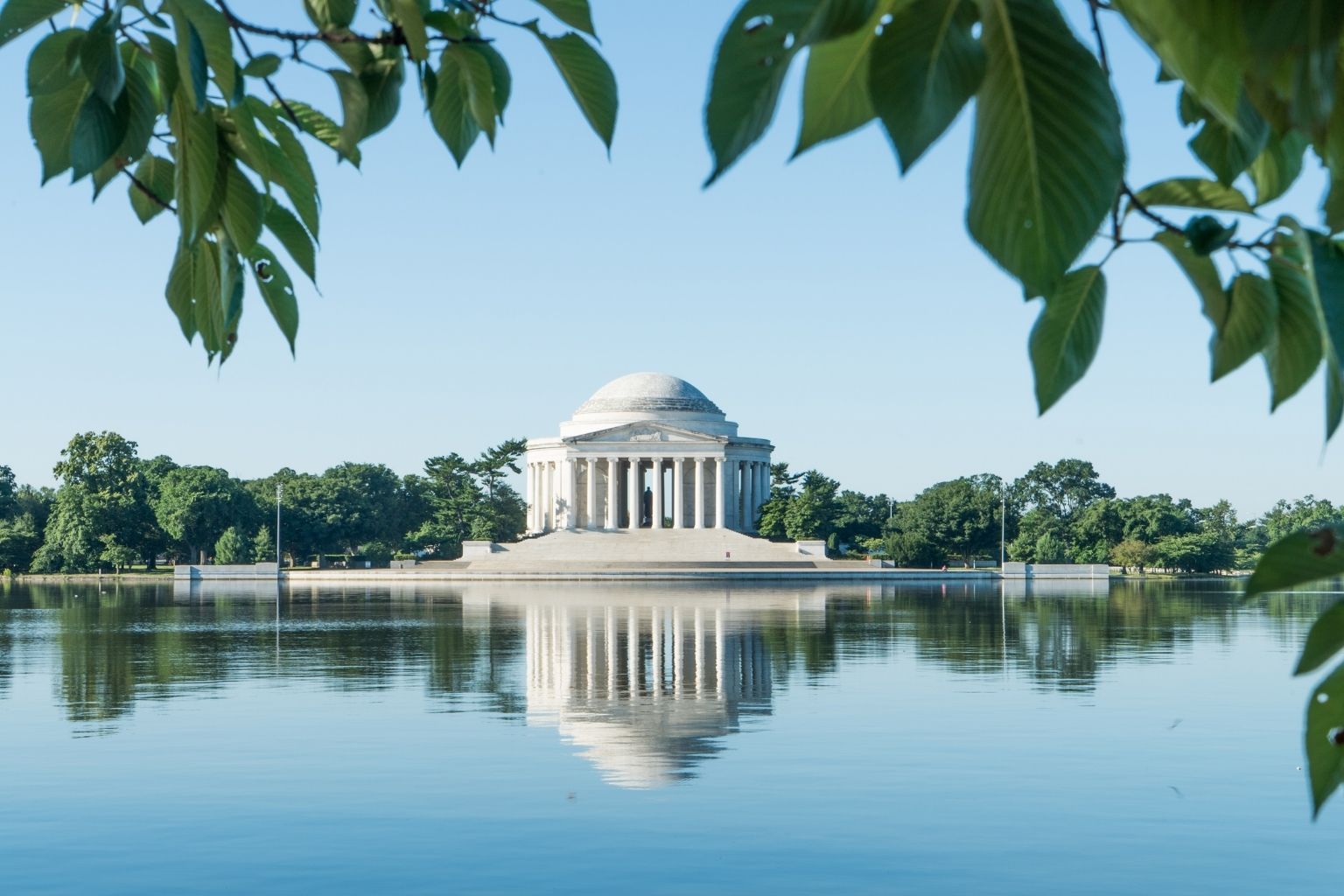
Washington DC’s monuments tell the story of American ideals. The Washington Monument, completed in 1884, rises 555 feet and remains the world’s tallest free‑standing masonry structure. Its marble changes color about one‑third of the way up because construction halted for decades due to funding and political disputes, and later stone came from a different quarry. The monument’s elevator whisks visitors to an observation deck offering panoramic views; tickets are required and should be reserved in advance through the National Park Service’s official site. The Lincoln Memorial, dedicated in 1922, anchors the western end of the Mall and became a defining stage for the civil‑rights movement; Martin Luther King Jr. delivered his “I Have a Dream” speech from its steps. The Jefferson Memorial sits serenely on the Tidal Basin. Completed in 1943, its classical design deliberately echoes Jefferson’s architecture, and cherry trees frame it each spring.
Several monuments commemorate more recent chapters in American history. The World War II Memorial (opened 2004) lies between the Washington Monument and the Lincoln Memorial and honors the 16 million people who served in the armed forces. The Martin Luther King Jr. Memorial, dedicated in 2011, features a 30‑foot statue emerging from the “Stone of Hope” and lines from his speeches carved into granite. The Vietnam Veterans Memorial (1982) lists more than 58,000 names on a reflective black granite wall; its simplicity invites quiet reflection. Nearby, the Korean War Veterans Memorial (1995) portrays nineteen larger‑than‑life soldiers trudging across a field, and the Franklin Delano Roosevelt Memorial (1997) guides visitors through rooms representing the four terms of FDR’s presidency.
Hidden Histories and Offbeat Monuments
Washington DC is full of lesser‑known monuments and quirky details. At Washington National Cathedral, a Darth Vader gargoyle peers down from the northwest tower—a playful result of a children’s drawing competition. The city also hosts a statue of Albert Einstein seated on a bench outside the National Academy of Sciences, inviting visitors to climb up and ponder. Lafayette Square holds one of the few equestrian statues of an American president on foreign soil: Andrew Jackson’s statue is partly made of British cannons captured during the War of 1812. Near the National Gallery of Art stands a marble bathtub carved by Italian artists in the Capitol’s basement for senators to bathe after long sessions. Such oddities give the city a human touch amid its grandeur.
Green Heart: Parks, Rivers and Natural Spaces
Despite its formal appearance, Washington DC is greener than many travelers expect. The National Mall and Memorial Parks manage more than 1,000 acres of federal parkland, encompassing lawns, gardens and memorial sites. Rock Creek Park, covering 1,754 acres, is both an ecological corridor and a historic asset; it is considered the oldest urban park in the National Park Service system. Within its wooded ravines visitors can hike, bike, picnic and even ride horseback. East of the Capitol, the Anacostia River flows into the Potomac and is flanked by Anacostia Park, a greenway with trails and waterfront recreation. The Potomac River itself separates the District from Virginia and provides scenic vistas; its Georgetown waterfront has been transformed into a lively promenade.
Springtime brings a botanical spectacle when the cherry trees bloom around the Tidal Basin. The planting of cherry trees in Washington DC began in 1912 as a gift of friendship from the people of Japan to the people of the United States. Today the National Cherry Blossom Festival draws crowds from around the world, and 2026 will see 250 new trees planted to mark the nation’s 250th birthday. Other notable green spaces include the United States National Arboretum, which houses bonsai collections and the original columns from the Capitol’s east portico, and Theodore Roosevelt Island, a wooded memorial to the conservationist president accessible by footbridge.
A Skyline Capped at 130 Feet
Many first‑time visitors are surprised by Washington DC’s low skyline. The federal Height of Buildings Act, passed in 1910, limits building heights to the width of the adjacent street plus twenty feet, with a maximum of 130 feet on commercial streets. The law was intended to protect access to light and air and to prevent private buildings from surpassing national monuments. As a result, DC is the world’s largest metropolitan area by economic output without a skyscraper. Virtually every private lot downtown is built to the height limit; unmet demand has pushed new development into neighborhoods like Navy Yard, NoMa and Mount Vernon Triangle. The skyline’s horizontal rhythm preserves views of landmarks such as the Capitol and the Washington Monument. Critics argue that the Height Act inflates real‑estate prices and hinders density, while supporters cherish the distinctive character it imparts.
Life and Culture: Neighborhoods, Music and Museums
Demography and Communities
Washington DC has bounced back from mid‑century population decline. After shrinking from about 802,000 residents in 1950 to roughly 572,000 in 2000, the city rebounded strongly in the 2010s. The 2020 Census counted 689,545 residents, and the population remains highly educated and diverse: 64.2 percent of adults aged 25 and older hold at least a bachelor’s degree, 14.3 percent of residents are foreign‑born and 19.1 percent speak a language other than English at home. The federal government still provides more than 30 percent of jobs, but universities, hospitals, law firms, nonprofits and tourism also drive the economy. Median household income in 2020–2024 was around $109,870, reflecting the affluence generated by professional services and the federal workforce.
The District has no official neighborhood boundaries, but well‑known communities carry strong identities. Georgetown and Capitol Hill signal age and prestige; Shaw and Anacostia anchor Black historical memory; Navy Yard represents rapid waterfront redevelopment. Ward 1, including Mount Pleasant and Adams Morgan, has evolved into the heart of the city’s Latino community, while Dupont Circle’s 17th Street corridor is noted for gay‑owned businesses. Anacostia remains a historically Black neighborhood rich in heritage. Newcomers have revitalized neighborhoods like H Street NE and Shaw, leading to debates about gentrification and cultural preservation.
Go‑Go Music and Local Sound
Washington DC’s official music genre is go‑go—a funk‑infused sound pioneered by Chuck Brown in the 1970s that blends African rhythms, call‑and‑response chants and extended jam sessions. In 2020 the DC Council designated go‑go the official music of the District. Live go‑go shows still energize clubs and street corners, particularly in neighborhoods east of the river. The genre’s resilience reflects the city’s Black cultural heritage and continues to influence local artists. Street percussion ensembles, or “bucket drummers,” often fill Metro stations with polyrhythmic beats, creating an impromptu soundtrack for commuters.
A Capital of Museums
Washington DC boasts one of the densest museum ecologies in the world. The Smithsonian Institution—a complex of 21 museums and the National Zoo—operates 17 free museums in the DC area, including iconic venues such as the National Museum of American History, National Museum of Natural History, National Air and Space Museum and the National Museum of African American History and Culture. Admission is free, although timed‑entry passes are sometimes required. The National Gallery of Art, run separately from the Smithsonian, houses masterpieces from da Vinci to Rothko and offers free concerts and films. The International Spy Museum, an independent nonprofit, showcases espionage gadgets and interactive exhibits; according to the museum there are more than 10,000 spies in Washington, and the city hosts more than 175 foreign embassies and diplomatic missions. Museums beyond the Mall include the Phillips Collection (America’s first modern art museum), the Textile Museum at George Washington University and the Anacostia Community Museum focusing on local heritage.
Spies, Embassies and Global Connections
Washington DC is a global village where international politics unfold daily. The presence of over 175 embassies, chanceries and diplomatic residences gives the city a cosmopolitan flair, and tens of thousands of international students add to its diversity. Networks of foreign agents operate quietly amid the bustle; the International Spy Museum estimates that more than 10,000 spies work in the area, and the FBI corroborates the scope of the threat. This clandestine reality adds intrigue to the capital’s streets. Visitors can tour the Spy Museum to test their spycraft skills, learn about famous double agents and see artefacts like the lipstick pistol and cipher machines.
Higher Education and Think Tanks
Three major universities—Howard University, Georgetown University and George Washington University—anchor the city’s academic life. Howard, a historically Black university, has produced generations of leaders; Georgetown is renowned for its schools of foreign service and law; and George Washington University sits just blocks from the White House. Numerous think tanks, including the Brookings Institution, Center for Strategic and International Studies and the Urban Institute, shape national and international policy debates. This concentration of intellectual capital fuels the city’s reputation as a center for ideas.
DC250 and Beyond: Events, Festivals and Travel Tips
The semiquincentennial celebrations will saturate the capital in 2026. To help you plan, here are the standout events and what makes them special:
Major Museum Openings and Exhibitions
- National Geographic Museum of Exploration – A brand‑new museum debuting downtown will showcase expeditions, immersive environments and cutting‑edge science.
- Underground Museum under the Lincoln Memorial – A new interpretive center beneath the memorial will explore Lincoln’s legacy in innovative ways.
- National Air and Space Museum Expansion – The Smithsonian is completing a multi‑year renovation and expansion of its most visited museum. Expect new galleries on lunar exploration, commercial spaceflight and climate science.
- Hirshhorn Sculpture Garden Reopening – The Hirshhorn’s outdoor space will reopen after a $68 million renovation, featuring modern sculptures and installations.
Festivals and Special Events
- National Cherry Blossom Festival (March 20 – April 12, 2026) – The festival will celebrate the planting of 250 new trees to commemorate America’s 250th birthday. Parades, kite festivals and cultural performances enliven the city.
- Smithsonian Festival of Festivals (June–July 2026) – An expanded version of the Folklife Festival will bring craft demonstrations, food and music from across the United States to the National Mall.
- Great American State Fair (June 25 – July 10, 2026) – Installations from all 50 states will transform the Mall into a vast fairground. Expect culinary booths, agriculture exhibits and interactive experiences.
- Enhanced July Fourth Celebrations – A supercharged fireworks display and patriotic concert will light up the Mall.
- DC JazzFest (September 5–6, 2026) – The annual festival at The Wharf will honor “America’s Next 250 Years” and feature world‑class jazz artists.
- Other performances – Theater productions like “1776” at Ford’s Theatre, exhibitions at the National Gallery of Art and commemorative events at the Smithsonian Castle will punctuate the year.
Practical Planning Tips
Best times to visit:
• Spring (late March to early April) – Witness the cherry blossoms and attend the festival. Weather is mild but crowds are heavy; book hotels early.
• Summer (June to August) – Great for festivals like the Smithsonian Festival of Festivals and state fair. Temperatures can be hot and humid; pack lightweight clothing.
• Fall (September to October) – Enjoy comfortable temperatures, fall foliage in Rock Creek Park and cultural events like DC JazzFest and the Marine Corps Marathon.
• Winter (December to February) – Fewer tourists and festive holiday displays. Museums remain open, though some attractions have reduced hours.
Transportation:
• Metro: The Metrorail system serves 98 stations across a 128‑mile network. It is efficient for reaching major sights; purchase a reloadable SmarTrip card.
• Bus and Streetcar: Metrobus covers the District and suburbs; the DC Streetcar runs along H Street NE.
• Bikeshare: Capital Bikeshare operates more than 8,000 bikes and 800 stations across the region. Dedicated bike lanes cover 114 miles.
• Walking: Many attractions on the National Mall are within a two‑mile radius. Comfortable shoes are essential.
• Airports: Ronald Reagan Washington National Airport and Washington Dulles International Airport handled a record 53.9 million passengers in 2025. Baltimore/Washington International Airport offers an additional option.
Accommodation:
As you plan your stay, consider Hotel Washington, the closest hotel to the White House and positioned at the edge of the White House Lawn. Its prime location puts you within walking distance of the National Mall, museums and many DC250 events. From rooftop views of the Washington Monument to elegant rooms inspired by the city’s heritage, it provides a memorable base for exploring the capital. Learn more at the hotel’s official site.
Comparison of Key Monuments and Memorials
| Monument | Year | Distinguishing fact | Official site |
|---|---|---|---|
| Washington Monument | 1884 | 555 feet tall; world’s tallest free‑standing masonry structure | nps.gov/wamo |
| Lincoln Memorial | 1922 | Western anchor of the Mall and iconic civil‑rights stage | nps.gov/linc |
| Jefferson Memorial | 1943 | Tidal Basin setting with classical design | nps.gov/thje |
| World War II Memorial | 2004 | Memorial between the Washington Monument and Lincoln Memorial | nps.gov/wwii |
Frequently Asked Questions
What makes Washington DC unique compared with other U.S. cities?
Washington DC was purpose‑built as the federal capital. Its residents live under congressional authority with limited voting rights, its streets follow a ceremonial grid designed by L’Enfant, and a height‑limit law keeps the skyline low.
Why are there no skyscrapers in Washington DC?
The Height of Buildings Act of 1910 limits buildings to the width of their street plus twenty feet, with a maximum of 130 feet on commercial streets. This preserves sightlines to monuments and prevents skyscrapers from dominating the skyline.
Did George Washington ever live in the White House?
No. The White House was completed after his presidency; John Adams was the first president to reside there. Washington’s influence lives on through the city’s name and the layout he approved.
How did Washington DC get its cherry blossom trees?
In 1912 the people of Japan gave cherry trees to the people of the United States as a gift of friendship. The annual National Cherry Blossom Festival celebrates this legacy, and 2026 will add 250 new trees.
Do Washington DC residents have full representation in Congress?
DC residents elect a mayor and council and can vote for president, but they have no voting senators and only a non‑voting delegate in the House. The statehood debate continues.
What are the four quadrants of Washington DC?
The city is divided into northwest, northeast, southwest and southeast quadrants. Streets are numbered or lettered, and diagonal avenues named after states connect squares and circles.
Is it true that there are spies everywhere in DC?
Washington DC is a hub of diplomacy and espionage. The International Spy Museum estimates that more than 10,000 spies operate in the region and notes there are more than 175 embassies and diplomatic missions.
When is the best time to visit Washington DC?
Spring is popular for cherry blossoms, summer for festivals, fall for mild weather and cultural events, and winter for smaller crowds. Plan around major celebrations like the National Cherry Blossom Festival and DC JazzFest to match your interests.
Conclusion
Washington DC is a city of contrasts: the seat of federal power and a home town; a landscape of grand monuments and intimate neighborhoods; a place where history lives alongside everyday life. From the symbolism embedded in L’Enfant’s street grid and the monumental architecture of the National Mall to the vibrant cultures of its neighborhoods and the hidden world of spies, the capital invites exploration and reflection. With America’s 250th birthday on the horizon and a calendar full of new museums and festivities, there is no better time to discover these fascinating facts and plan your own journey. Whether you come to admire the blossoms, ponder the city’s unique political status or simply enjoy its green spaces and museums, Washington DC rewards curiosity. When you do visit, the Best Hotel in Washington DC—Hotel Washington—stands ready to welcome you at the edge of the White House Lawn with views, hospitality and a front‑row seat to history.
Read other posts