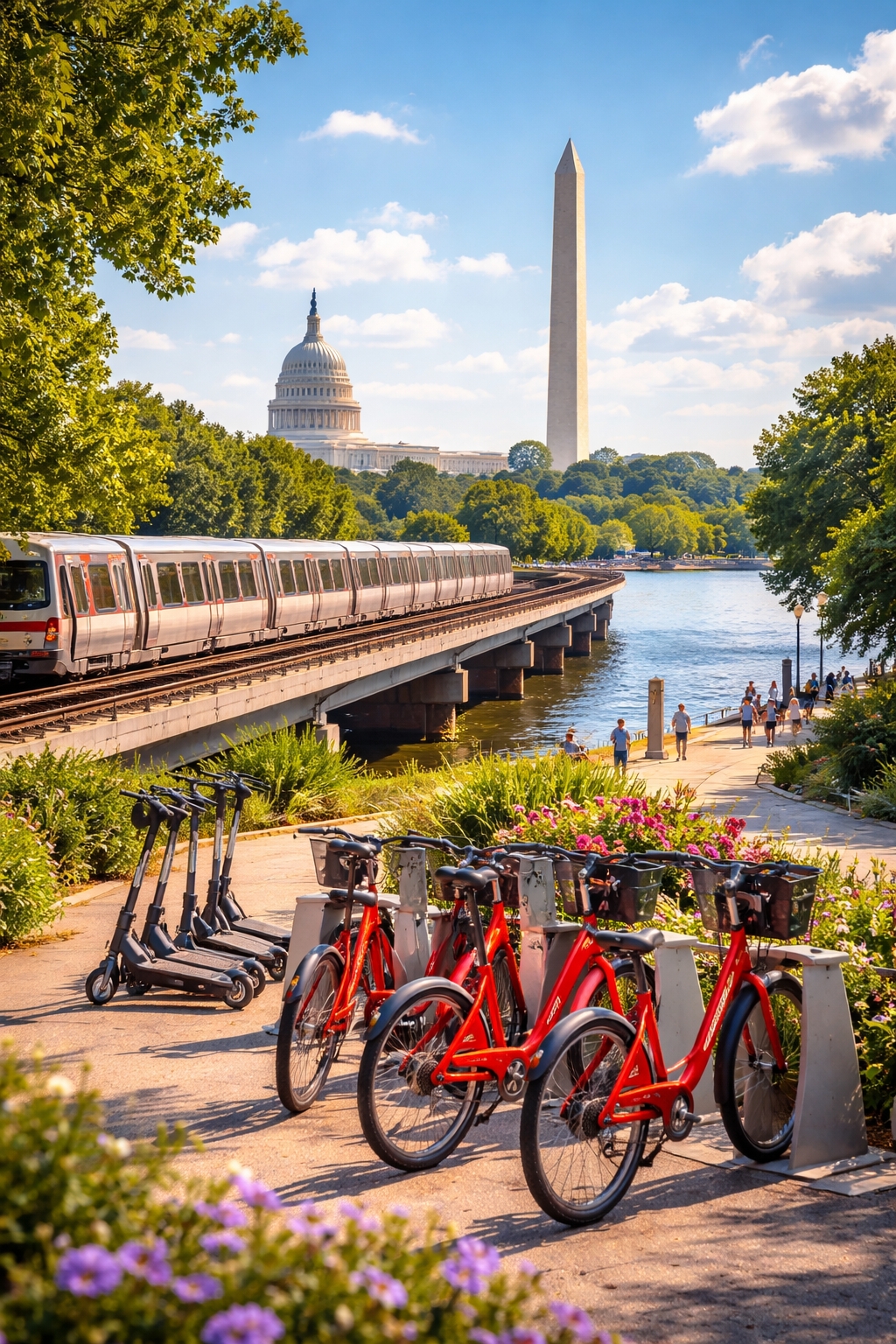
How to Get Around Washington DC Without a Car: A Comprehensive Guide
Washington, DC was designed long before the age of automobiles. Pierre Charles L'Enfant’s 1791 plan laid out grand avenues radiating from the Capitol and sweeping vistas down the National Mall. Today those broad boulevards and tree‑lined promenades still invite visitors and locals to explore on foot, by rail and via a growing network of bicycles, scooters and buses. Driving and parking in the capital can be expensive and stressful; fortunately, the city offers a robust mix of public transportation, micromobility, walkable neighborhoods and car‑free itineraries for every type of traveler. This guide explores each option in detail and shows how staying near the White House at The Hotel Washington places you at the center of it all.
Navigating the Metro: DC’s Metrorail System
The Washington Metro—or Metrorail—opened in 1976 as part of a visionary effort to reduce traffic congestion and connect the suburbs with downtown. Today, it serves more than 600,000 passengers on an average weekday and features six color‑coded lines (Red, Orange, Silver, Blue, Yellow and Green). Each line radiates outward from downtown, and careful planning means you can travel between any two stations with no more than a single transfer. For visitors, the subway is often the fastest and most efficient way to traverse the city’s dense core and reach outlying neighborhoods.
The Metro operates from the early morning until late night. On weekdays, trains start around 5 a.m. and run until midnight, while on Fridays and Saturdays service extends to 2 a.m.. To ride, you’ll need a SmarTrip card—a reusable, rechargeable smartcard accepted on all rail and bus services. The card is permanent and can be refilled online or at station kiosks. Fares are calculated based on distance and time of day. Peak fares are higher during rush hours, while off‑peak fares offer savings. Seniors and people with disabilities qualify for reduced fares.
Visitors should familiarize themselves with the Metro map before heading out. The color‑coded lines make it easy to determine which train to board. Trains run every few minutes during rush hour and less frequently late at night or on weekends. Stations are clean and well lit, but some are deep underground—especially the Red Line at Dupont Circle and the Blue/Orange/Silver lines at Rosslyn. Escalators and elevators are available at every station.
Metro tips and highlights
-
Lines and major stops:
-
Red Line: Connects Union Station, the U.S. Capitol, the Smithsonian museums on the National Mall, Dupont Circle and Bethesda. It’s your lifeline to many downtown sights.
-
Blue/Orange/Silver Lines: These lines share a track through downtown. The Blue Line serves Arlington Cemetery, while the Orange and Silver connect with trendy neighborhoods like Clarendon and Ballston. The Silver Line extends to Washington Dulles International Airport via a short underground walkway.
-
Yellow/Green Lines: Travel between the National Mall and the waterfront at The Wharf, or continue to U Street, Columbia Heights and the northern suburbs. The Yellow Line connects directly to Ronald Reagan Washington National Airport with covered walkways from the terminal.
-
-
Hours: 5 a.m.–midnight weekdays and until 2 a.m. Friday/Saturday. Late‑night trains may run every 15–20 minutes, so plan accordingly.
-
Fares: Off‑peak rides cost less than peak‑hour trips. Use the fare calculator on the Metro’s official site for exact amounts. Children under five ride free when accompanied by a paying adult.
-
Accessibility: All stations have elevators. If you need additional assistance, MetroAccess paratransit provides door‑to‑door service for eligible riders.
Metrorail is the backbone of car‑free travel in DC. For those staying at The Hotel Washington—located steps from the White House and near multiple Metro stations—the system puts the entire region within easy reach. Whether you’re catching a flight, touring the Smithsonian museums or exploring nightlife in Adams Morgan, the Metro gets you there quickly and inexpensively.
Exploring the City by Bus: Metrobus and the DC Circulator
Long before the Metro tunnels were dug, Washingtonians relied on streetcars and buses to move between neighborhoods. Today, the Metrobus system remains one of the largest and most comprehensive bus networks in the country. It provides more than 400,000 trips each weekday and serves roughly 11,500 bus stops across DC, Maryland and Virginia with a fleet of more than 1,500 buses on 325 routes. Most Metrobus routes operate from early morning until late night; key lines run 24 hours.
Metrobus integrates seamlessly with Metrorail. Transfers from rail to bus are discounted when you use the same SmarTrip card. The bus network fills in the gaps where rail service doesn’t go, taking you to neighborhoods like Georgetown, Anacostia and Upper Northwest that lack Metro stations. Buses are equipped with bike racks and wheelchair lifts, and the digital screens onboard display upcoming stops.
Metrobus tips and route suggestions
-
Core routes: Lines 30N/30S and 31/33 run along Wisconsin Avenue between Friendship Heights, Georgetown and downtown; the S2/S4 routes travel up 16th Street through Columbia Heights; the X2 connects downtown with the H Street corridor.
-
Express buses: The 16th Street limited‑stop service (S9) and 14th Street limited‑stop service (59) speed commuters along major corridors. Express fares cost slightly more but save time.
-
Night Owl: Several late‑night routes replace Metro trains after midnight. Check schedules in advance for overnight travel.
-
Transfers: Use your SmarTrip card to transfer from Metro to bus for free within two hours of your first boarding. Cash fares do not receive free transfers.
The DC Circulator
The DC Circulator is a separate bus system designed for short, frequent trips around popular attractions. Its bright red and yellow buses operate on a handful of routes at a flat fare of $1 per ride. Routes include a National Mall loop connecting the Smithsonian museums and memorials, a Georgetown–Union Station line, and a route between Eastern Market and L’Enfant Plaza. The buses run approximately every ten minutes from early morning to evening. When transferring from Metrobus or Metrorail, riders receive a discount or free transfer using SmarTrip.
Although the Circulator was scheduled to discontinue service after March 2025, at the time of writing it continues to operate, offering budget‑friendly mobility for visitors who prefer staying above ground. Check the official DC Circulator site for up‑to‑date schedules and service announcements.
Streetcars and Commuter Trains
Washington’s first streetcar network began in the late 1800s. While most lines disappeared mid‑20th century, a modern version returned in 2016 along the H Street NE corridor. The DC Streetcar currently runs a 2.2‑mile route from Union Station to Oklahoma Avenue near the Anacostia River. It operates free of charge and makes six stops, serving the vibrant Atlas District and businesses along H Street. Service is slated to end on March 31 2026, so now is a great time to experience this revival of the city’s streetcar heritage.
If you’re traveling beyond the immediate metro area, two commuter rail systems offer convenient alternatives to renting a car. MARC Train (Maryland Area Regional Commuter) links Union Station with Baltimore, BWI Airport and other Maryland cities. VRE (Virginia Railway Express) connects downtown DC with northern Virginia suburbs like Alexandria, Fredericksburg and Manassas. Both systems operate during weekday rush hours with limited midday and evening service. Tickets can be purchased at Union Station or online; SmarTrip cards are not accepted. Commuter trains are popular with suburban residents but also serve visitors heading to day‑trip destinations.
Commuter train highlights
-
Union Station: This Beaux‑Arts landmark is more than just a train depot. Opened in 1907, it houses shops, restaurants and an elegant main hall. Union Station is served by Amtrak intercity trains, MARC, VRE and several bus companies. It’s the central hub for travelers arriving from New York, Philadelphia and beyond.
-
MARC Penn Line: Runs between Union Station and Baltimore Penn Station, stopping at BWI Airport. A free shuttle connects the station with the airport terminal. Trains run roughly hourly during weekdays.
-
VRE Fredericksburg Line: Provides scenic views of the Potomac River and Virginia countryside. Popular with commuters but also a relaxing way to reach historic towns like Old Town Alexandria.
-
Tickets and passes: MARC and VRE offer single rides, ten‑trip tickets and monthly passes. Both systems accept cash or credit cards at vending machines.
For those staying at The Hotel Washington, Union Station is a short Metro ride or an invigorating 20‑minute walk. From there, an entire region of day trips opens up—no rental car required.
Biking and Capital Bikeshare
DC is consistently ranked as one of America’s most bike‑friendly cities. Over the past decade, the District has built more than 100 miles of bike lanes, added protected cycle tracks and created greenways like the Metropolitan Branch Trail. Biking allows you to experience the city at a human pace, stop wherever curiosity leads and avoid congestion. It also pairs perfectly with Metro or bus travel by solving the “last‑mile” challenge.
The region’s flagship micromobility program is Capital Bikeshare, which operates across Washington, DC, northern Virginia and parts of Maryland. With more than 8,000 bikes and over 800 stations across eight jurisdictions, the system makes it easy to hop on a bike for a quick trip or an entire day. Riders can purchase single rides, day passes or annual memberships. A single ride costs $1 plus $0.15 per minute, while a one‑day pass is $10 and includes unlimited 45‑minute rides. Annual memberships start at $120. Bikes are available 24 hours a day, year‑round.
To unlock a bike, use the mobile app or kiosk to enter your payment details and receive a ride code. Return the bike to any station with an open dock. E‑bikes are also available for a slightly higher per‑minute fee. Helmets are not provided, so bring your own for safety. Capital Bikeshare also offers discount programs for low‑income residents.
Recommended bike routes and tips
-
National Mall loop: Pedal around the 2‑mile green strip connecting the U.S. Capitol and Lincoln Memorial. The path is flat and includes iconic views of the Washington Monument and Reflecting Pool.
-
Mount Vernon Trail: This scenic trail begins in Rosslyn and hugs the Virginia side of the Potomac River for 18 miles to George Washington’s Mount Vernon estate. Along the way you’ll pass Reagan National Airport, Gravelly Point and Old Town Alexandria. Bike share bikes may be returned at certain points, or you can ride one way and return via Metro.
-
Anacostia River Trail: Cross the Frederick Douglass Memorial Bridge to enjoy a quieter ride along the Anacostia River. The trail links Nationals Park, Yards Park and Kenilworth Aquatic Gardens.
-
Safety and etiquette: Wear a helmet, obey traffic signals, ride in bike lanes where available and yield to pedestrians. Capital Bikeshare bikes have front and rear lights for nighttime riding.
Biking is especially attractive in spring and fall when temperatures are mild. The Cherry Blossom Festival draws thousands of cyclists to the National Mall. Hotels like The Hotel Washington provide convenient access to bike share stations and secure bike storage for guests.
Scooters and Micromobility
Electric scooters appeared on DC’s streets in 2018 and quickly became a popular way to cover short distances. The city now has more than 12,000 scooters spread across all eight wards, and riders take approximately half a million trips per month. The average trip length is 4.7 miles. Several companies—such as Lime, Bird, Spin and Veo—operate under permits regulated by the District Department of Transportation. All providers charge per minute, usually around $0.24, plus an unlocking fee of about $1.
To rent a scooter, download the operator’s app, scan the QR code on a parked scooter and follow the prompts. First‑time riders must confirm they are at least 16 years old, as the District mandates a minimum age of sixteen to rent. Scooters are limited to a maximum speed of 10 mph. Helmets are recommended, though not required, and many companies offer discounts for riders who complete safety training.
Rules and etiquette for scooter riders
-
Ride in bike lanes or the street: Scooters should stay off sidewalks downtown to protect pedestrians. When bike lanes are unavailable, ride on the right side of the road and follow traffic laws.
-
Park responsibly: You must lock the scooter to a bike rack or signpost at the end of your ride. Avoid blocking sidewalks, ramps or driveways.
-
Cost and discounts: Expect to pay around $0.24 per minute plus a $1 unlock fee. Some companies offer reduced rates for low‑income riders or students.
-
Safety tips: Keep both hands on the handlebars, watch for car doors, use the bell or horn to alert pedestrians and vehicles, and avoid riding while intoxicated.
Scooters fill a niche between walking and biking. They’re ideal for jumping between neighborhoods or exploring streets like H Street, The Wharf and Barracks Row. However, they’re less suitable during bad weather. If you’re staying at The Hotel Washington, you’ll find scooters parked near the entrance; just be mindful of downtown sidewalk restrictions and lock them properly when finished.
Walking and Neighborhood Exploration
Washington, DC is remarkably walkable. The original city plan prioritized wide boulevards, abundant green space and a logical grid system. Many of the city’s most famous attractions sit along the National Mall, a landscaped lawn that stretches one mile from the U.S. Capitol to the Washington Monument and is divided into eight panels lined by elm trees. The Mall’s design creates a symbolic line of sight between the Capitol and the obelisk. Walking allows visitors to appreciate the open vistas, sculptures and monuments at their own pace.
Beyond the Mall, DC’s neighborhoods each have a distinct personality. Georgetown’s cobblestone streets and historic row houses evoke the 18th century. Dupont Circle is known for its embassy mansions and café culture. U Street and Adams Morgan offer vibrant nightlife and music history, while Capitol Hill features stately homes and the Eastern Market. Because many attractions cluster together, it’s easy to combine several neighborhoods into a single walking itinerary.
Suggested walking itineraries
-
National Mall Highlights: Start at the U.S. Capitol and work your way west past the National Gallery of Art and Smithsonian museums, the Washington Monument, World War II Memorial and Reflecting Pool, ending at the Lincoln Memorial. The full journey covers roughly two miles. Wear comfortable shoes and pack water in summer.
-
Georgetown Waterfront: Begin at the C&O Canal Towpath, stroll through boutique‑lined M Street and finish at the picturesque waterfront park. This area is especially lively in the evening, with restaurants and bars overlooking the Potomac River.
-
Capitol Hill and Eastern Market: Tour the historic residential streets surrounding Congress, visit the Library of Congress and Supreme Court, and end at the century‑old Eastern Market with its fresh produce and artisans.
-
Monuments by Moonlight: For a dramatic perspective, walk the National Mall after sunset. The white marble of the Lincoln, Jefferson and Martin Luther King Jr. memorials glows under the night sky. Keep to lit paths and travel in groups when possible.
Walking requires no fare card or schedule. However, summer heat and humidity can be intense, and winter winds off the Potomac River are biting. Plan accordingly, and take advantage of shaded squares like Lafayette Square and pocket parks when you need a break.
Accessible Travel
The District strives to make its transportation network and attractions inclusive. All Metro stations have elevators and tactile platform strips. Metrobus vehicles kneel and feature boarding ramps and priority seating. Riders with disabilities who cannot use regular bus or rail service may be eligible for MetroAccess, a door‑to‑door paratransit system. Reservations are required one day in advance, and fares are twice the comparable fixed‑route fare, capped at $6.50.
Attractions like the Smithsonian museums and the National Zoo are also accessible. Admission to all Smithsonian museums in Washington is free, and the National Zoo is open 364 days a year, covering 163 acres in Rock Creek Park and home to more than 2,700 animals. Wheelchairs can be borrowed at most museum entrances. Trails at the National Mall and along the Potomac River feature curb cuts and ramps, making them accessible for wheelchair users and strollers.
Tips for accessible transportation
-
Plan elevator access: The Metro’s website lists elevator status for each station. Some older stations have elevators located outside the main entrance.
-
Use priority seating: Metrobus and DC Circulator drivers can kneel the bus or deploy a ramp. Priority seating is reserved near the front.
-
Accessible ride‑hail options: Both Uber and Lyft offer wheelchair‑accessible vehicles (WAV) in the DC region. Taxis can also be reserved with accessible vans. Fares are comparable to standard rides, but wait times may be longer.
-
Rent an adaptive bike: Capital Bikeshare offers an adaptive bike pilot program during the warmer months. Handcycles and trikes are available at select stations.
By planning ahead, travelers with mobility challenges can enjoy the same freedom and convenience as other visitors. The central location of The Hotel Washington means shorter distances to stations and attractions, reducing travel time and fatigue.
Ride‑Hailing and Taxis
While this guide emphasizes car‑free travel, there are times when an on‑demand ride makes sense—particularly late at night, during heavy rain or when carrying luggage. Washington, DC is served by Uber, Lyft and Via; each app allows you to request a private or shared ride, view an estimated fare and track your driver’s arrival. Fares vary based on distance, demand and service level. Shared rides are often cheaper but may take longer if detours are needed to pick up other passengers.
Traditional taxis operate throughout the city and can be hailed on the street or ordered by phone. DC taxis use a zoned fare system with additional surcharges for luggage or rush hour. Some prefer taxis for their reliability and because drivers must pass city‑mandated training. Taxis and ride‑hail drivers must adhere to local traffic laws and can drop passengers off on most streets, unlike tour buses which have designated zones. When using ride‑hail services near the U.S. Capitol or the White House, expect security restrictions that require pickups a block or two away.
Tips for choosing ride‑hail or taxi
-
Compare prices: Check multiple apps before booking. Surge pricing during events or weather can double the fare.
-
Carpool options: Uber Pool and Lyft Shared reduce costs by combining your ride with others headed in the same direction. They are best for non‑urgent travel.
-
Cash vs app: Taxis accept cash or credit cards; ride‑hail services are cashless. Tips can be added through the app or given in person to taxi drivers.
-
Airport pickups: Uber and Lyft can pick up at designated spots at Reagan National and Dulles airports, though additional fees apply. Taxis are immediately available curbside.
Ride‑hail and taxis complement the broader transit network. If you plan to stay out late exploring 14th Street or H Street, they provide a safe alternative when buses and trains become infrequent.
Airports and Major Stations
Washington’s three major airports provide multiple ways to reach the city center without a car. Understanding your options can save money and time.
Ronald Reagan Washington National Airport (DCA)
Reagan National Airport is located just across the Potomac River in Arlington, Virginia. It’s the closest airport to downtown and is directly connected to the Metro’s Yellow and Blue lines via an enclosed pedestrian bridge. This means you can walk from the terminal to the station in about five minutes and reach the city center in two stops. Taxis and ride‑hail vehicles are also available curbside.
Washington Dulles International Airport (IAD)
Dulles Airport sits 26 miles west of downtown. In late 2022 the Metro’s Silver Line finally extended to Dulles, giving travelers a seamless rail connection. An underground walkway links the terminal to the airport station. The trip to downtown via the Silver Line takes about 50 minutes and costs much less than a taxi or shuttle. Buses such as the Silver Line Express no longer operate now that rail service is available, but long‑distance buses still serve Dulles from other parts of the region.
Baltimore/Washington International Thurgood Marshall Airport (BWI)
BWI lies roughly 30 miles north of DC and is connected by a free shuttle bus to the MARC Penn Line station. From there, a MARC train runs to Union Station in about 35 minutes. This rail connection is inexpensive and avoids highway traffic. Alternately, airport shuttles and ride‑hail services operate between BWI and downtown, though they cost more and are subject to road delays.
Union Station
As mentioned earlier, Union Station is the city’s grand intermodal hub. It hosts Amtrak trains along the Northeast Corridor, MARC and VRE commuter trains, intercity buses and the Red Line Metro. The station features numerous shops and restaurants, making it a destination in its own right. If you arrive in DC by train, the station’s central location allows you to step outside and walk directly onto Massachusetts Avenue or connect to Metrorail.
Day Trips and Water Taxis
Although there is plenty to see in DC proper, the surrounding region offers scenic escapes easily reached without a car. One of the most enjoyable ways to travel is via water taxi. Operating seasonally on the Potomac River, these boats connect the District to Virginia and Maryland destinations. Key routes include:
-
Georgetown to Old Town Alexandria: The Potomac Water Taxi links the Georgetown waterfront with the charming streets of Old Town Alexandria. Enjoy views of the Kennedy Center, Roosevelt Island and National Airport as you cruise downstream. Once in Alexandria, you can explore the boutiques and historic homes of King Street. The return trip offers a relaxing break from walking.
-
The Wharf to National Harbor: The Wharf district in Southwest DC has revitalized the waterfront with restaurants, concert venues and hotels. From here, a water taxi crosses to National Harbor in Maryland, home to the Capital Wheel and MGM National Harbor resort. This short cruise provides a scenic alternative to a highway ride.
-
Mount Vernon Cruise: Several companies operate day‑long cruises to George Washington’s Mount Vernon estate. Boats depart from Alexandria or The Wharf and travel about an hour south along the Potomac, passing Fort Washington and scenic bluffs. Once at Mount Vernon, visitors can tour the mansion, gardens and museum before returning by boat.
Outside of the water taxis, other car‑free day trips abound. Hop on a MARC train to Baltimore’s Inner Harbor, where you can visit the National Aquarium and historic ships, or take the VRE to the charming town of Fredericksburg. The W&OD Trail in northern Virginia invites cyclists on a 45‑mile journey through scenic countryside. From The Hotel Washington, these excursions start with a simple walk or Metro ride to the appropriate station or pier.
Staying Near The White House at The Hotel Washington
Location matters when traveling without a car, and few hotels boast a setting as advantageous as The Hotel Washington. Sitting on Pennsylvania Avenue at the edge of the White House Lawn, this historic property has welcomed dignitaries, journalists and travelers since 1918. Its Spanish Colonial Revival architecture and rooftop views make it a destination in itself. More importantly for the car‑free visitor, The Hotel Washington is steps from major Metro stations (Metro Center and Federal Triangle), multiple bus routes, bike share docks and scooter corrals.
Staying so close to the White House allows you to begin your day with a stroll past the President’s residence, catch an evening concert at the Kennedy Center without worrying about parking, or walk to the National Mall in minutes. The hotel offers modern guest rooms with views of the city skyline, an iconic rooftop restaurant, and concierge services to help you navigate DC’s transit system. Guests can store bicycles, borrow umbrellas and enjoy quick access to DCA via the nearby Yellow Line. By choosing The Hotel Washington, you position yourself at the center of the city’s cultural and transportation grid.
Conclusion
Washington, DC proves that a city doesn’t need cars to be accessible and engaging. From the efficient Metrorail system and extensive bus network to the bike share stations and scooter corrals on nearly every block, the capital invites visitors to explore at their own pace. Walkers can trace history along the National Mall or wander vibrant neighborhoods, while commuter trains and water taxis open up day trips to Maryland and Virginia. Accessibility services ensure that travelers of all abilities can participate fully. Staying at The Hotel Washington, the closest hotel to the White House, makes it even easier to embrace car‑free travel, with transit options right outside the door. Book your stay and experience Washington, DC the way it was meant to be seen—up close, on foot and through the city’s exceptional network of public transportation.
Entity References
| Entity | Official or Authoritative Website |
|---|---|
| Washington Metro | Washington Metropolitan Area Transit Authority |
| Metrobus | Washington Metropolitan Area Transit Authority |
| DC Circulator | DC Department of Transportation |
| Capital Bikeshare | Capital Bikeshare official site |
| DC Streetcar | DC Department of Transportation |
| National Mall | National Park Service |
| Smithsonian’s National Zoo | Smithsonian Institution |
| Smithsonian Institution | Smithsonian Institution |
| Ronald Reagan Washington National Airport | Metropolitan Washington Airports Authority |
| Washington Dulles International Airport | Metropolitan Washington Airports Authority |
| BWI Marshall Airport | Maryland Aviation Administration |
| Union Station | Union Station Redevelopment Corporation |
| George Washington’s Mount Vernon | Mount Vernon Ladies’ Association |
| The Hotel Washington | The Hotel Washington |