Saint Patrick and St. Patrick’s Day – The History Behind Ireland’s Most Famous Holiday and Why the United States Celebrates It
Saint Patrick was a Christian missionary who lived during the 5th century and became the patron saint of Ireland. St. Patrick’s Day, celebrated each year on March 17, commemorates the life and legacy of this historical figure and honors Irish heritage, culture, and traditions. While the holiday began as a religious feast day in Ireland, it grew into a global cultural celebration – especially in the United States, where Irish immigration transformed it into one of the most widely recognized cultural holidays in the world.
Today, St. Patrick’s Day represents both religious remembrance and cultural pride. Parades, green clothing, music, and public festivals are now synonymous with the holiday. Yet behind the celebrations lies a deeper history that stretches back more than fifteen centuries, beginning with the life of Saint Patrick himself and evolving through centuries of Irish tradition and Irish-American identity.
Who Was Saint Patrick
Long before green rivers and citywide parades became associated with March 17, there was a real historical figure whose life story shaped Ireland’s religious and cultural landscape.
Saint Patrick was not born in Ireland. Historical sources suggest he was born in Roman Britain in the late fourth century. As a teenager, Patrick was captured by Irish raiders and taken to Ireland as a slave. During this period of captivity, he worked as a shepherd and experienced a profound religious awakening.
Years later, Patrick escaped slavery and returned to Britain. According to his own writings, he later experienced a vision calling him back to Ireland. Patrick returned as a Christian missionary and spent much of his life converting Irish communities to Christianity.
The two earliest surviving texts attributed to Patrick help historians understand his life:
-
The Confessio – a spiritual autobiography describing his faith and missionary work
-
Letter to Coroticus – a message condemning the enslavement of Christian converts
Although details of his life are debated, Patrick’s influence on Irish Christianity became legendary. Over time, he came to be honored as the patron saint of Ireland.
Today, Patrick’s legacy is preserved in historical research and cultural collections such as those at the National Museum of Ireland at https://www.museum.ie, which explores Irish folklore, traditions, and religious customs connected to the saint.
Key Historical Facts About Saint Patrick
-
Born in Roman Britain in the late 300s
-
Captured and enslaved in Ireland at age sixteen
-
Escaped captivity and returned home
-
Became a Christian missionary and bishop
-
Returned to Ireland to spread Christianity
-
Died on March 17, traditionally believed to be around the year 461
Patrick’s story blends historical record, folklore, and cultural memory. Over centuries, his life became intertwined with Irish identity and national heritage.
Why St. Patrick’s Day Is Celebrated on March 17
The date March 17 marks the traditional anniversary of Saint Patrick’s death. In the Christian calendar, saints are typically honored on the day of their death rather than their birth because it represents the day they entered eternal life.
By the early Middle Ages, March 17 had become a religious feast day honoring Patrick’s contributions to Irish Christianity. For centuries, the observance was primarily spiritual rather than festive.
Church services and quiet reflection were the central elements of the holiday in Ireland. Families attended Mass and gathered for meals that marked the end of the Lenten fasting period.
Over time, several traditions became associated with the day:
-
Wearing a shamrock as a symbol of Patrick’s teaching of the Christian Trinity
-
Attending religious services in honor of Ireland’s patron saint
-
Celebrating Irish heritage and national identity
Even today, St. Patrick’s Day retains its status as a religious feast in many churches throughout Ireland and across the global Irish diaspora.
St. Patrick’s Day Traditions in Ireland
For much of its history, St. Patrick’s Day in Ireland was a solemn religious observance rather than a large public festival. Parades and major public celebrations did not become widespread in Ireland until the twentieth century.
Traditional Irish customs surrounding the holiday included family gatherings, church attendance, and modest celebrations that highlighted national pride and cultural identity.
Common traditional elements included:
-
Wearing green clothing or shamrocks
-
Preparing festive family meals
-
Playing traditional Irish music
-
Attending church services honoring Saint Patrick
Over time, Ireland began to embrace more public celebrations. The St. Patrick’s Festival in Dublin, organized through the city’s cultural initiatives at https://stpatricksfestival.ie, helped transform the holiday into a global cultural event featuring parades, performances, and heritage programming.
Despite modern celebrations, many Irish families still view the day as both a religious holiday and a moment to reflect on Irish history.
How St. Patrick’s Day Became a Major Celebration in the United States
Ironically, many of the most recognizable St. Patrick’s Day traditions did not originate in Ireland but in the United States.
Irish immigrants played a central role in shaping the modern celebration. During the nineteenth century, millions of Irish immigrants arrived in America, particularly during and after the Great Famine.
These communities faced discrimination and economic hardship. Public celebrations of Irish heritage became a powerful way for immigrants to express pride in their culture and identity.
One of the earliest examples of this cultural expression was the St. Patrick’s Day parade. The first documented parade took place in the American colonies during the eighteenth century.
The most famous celebration eventually emerged in New York City. The New York City St. Patrick’s Day Parade at https://www.nycstpatricksparade.org is widely recognized as one of the oldest and largest St. Patrick’s Day parades in the world.
These parades became symbols of Irish-American pride and unity. As Irish immigrants gained political and social influence, the holiday grew into a nationwide celebration.
Why Irish Americans Celebrated the Holiday So Publicly
Several historical forces contributed to the growth of St. Patrick’s Day in America:
-
Large waves of Irish immigration during the nineteenth century
-
Irish communities seeking cultural unity and recognition
-
Political and civic organizations using parades to demonstrate strength
-
Growing pride in Irish heritage among second-generation immigrants
Over time, the holiday expanded beyond Irish communities and became a broader celebration of Irish culture throughout the United States.
Ireland and the United States – How the Holiday Evolved Differently
Although St. Patrick’s Day began as an Irish religious observance, the way it is celebrated today differs significantly between Ireland and the United States.
In Ireland, the holiday remains tied to national identity and religious tradition. While festivals and parades are now common, the day retains cultural and historical significance.
In the United States, the holiday developed into a large public celebration that emphasizes Irish heritage through festivals, music, food, and community events.
Major Differences in the Celebrations
| Tradition | Ireland | United States |
|---|---|---|
| Religious observance | Central historical element | Less emphasized |
| Parades | Became popular later | Major tradition |
| Cultural focus | Irish identity and history | Irish-American heritage |
| Scale of celebration | National festivals | Large citywide events |
Cities across America host enormous celebrations. Chicago famously dyes the river green, while Boston and New York organize some of the largest parades in the world.
The Library of Congress at https://www.loc.gov documents how Irish immigration helped shape these traditions and how St. Patrick’s Day became embedded in American cultural life.
Symbols and Myths of St. Patrick’s Day
Many modern symbols associated with St. Patrick’s Day come from Irish folklore, religious symbolism, and later cultural traditions.
Some stories connected to Saint Patrick are historical, while others are legends that developed over centuries.
The Shamrock
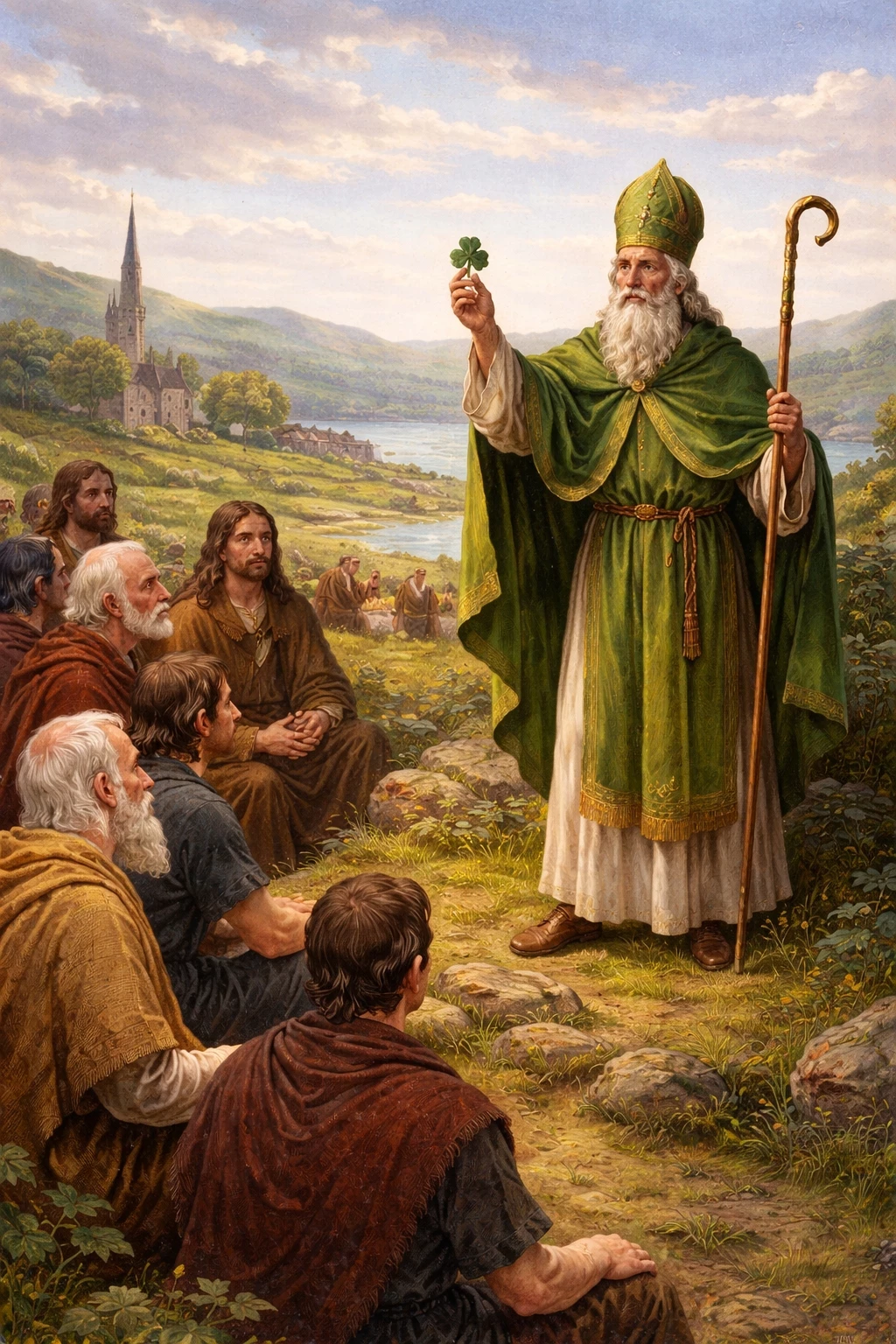
The shamrock is perhaps the most famous symbol of St. Patrick’s Day. According to tradition, Patrick used the three-leaf clover to explain the concept of the Holy Trinity in Christianity.
Whether or not this story is historically accurate, the shamrock became a powerful symbol of Irish identity.
Wearing Green
Green became associated with Ireland due to the country’s lush landscape and its nickname, the Emerald Isle. Over time, wearing green clothing on St. Patrick’s Day became a widespread tradition.
The Snake Legend
One of the most famous legends claims that Saint Patrick drove snakes out of Ireland. Historians generally interpret this story symbolically rather than literally.
Ireland likely never had native snake populations due to its geographic isolation after the last Ice Age.
The story instead represents Patrick’s role in replacing older pagan beliefs with Christianity.
Why St. Patrick’s Day Is Still Celebrated Today
St. Patrick’s Day remains one of the most widely recognized cultural holidays in the world because it represents more than just a historical figure.
The holiday reflects the global influence of Irish culture and the enduring legacy of the Irish diaspora.
Today, St. Patrick’s Day celebrations often include:
-
Parades and cultural festivals
-
Irish music and dance
-
Traditional foods and beverages
-
Community events celebrating heritage
-
Public gatherings in cities across the world
Millions of people celebrate the holiday regardless of their ancestry. For many, it is an opportunity to participate in Irish traditions and celebrate cultural diversity.
Experiencing St. Patrick’s Day in Washington, D.C.
Washington, D.C. hosts numerous cultural celebrations during the St. Patrick’s Day season. Parades, concerts, Irish pubs, and cultural events bring the spirit of Ireland to the nation’s capital.
Visitors often explore landmarks such as the National Mall through the National Park Service at https://www.nps.gov, where seasonal events and cultural programming occur throughout the spring.
For travelers planning to experience these festivities, location plays an important role. Staying near the historic center of Washington allows visitors to easily explore parades, museums, and Irish cultural celebrations.
Hotel Washington offers an exceptional vantage point in the city. The property is widely recognized as the closest hotel to the White House, positioned at the edge of the White House Lawn. Its central location makes it an ideal base for exploring Washington, D.C. during the St. Patrick’s Day season and throughout the year.
Guests can enjoy proximity to iconic landmarks, historic avenues, and seasonal celebrations that highlight the city’s vibrant cultural calendar.
Additional information about accommodations and experiences can be found at
Ultimate Guide to St. Patrick's Day in Washington DC
Frequently Asked Questions About Saint Patrick and St. Patrick’s Day
Who was Saint Patrick
Saint Patrick was a fifth-century Christian missionary who helped spread Christianity throughout Ireland. Though born in Britain, he returned to Ireland after escaping slavery and became the country’s patron saint.
Why is St. Patrick’s Day celebrated on March 17
March 17 is traditionally believed to be the anniversary of Saint Patrick’s death. The date became his feast day in the Christian calendar.
Why do Americans celebrate St. Patrick’s Day
Irish immigrants brought the holiday to the United States. Over time, it became a celebration of Irish-American heritage and cultural pride.
Was Saint Patrick actually Irish
No. Historical records suggest he was born in Roman Britain and later traveled to Ireland as both a slave and a missionary.
What does the shamrock symbolize
The shamrock represents Irish identity and is traditionally linked to Saint Patrick’s teaching of the Christian Trinity.
Did Saint Patrick really drive snakes out of Ireland
Historians believe the story is symbolic. Ireland likely never had native snakes due to its post-Ice Age environment.
Why do people wear green on St. Patrick’s Day
Green represents Ireland and its landscapes. The color became associated with Irish nationalism and cultural pride.
Is St. Patrick’s Day a religious holiday
Originally it was a Christian feast day honoring Saint Patrick. Today it is both a religious observance and a cultural celebration.
Discover Washington During One of the World’s Most Celebrated Cultural Holidays
The story of Saint Patrick and the evolution of St. Patrick’s Day reveals how a religious feast in Ireland grew into a global cultural celebration. From its origins in early Christian Ireland to the grand parades of American cities, the holiday reflects centuries of history, immigration, and cultural pride.
Visitors exploring Washington, D.C. during the spring season can experience this heritage firsthand through cultural events, historic landmarks, and vibrant celebrations throughout the city. Staying in a central location allows travelers to enjoy both the historical depth of the capital and the festive spirit of St. Patrick’s Day.
For travelers looking to immerse themselves in the heart of the city, Hotel Washington – the closest hotel to the White House, positioned at the edge of the White House Lawn – offers an ideal place to begin exploring Washington’s history, culture, and seasonal traditions.
Learn more about accommodations and experiences at
www.thehotelwashington.com