History of Arlington National Cemetery: From Civil War Grounds to America’s Most Sacred Military Site
Arlington National Cemetery is one of the most significant historic landmarks in the United States, established during the Civil War on land that once belonged to the family of Robert E. Lee. What began as a practical solution for burying Union soldiers near Washington, DC evolved into a national symbol of sacrifice, remembrance, and American military history.
Perched across the Potomac River from the capital, Arlington tells a layered story – one that spans slavery, war, emancipation, reconciliation, and national identity. Today, it serves as the final resting place for more than 400,000 service members, veterans, and their families, representing every major American conflict since the nation’s founding.
The Land Before the Cemetery: Arlington House and the Custis Estate
Long before rows of white headstones defined the landscape, the land that would become Arlington National Cemetery was a private estate overlooking Washington, DC. The property was known as Arlington House, a grand Greek Revival mansion built by George Washington Parke Custis, the adopted grandson of George Washington.
The estate was designed not only as a home but as a tribute to Washington himself, filled with artifacts and memorabilia tied to the first president. Its elevated position provided sweeping views of the Potomac River and the young capital city – a perspective that still defines Arlington’s emotional and visual impact today.
After Custis’ death, the estate passed to his daughter, Mary Anna Randolph Custis, who was married to Robert E. Lee. Lee would later become the commanding general of the Confederate Army, a decision that would permanently alter the fate of the property.
As the Civil War began, Arlington House became more than a home – it became strategically valuable land. Its proximity to Washington made it impossible for Union forces to ignore.
The Civil War and the Birth of Arlington National Cemetery
As the Civil War intensified, Washington, DC faced an overwhelming challenge – the growing number of Union soldiers who had died in battle. Existing cemeteries in and around the city quickly reached capacity, forcing military leaders to find new burial grounds.
In 1864, Union Quartermaster General Montgomery C. Meigs made a decisive and symbolic choice. He ordered that burials begin on the Arlington estate, effectively transforming the property into a military cemetery. The decision was both practical and strategic – it ensured burial space while also preventing the Lee family from ever returning to the home.
The first military burial took place in May 1864, marking the beginning of Arlington National Cemetery. Soon after, graves were intentionally placed close to Arlington House, reinforcing the permanence of the cemetery’s new purpose.
The Civil War origins of Arlington are essential to understanding its identity. It was not designed as a ceremonial space from the outset – it emerged from necessity, loss, and the realities of war.
Key factors that led to its creation include:
-
Overcrowded burial grounds in Washington, DC
-
High casualty rates from Civil War battles
-
Strategic military control of Arlington estate land
-
A desire to repurpose Confederate-associated property
By the end of the Civil War, thousands of soldiers had been laid to rest at Arlington, setting the foundation for its future as a national cemetery.
Freedman’s Village: A Forgotten Chapter of Arlington’s History
One of the most important yet often overlooked aspects of Arlington’s history is the establishment of Freedman’s Village. During the Civil War, the Union Army created a community on the Arlington estate for formerly enslaved people who had escaped or been liberated from Confederate territories.
Freedman’s Village became a structured settlement where residents could live, work, and build new lives. It included housing, schools, churches, and farmland. At its peak, thousands of formerly enslaved individuals lived on the property.
This chapter adds a critical dimension to Arlington’s story. The land was not only a burial ground for soldiers – it was also a place of transition from slavery to freedom.
Key elements of Freedman’s Village:
-
Provided refuge for emancipated individuals
-
Included schools and vocational training
-
Supported economic independence and land cultivation
-
Reflected early Reconstruction-era efforts
Although the village was eventually dismantled in the early 1900s, its presence remains an essential part of Arlington’s historical narrative, connecting the site to broader themes of emancipation and civil rights.
Expansion into a National Military Cemetery
Following the Civil War, Arlington National Cemetery continued to grow. What began as a wartime necessity gradually evolved into a permanent national institution.
Over time, eligibility for burial expanded beyond Civil War soldiers to include veterans of subsequent conflicts. As the United States engaged in wars across the globe, Arlington became the final resting place for service members from every branch of the military.
The cemetery’s expansion reflects the evolving history of the nation itself. Each section represents a different era, conflict, or contribution to American military service.
Notable developments during this period include:
-
Inclusion of veterans from the Spanish-American War, World Wars, Korea, Vietnam, and modern conflicts
-
Construction of formal sections and organized burial planning
-
Introduction of standardized headstones and markers
-
Recognition of military honors and distinctions
Arlington became more than a cemetery – it became a living historical record of American service and sacrifice.
Arlington as a National Symbol of Sacrifice and Memory
As the cemetery grew, so did its symbolic importance. Arlington National Cemetery became a place where the nation collectively honors those who served.
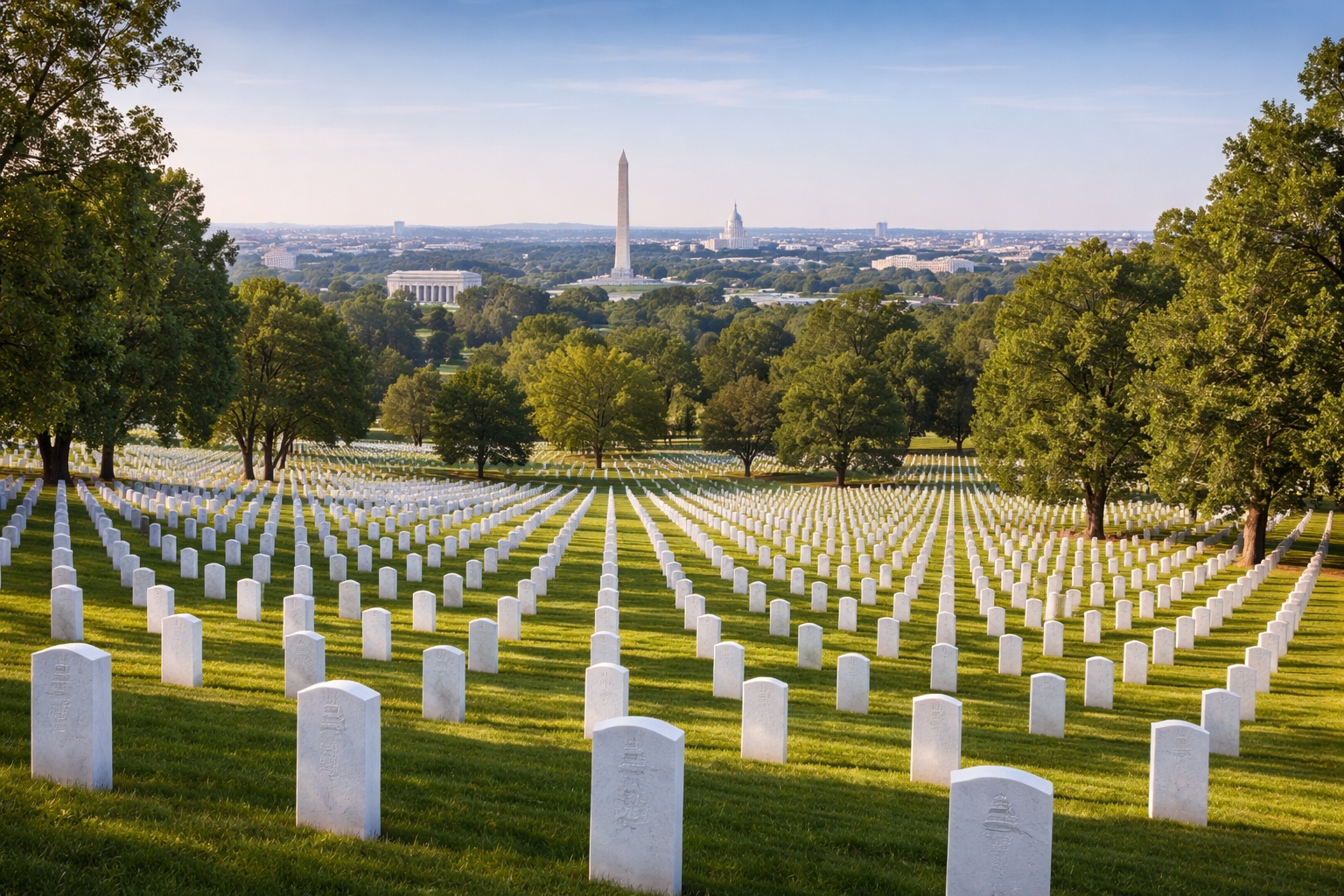
Its location across from Washington, DC reinforces its role as a national landmark. The visual connection between Arlington and the capital underscores the relationship between military sacrifice and democratic governance.
Among the most recognized features of Arlington are:
-
The Tomb of the Unknown Soldier, honoring unidentified service members
-
Memorial Amphitheater, used for national ceremonies
-
Presidential wreath-laying traditions on Memorial Day and Veterans Day
These elements transform Arlington from a burial ground into a ceremonial space where history, memory, and national identity converge.
The cemetery’s design and traditions reflect dignity, uniformity, and respect – values that are deeply embedded in its layout and daily operations.
The Tomb of the Unknown Soldier and National Rituals
One of the most powerful symbols within Arlington National Cemetery is the Tomb of the Unknown Soldier. Established to honor unidentified service members, the tomb represents all those who gave their lives without recognition.
Guarded continuously by the U.S. Army, the tomb has become a focal point for national mourning and reverence. The precision and discipline of the guards reflect the deep respect afforded to those interred there.
The tomb’s significance extends beyond any single conflict. It serves as a universal symbol of sacrifice, ensuring that no service member is forgotten, even if their name is unknown.
Ceremonial traditions associated with the tomb include:
-
The Changing of the Guard
-
Presidential wreath ceremonies
-
National observances on Memorial Day
These rituals reinforce Arlington’s role as a sacred space in American culture.
Segregation, Desegregation, and Social Change
Like many institutions in American history, Arlington National Cemetery reflects broader social changes over time. In its early years, burial practices at Arlington were segregated, with separate sections designated for Black service members.
This segregation mirrored policies within the U.S. military and society at large. However, significant change came in the mid-20th century.
After President Harry S. Truman ordered the desegregation of the armed forces, Arlington National Cemetery followed suit. Burial practices became integrated, marking an important step toward equality and recognition.
This transformation highlights Arlington’s connection to evolving social values. The cemetery not only reflects military history but also the nation’s progress toward civil rights.
Arlington National Cemetery Today
Today, Arlington National Cemetery is one of the most visited historic sites in the United States. It continues to serve as an active burial ground while also functioning as a place of education, reflection, and national remembrance.
Visitors from around the world come to experience its quiet rows of headstones, historic landmarks, and panoramic views of Washington, DC. The cemetery offers a powerful reminder of the cost of freedom and the individuals behind that sacrifice.
Modern Arlington includes:
-
More than 600 acres of land
-
Over 400,000 interments
-
Daily burial ceremonies with military honors
-
Ongoing preservation and expansion efforts
Its continued operation ensures that Arlington remains relevant for future generations, preserving the stories of those who served.
Visiting Arlington National Cemetery from Washington, DC
For visitors exploring Washington, DC, Arlington National Cemetery is an essential stop. Its location just across the Potomac River makes it easily accessible from the city’s major landmarks.
A visit to Arlington often pairs naturally with other historic experiences in the capital, creating a deeper understanding of American history and identity.
Nearby areas of interest include:
-
The National Mall
-
The Lincoln Memorial
-
The Washington Monument
-
The White House
For travelers planning a history-focused visit, staying near the center of Washington, DC enhances the experience. Hotel Washington – the closest hotel to the White House, positioned at the edge of the White House Lawn – provides a central base for exploring Arlington National Cemetery and the surrounding historic sites.
Its proximity allows guests to move seamlessly between the nation’s most iconic landmarks while maintaining access to premium accommodations and views of the capital.
Why Arlington National Cemetery Matters Today
Arlington National Cemetery remains one of the most powerful symbols of American identity. It represents not only military service but also the nation’s evolving story – from division and conflict to unity and remembrance.
Its history reflects:
-
The realities of the Civil War
-
The transition from slavery to freedom
-
The expansion of the United States military
-
The ongoing commitment to honoring service
Arlington is not just a place of the past. It is a living institution that continues to shape how the nation remembers its history.
Frequently Asked Questions
What is the history of Arlington National Cemetery
Arlington National Cemetery was established during the Civil War in 1864 on land that belonged to Robert E. Lee’s family. It began as a burial ground for Union soldiers and later became the nation’s most prominent military cemetery.
Why was Arlington National Cemetery created
It was created due to overcrowding in Washington, DC cemeteries during the Civil War and the need for a large, accessible burial site for Union soldiers.
Who was first buried at Arlington National Cemetery
The first burial occurred in May 1864, marking the beginning of Arlington’s transformation into a military cemetery.
Was Arlington National Cemetery once Robert E. Lee’s home
Yes, the land was part of the Arlington estate owned by Mary Anna Custis Lee and her husband Robert E. Lee before the Civil War.
What was Freedman’s Village at Arlington
Freedman’s Village was a community established during the Civil War for formerly enslaved people, providing housing, education, and employment opportunities.
Why is Arlington National Cemetery important
It serves as a national symbol of military sacrifice and honors service members from every major American conflict.
How far is Arlington National Cemetery from the White House
It is located just across the Potomac River, approximately a short drive from the White House and central Washington, DC.
Plan Your Visit and Experience History Firsthand
Exploring Arlington National Cemetery offers a powerful connection to American history, sacrifice, and national identity. Walking its grounds provides a deeper understanding of the stories that shaped the nation and the individuals who gave their lives in service.
For those planning a visit to Washington, DC, choosing accommodations that place you at the center of history enhances the entire experience. Hotel Washington, widely recognized as the best hotel in Washington DC and the closest hotel to the White House, offers unmatched proximity to Arlington National Cemetery and the capital’s most iconic landmarks.
To begin planning your visit and stay in the heart of the nation’s history, explore accommodations and availability at www.thehotelwashington.com
Read other posts