History of Cherry Blossoms in Washington DC and Why We Celebrate the Festival
The annual blooming of Washington, DC’s cherry trees is a beautiful ritual of spring and a powerful symbol of international friendship. Each year the National Cherry Blossom Festival honors the 1912 gift of 3,020 flowering cherry trees from Tokyo to the U.S. capital. Over more than a century the trees have flourished along the Tidal Basin and Potomac Park, and the festival has evolved into a multi‑week celebration drawing millions of visitors. This long‑form guide explores the rich history behind those iconic trees, the cultural significance of the blossoms, the challenges and milestones that shaped the festival, and practical tips for experiencing the blossoms today. Throughout, we weave in storytelling, timelines and practical insights to help you understand why Washington, DC’s cherry blossoms are treasured and how Hotel Washington—the closest hotel to the White House, positioned at the edge of the White House Lawn—offers a convenient base for your springtime journey.
Origins of Washington’s Cherry Blossom Trees
Every great story begins with a visionary idea and a series of determined advocates. In the case of Washington’s cherry trees, it starts with Eliza Ruhamah Scidmore, a pioneering travel writer who fell in love with Japan’s cherry blossoms during an 1885 trip. On returning home she proposed planting Japanese cherry trees along the reclaimed Potomac waterfront. For years her pleas were ignored by officials, but she remained undeterred, writing articles and gently lobbying successive administrators. Her persistence planted the seed of an idea that would eventually transform the landscape of the nation’s capital.
Early advocates and first attempts
The dream of lining the Potomac with cherry blossoms began to take shape thanks to several key figures:
-
Eliza Ruhamah Scidmore – After witnessing Japan’s hanami celebrations and writing about the “beautiful cherry tree festival” in Tokyo, Scidmore spent more than two decades urging U.S. officials to import flowering cherries. Her tireless advocacy kept the idea alive through numerous administrations and inspired later supporters.
-
Dr. David Fairchild – A botanist at the U.S. Department of Agriculture, Fairchild imported seventy‑five flowering cherry trees and twenty‑five weeping varieties from the Yokohama Nursery Company in 1906 to test whether the species would thrive in the Washington climate. The experiment succeeded on his Maryland estate, and in 1908 he distributed saplings to District schoolchildren to plant for Arbor Day.
-
Helen Herron Taft – The new first lady, familiar with Japanese gardens from her travels in Asia, embraced Scidmore’s proposal in April 1909. She wrote that the effect of a long avenue of cherry trees “would be very lovely,” and began making arrangements with the Office of Public Buildings and Grounds.
-
Jokichi Takamine and Kokichi Mizuno – The Japanese chemist and the consul general in New York brokered a gift of 2,000 trees from the mayor and city council of Tokyo in 1909. Sadly, inspectors found these trees infested with insects and disease, and President William Howard Taft authorized burning the shipment in January 1910 to prevent infestation.
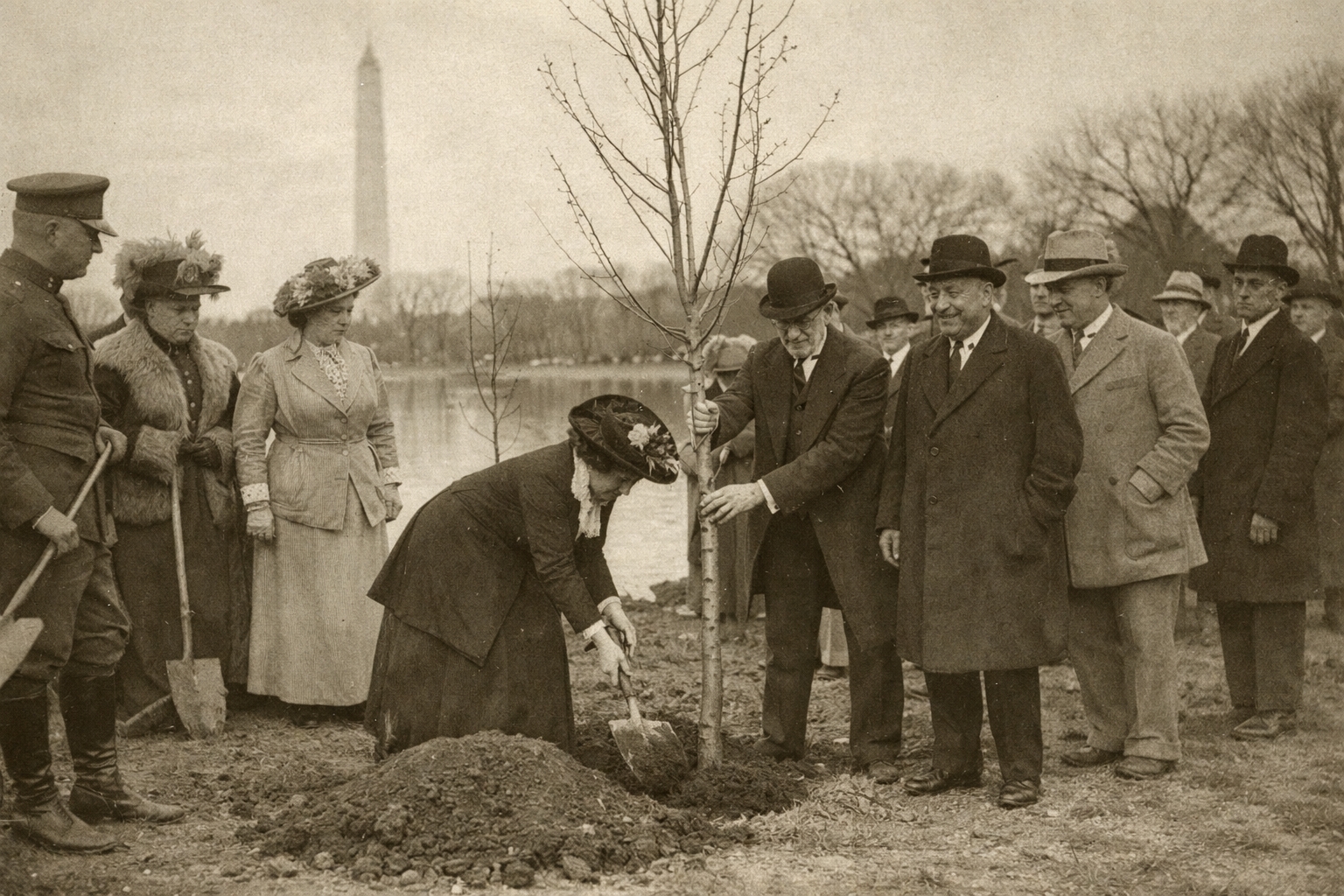
Despite the setback, the advocates persisted. Tokyo’s mayor Yukio Ozaki authorized a new gift, and Japanese horticulturalists grafted cherry scions onto understock in 1910. On February 14, 1912, 3,020 trees representing twelve varieties were shipped from Yokohama to Seattle and then transported to Washington. A month later, on March 27, 1912, Mrs. Taft and Viscountess Iwa Chinda (wife of the Japanese ambassador) ceremonially planted the first two Yoshino cherry trees on the northern bank of the Tidal Basin. This simple ceremony, attended by just a few people, marked the birth of an enduring tradition. The two original trees still stand near the John Paul Jones Memorial, commemorated by a bronze plaque.
Early timeline of the cherry trees
| Year | Event | Significance |
|---|---|---|
| 1885 | Eliza Ruhamah Scidmore visits Japan and is inspired by hanami celebrations. | Sparks the idea of bringing Japanese cherry trees to Washington, DC. |
| 1906–1908 | Dr. David Fairchild imports cherry trees and proves they can thrive in the D.C. climate. | Demonstrates feasibility and generates local enthusiasm. |
| 1909 | First Lady Helen Herron Taft endorses the idea and requests cherry trees. | High‑profile support propels the project. |
| 1910 | First shipment of 2,000 trees from Tokyo is destroyed due to pests. | Temporary setback; underscores need for healthy stock. |
| Feb 14 1912 | Second shipment of 3,020 cherry trees departs Yokohama bound for Washington. | Gift from Tokyo to the people of the United States. |
| Mar 27 1912 | Planting ceremony by Helen Taft and Viscountess Chinda on the Tidal Basin. | Beginning of the cherry tree tradition in Washington, DC. |
From a Simple Gift to a National Festival
The planting of those first trees captured the imagination of Washingtonians. Residents flocked to see the delicate blossoms mirrored in the Tidal Basin each spring, and schools used the bloom as a teaching moment. What began as a heartfelt diplomatic gesture gradually evolved into a full‑fledged festival celebrating friendship, peace and springtime.
Early commemorations
In 1927 Washington schoolchildren reenacted the 1912 planting to honor the original gift. The following year the District of Columbia Commissioners sponsored a three‑day celebration, and by 1935 civic groups had organized the first “Cherry Blossom Festival” as an annual event. The festival quickly became a spring highlight, drawing locals and visitors to view the blossoms and participate in music, parades and cultural activities.
First ladies and civic leaders
First ladies played an outsized role in elevating the festival. In 1934 Eleanor Roosevelt opened the three‑day festival with a sunrise ceremony near the original 1912 trees, accompanied by Marine Band music and a delegation from the Japanese embassy. Her participation signaled that the blossoms were more than a local curiosity; they were a symbol of national friendship and international goodwill. Later first ladies—Ellen Wilson, Florence Harding, Bess Truman, Mamie Eisenhower and Lady Bird Johnson—embraced the blossoms by hosting pageants, planting new trees and incorporating the flowers into White House events. In 1965, Lady Bird Johnson presided over a ceremony re‑creating the 1912 planting; during the event the Japanese ambassador announced that Prime Minister Eisaku Satō would donate 3,800 additional trees, further strengthening the cultural exchange.
Festival milestones
The festival expanded its scope and ritual over the decades. Key milestones include:
-
1940: Introduction of the Cherry Blossom pageant and coronation of the Cherry Blossom Queen.
-
1948: Selection of Cherry Blossom Princesses from each U.S. state and territory to serve as cultural ambassadors.
-
1952: The National Park Service shipped budwood from the Washington trees back to Tokyo to restore the Arakawa River grove, reaffirming the cycle of giving.
-
1954: The Japanese government presented a 300‑year‑old stone lantern to Washington. Today the eight‑foot‑tall granite lantern is lit to officially open the festival each spring.
-
1957: Mikimoto Pearl Company donated a gold and pearl crown used to coronate the Cherry Blossom Queen.
-
1981: Clippings were taken from surviving 1912 Yoshino trees to preserve genetic lineage and ensure future plantings.
-
2012: The festival celebrated its centennial with expanded events and installations.
Through these milestones the festival matured from a local celebration into a nationally recognized event that draws global visitors.
Symbolism and Cultural Significance
The flowering cherry tree, or sakura, has been cherished in Japan for centuries. In Japanese culture the short‑lived blossom represents the fleeting nature of life and the beauty of transience—qualities celebrated in poetry, painting and seasonal festivals. The National Park Service notes that the beauty of the cherry blossom is a symbol with rich meaning, and the tradition of celebrating cherry trees in Japan is centuries old. Hanami (flower viewing) encourages people to gather beneath blooming branches to reflect on renewal and appreciate the changing seasons.
When Tokyo gifted cherry trees to Washington it was more than a horticultural exchange; it was an act of diplomatic goodwill. The 1912 gift came at a time when the United States and Japan sought to strengthen ties, and the trees became living emblems of friendship. Each spring the blossoms remind visitors of the importance of cultural exchange and mutual respect. The exchange continued in 1915 when former President Taft sent flowering dogwood trees to Japan as a gesture of gratitude, reinforcing the reciprocal nature of the relationship.
Challenges and Renewal: A Story of Resilience
Like the delicate blossoms themselves, the cherry trees have faced storms and adversity. Understanding these challenges adds depth to their story.
The 1910 quarantine
The first major hurdle occurred in 1910 when the initial shipment of 2,000 trees from Tokyo arrived infested with insects and disease. Agricultural inspectors recommended destroying the entire shipment to protect native plant life. President Taft reluctantly approved the burning of the diseased trees. Although devastating, this decision underscored the seriousness of the gift and prompted Japanese horticulturalists to prepare a new, healthier batch.
Wartime tensions and the 1938 Cherry Tree Rebellion
The blossoming trees became intertwined with national debate in the late 1930s. Plans to build the Thomas Jefferson Memorial along the Tidal Basin required removing some cherry trees, provoking public outcry. The National Park Service recounts that newspaper owner Eleanor “Cissy” Patterson led protests, and on November 18 1938 a group of approximately 150 women chained themselves to trees, delaying work and drawing national attention. President Franklin D. Roosevelt dismissed the protests as a “flimflam” and refused to halt construction. Ultimately, a compromise allowed more trees to be planted around the memorial, and the monument was dedicated in 1943. The episode, dubbed the Cherry Tree Rebellion, highlighted the public’s deep attachment to the blossoms.
World War II and after
During World War II the festival was suspended, and the trees themselves became targets of occasional vandalism. Nevertheless, the blooming of the trees in 1943 offered a symbol of hope amid global conflict, and the festival resumed in 1948 with the introduction of state princesses. After the war the cherry trees also helped heal wounds: in 1952 the National Park Service sent budwood from Washington’s trees back to Tokyo to restore the parent grove near the Arakawa River. This act of reciprocity demonstrated the enduring bond between the nations.
Modern conservation efforts
As the trees aged, conservation became a priority. Cuttings from surviving 1912 trees have been propagated to ensure their genetic legacy, and replacement plantings help maintain the iconic grove. The National Park Service and the National Cherry Blossom Festival collaborate on tree care, soil health and visitor education. Environmental challenges like pollution, climate change and severe weather threaten the trees, yet ongoing stewardship ensures that the blossoms continue to flourish for future generations.
The National Cherry Blossom Festival Today
What began as a diplomatic gesture has grown into a month‑long celebration of spring that attracts visitors from around the world. The National Cherry Blossom Festival is a four‑week program highlighting art, culture, and community that “celebrates the enduring friendship between the people of the United States and Japan”. Events span late March through early April; the 2026 festival runs from March 20 through April 12.
Signature events
The modern festival features a diverse lineup of signature events:
-
Opening Ceremony: Kicking off the festival at a major indoor venue near the National Mall, the opening ceremony features cultural performances and dignitaries. Tickets are typically free but must be reserved in advance.
-
Blossom Kite Festival: Families gather on the Washington Monument grounds to fly kites against a backdrop of blooms. Demonstrations highlight traditional Japanese kites, synchronized sport‑kiting and hands‑on kite making.
-
Pink Tie Party and Art in Bloom®: A stylish evening gala and art installations raise funds for the festival and celebrate creative interpretations of cherry blossoms.
-
Petalpalooza®: A high‑energy waterfront celebration at The Wharf featuring live music, food vendors, family activities and a fireworks finale.
-
National Cherry Blossom Festival Parade: A spectacular parade along Constitution Avenue showcases floats, marching bands and performers. Viewing areas near the White House and National Mall fill early, and visitors staying within walking distance gain a significant advantage.
-
BloomFest at the Tidal Basin: A family‑friendly street festival with cultural demonstrations, food and interactive activities.
-
Sakura Matsuri – Japanese Street Festival: A separate event run by the Japan‑America Society of Washington DC, this festival on Pennsylvania Avenue features traditional arts, cuisine and performances.
Community programs and cultural experiences
In addition to the headline events, the festival offers community programs designed to engage diverse audiences. These include the Bloomin’ Junior Ranger Program for children, Blossom Tea Party events for seniors, Art in Bloom® public art installations, Oxon Run Pinknic & Kite Fly, Girl Scout patch program, Student Art Showcase, and tree plantings that spread the blossoms beyond the Tidal Basin. Participating businesses decorate storefronts through the City in Bloom® campaign, and Cherry Picks restaurants craft blossom‑inspired menus. These programs broaden the festival’s reach and embed it in the city’s cultural fabric.
Planning your visit
Visitors often plan their trip around the peak bloom, defined by the National Park Service as the point when about 70 percent of blossoms are open. Peak bloom typically occurs in late March to early April and can vary widely depending on weather. The National Cherry Blossom Festival schedule extends beyond peak bloom, giving travelers flexibility. Key planning considerations include:
-
Dates: The 2026 festival runs March 20 – April 12.
-
Duration: The festival spans three to four weeks, but the busiest period falls during peak bloom and parade weekend.
-
Peak bloom: Late March to early April; plan a flexible itinerary.
-
Crowds: Weekends are busiest; weekday visits offer easier movement around monuments and viewing areas.
-
Viewing tips: Arrive early in the morning, monitor bloom forecasts, and explore multiple locations (Tidal Basin, West and East Potomac Parks, National Mall).
-
Accessibility: Most events are free and open to the public. Tickets may be required for select performances; check official channels.
Schedule snapshot for 2026
| Date | Event | Location |
|---|---|---|
| March 20 – April 12 2026 | National Cherry Blossom Festival | Throughout Washington, DC |
| Late March (TBD) | Opening Ceremony | Major indoor venue near the National Mall |
| March 28 2026 | Blossom Kite Festival | Washington Monument grounds |
| April 4 2026 | Petalpalooza & fireworks | The Wharf or Capitol Riverfront |
| April 11 2026 | National Cherry Blossom Festival Parade | Constitution Avenue |
| April 11 – 12 2026 | Sakura Matsuri – Japanese Street Festival | Pennsylvania Avenue NW |
Where to Experience the Blossoms
The blossoms are most famously concentrated around the Tidal Basin, but there are several prime viewing locations across the National Mall and Potomac waterfront. According to travel recommendations, the most popular areas include the Tidal Basin, National Mall, West Potomac Park, East Potomac Park and the grounds near the Washington Monument. These spots are within walking distance of downtown and offer stunning perspectives of historic landmarks framed by blossoms.
For a quieter experience, consider strolling the East Potomac Park golf course paths, visiting Hains Point, or exploring trails along Anacostia Park. Each area showcases different tree varieties and crowd densities. Because the Metro and roadways can become congested during peak bloom, choosing accommodation within walking distance of the Tidal Basin minimizes travel hassles. Be prepared for variable weather—temperatures can range from chilly mornings to warm afternoons—and pack comfortable shoes for long walks.
Why We Celebrate: Enduring Friendship and Renewal
The National Cherry Blossom Festival endures because it embodies multiple layers of meaning. At its core the festival commemorates a gift of friendship between Japan and the United States. The 3,020 trees delivered in 1912 were tangible symbols of goodwill at a time when both nations sought closer relations. Planting the trees on the National Mall integrated Japanese aesthetics into the American capital’s landscape, promoting cultural appreciation and diplomatic ties.
The blossoms also symbolize renewal and the passage of time. Each spring the trees burst into bloom for a brief period, reminding observers of life’s transience and beauty. The festival’s programming—from cultural performances to kite flying—encourages participants to celebrate the arrival of spring and to reflect on how communities can flourish together. Moreover, the story of the trees’ survival through pests, protests and war demonstrates resilience. The Cherry Tree Rebellion of 1938, wartime suspensions and modern conservation efforts all show that public engagement and stewardship are essential to protecting shared cultural treasures.
Finally, the festival underscores the power of people‑to‑people diplomacy. Students who plant saplings during Arbor Day programs, local businesses that adorn their storefronts in pink, and visitors who picnic beneath the blossoms all participate in a living tradition that transcends politics. Through the festival, Washington, DC becomes a stage for celebrating diversity and fostering understanding.
Staying Near the Action: Hotel Washington
Experiencing the cherry blossoms is easier when you can step outside your hotel and stroll to the National Mall. Hotel Washington, the closest hotel to the White House, positioned at the edge of the White House Lawn, offers precisely that convenience. Its central location allows guests to reach the Tidal Basin, parade route and major monuments on foot, avoiding road closures and transit delays. From the rooftop, guests can glimpse the Washington Monument and, during peak bloom, even catch views of pink canopies along the Mall. Staying nearby also affords flexibility: you can wake early for sunrise photo sessions, return for midday rest and head out again for evening fireworks.
When planning your visit, book accommodations well in advance—especially for peak bloom weekends—and monitor bloom forecasts for the most vivid displays. If you aim to combine blossom viewing with cultural attractions, schedule mid‑day museum visits when outdoor areas are most crowded. Above all, stay curious; the festival’s history and symbolic richness offer endless layers to discover.
Frequently Asked Questions
-
Why does Washington, DC have cherry blossom trees?
The trees were a 1912 gift of 3,020 cherry trees from Tokyo to the people of the United States, symbolizing friendship and cultural exchange. -
When was the first National Cherry Blossom Festival held?
Civic groups organized the first official festival in 1935 after smaller commemorations in 1927 and 1934. -
What is peak bloom and when does it occur?
Peak bloom refers to when roughly 70 percent of blossoms are open. It usually falls in late March to early April but varies with weather. -
Is the National Cherry Blossom Festival free?
Most events, including outdoor performances and parades, are free and open to the public; some concerts require tickets but are usually free. -
Where are the best places to see the cherry blossoms?
The Tidal Basin, National Mall, West Potomac Park, East Potomac Park and the area around the Washington Monument offer prime views. -
What happened to the first shipment of cherry trees in 1910?
Inspectors found the trees infested with insects and disease, so President Taft authorized burning the shipment to protect local flora. -
What is the Cherry Tree Rebellion?
In November 1938 protesters chained themselves to cherry trees to oppose removing trees for the Jefferson Memorial. The protest temporarily halted work but construction ultimately proceeded. -
How long does the National Cherry Blossom Festival last?
The festival typically spans three to four weeks, with the busiest period during peak bloom and the parade weekend.
Conclusion
As the cherry blossoms return each spring, they bring more than just beauty to Washington, DC—they carry a story of international friendship, cultural exchange, and renewal that has endured for more than a century. Experiencing the blooms firsthand connects you to that history in a way no photo or article can replicate. If you’re planning your visit, staying within walking distance of the Tidal Basin and National Mall transforms the experience from a crowded event into a seamless, unforgettable journey. Discover how to make the most of cherry blossom season and plan your stay at one of the most iconic locations in the city by visiting www.thehotelwashington.com and securing your place at the center of Washington, DC’s most celebrated spring tradition.
Read other posts