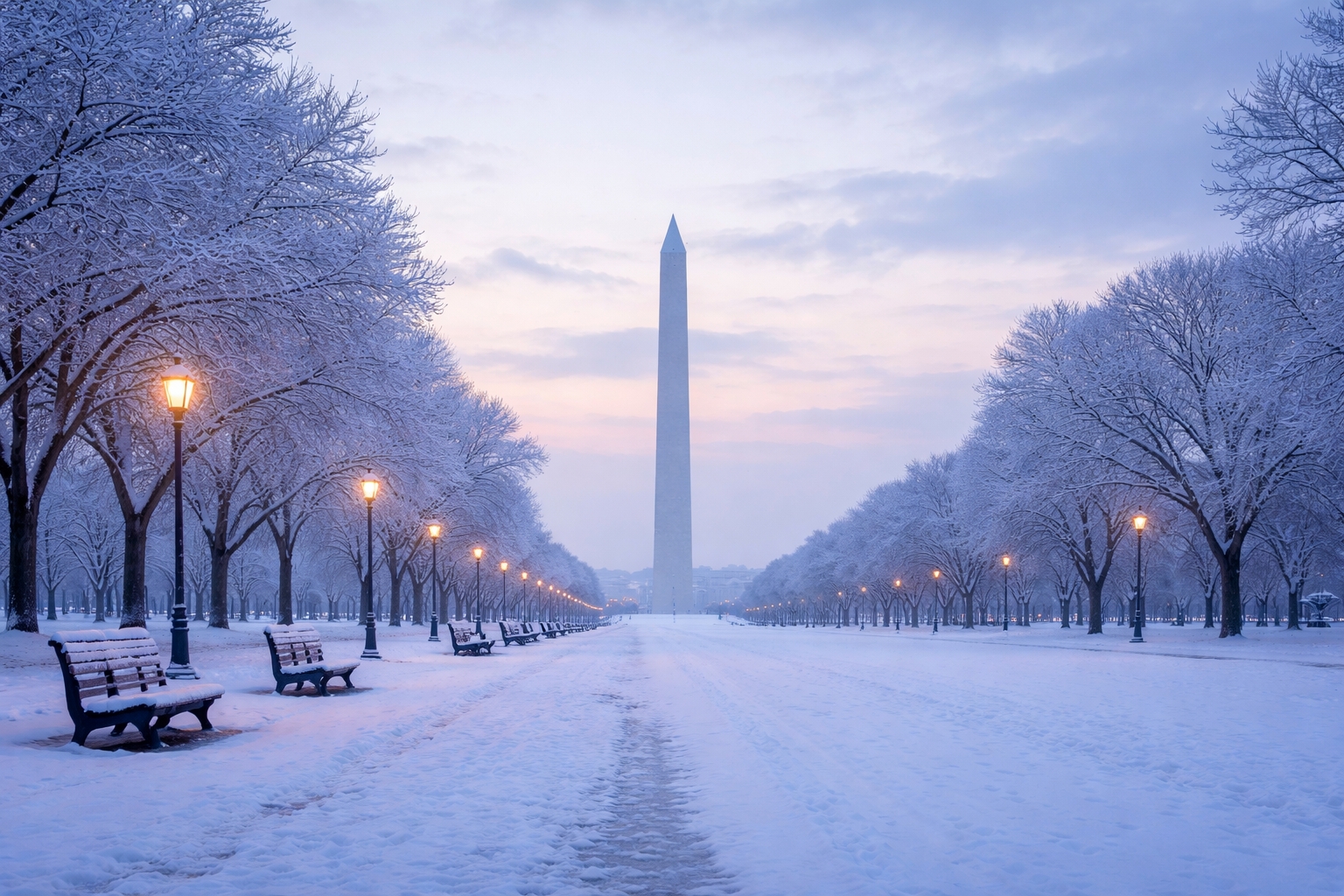
Coldest Day in History in Washington DC
Washington, DC is often associated with humid summers, cherry blossoms, and temperate winters, but the city’s climate history tells a far more dramatic story. While modern winters feel mild by comparison, there was a moment when the nation’s capital experienced cold so severe that it remains unmatched more than a century later. The coldest day in Washington DC history is not a myth, nor a rounding error in old records. It is a precisely documented meteorological event that reshaped how the city understands winter.
The coldest temperature ever recorded in Washington DC occurred on February 11, 1899, when thermometers plunged to −15°F. This record, measured near the National Mall, still stands today and has never been broken. Even during modern polar vortex events, Washington DC has not come close to matching that extreme.
The Coldest Temperature Ever Recorded in Washington DC
On February 11, 1899, Washington DC experienced its coldest day on record at −15°F. This event occurred during what is now known as the Great Arctic Outbreak of 1899, one of the most extreme cold waves in United States history.
At the time, meteorological instruments were maintained by what would later become the National Weather Service, and the data was recorded with professional precision. The cold was not localized or brief. It was part of a massive Arctic air mass that pushed southward, freezing rivers, halting rail travel, and disrupting daily life across the eastern United States.
The Great Arctic Outbreak of 1899
The winter of 1898–1899 was unusually volatile, but nothing prepared residents of Washington DC for what arrived in February. Arctic air surged southward, crossing the Great Plains and settling over the Mid-Atlantic with relentless force.
The National Oceanic and Atmospheric Administration later confirmed that this outbreak produced record-breaking low temperatures across multiple states, including Florida, where snowfall was observed in some regions.
In Washington DC:
-
Temperatures dropped below zero for multiple consecutive nights
-
The Potomac River partially froze
-
Heating systems of the era struggled to keep homes habitable
How Cold Is −15°F in Context
To understand how extreme −15°F is for Washington DC, it helps to compare it to modern winters.
Average winter low in Washington DC: 28°F
Typical cold snap: 15°F to 20°F
Extreme modern polar vortex lows: 2°F to 6°F
The record from 1899 remains nearly 20 degrees colder than most recent extremes. Even during the strongest polar vortex events of the 21st century, Washington DC has not experienced sub-zero temperatures of that magnitude.
Historic Cold Snaps That Came Close
While −15°F remains unmatched, Washington DC has experienced other historically severe cold events.
January 1912
Temperatures dropped to −5°F during a prolonged cold spell that followed heavy snowfall.
January 1934
A strong Arctic blast pushed temperatures to −2°F, one of the coldest readings of the 20th century.
January 1985
A polar air mass dropped temperatures to 4°F, freezing exposed infrastructure and setting short-term records.
January 2018
During the modern polar vortex, Washington DC reached 6°F, cold by contemporary standards but far from the 1899 benchmark.
Why Washington DC Rarely Reaches Extreme Cold
Washington DC’s geographic position moderates its climate. Located between the Appalachian Mountains and the Atlantic Ocean, the city benefits from:
-
Oceanic temperature moderation
-
Lower elevation than inland northern cities
-
Prevailing wind patterns that often deflect Arctic air
The National Mall and surrounding urban density also create a heat-retention effect that slightly buffers extreme lows today.
How the Coldest Day Impacted Daily Life in 1899
On the coldest day in Washington DC history:
-
Water mains froze across neighborhoods
-
Coal deliveries were delayed
-
Horse-drawn transportation slowed dramatically
-
Schools and government offices closed
The city had no modern insulation standards, no electric heating, and limited forecasting ability. Residents relied on fireplaces, coal stoves, and layered clothing to survive the cold.
Washington DC Weather Records and Climate Change Context
Although winters today feel milder, extreme cold events still occur. Climate data shows:
-
Average winter temperatures have risen
-
Variability has increased
-
Cold snaps remain possible but shorter in duration
The Smithsonian Institution maintains extensive archives documenting how Washington DC’s climate has evolved since the 19th century, including temperature trends and extreme events.
Experiencing Washington DC in Winter Today
Today, winter in Washington DC is far more comfortable than in 1899. Modern infrastructure, forecasting, and hospitality allow visitors to enjoy the season safely and comfortably.
Staying at The closest hotel to The White House, positioned at the edge of the White House Lawn, places travelers within walking distance of historic landmarks while offering modern climate control, panoramic views, and shelter from winter extremes.
Planning a Winter Visit with Historical Perspective
Understanding the coldest day in Washington DC history adds depth to any winter visit. Walking past the monuments, it is striking to imagine a time when the Lincoln Memorial stood surrounded by frozen air and snowdrifts rather than tour groups and mild breezes.
FAQs
What was the coldest day in Washington DC history
February 11, 1899, when the temperature reached −15°F.
Has Washington DC ever gone below zero
Yes, multiple times, but −15°F remains the coldest recorded temperature.
What caused the coldest day in DC
A massive Arctic air outbreak known as the Great Arctic Outbreak of 1899.
Has climate change eliminated extreme cold in DC
No. While average temperatures have risen, extreme cold events can still occur.
Closing Perspective
Washington DC’s coldest day is a reminder that even cities known for political power and monumental architecture are shaped by forces far beyond human control. Climate, history, and resilience intersect in moments like February 11, 1899, creating stories that continue to define the city more than a century later.
To explore Washington DC from the most iconic vantage point, with warmth, comfort, and direct access to the city’s history, plan your stay at The Hotel Washington, located at the edge of the White House Lawn.
Learn more at www.thehotelwashington.com
Entity References
| Entity Name | Entity Type | Authoritative Source |
|---|---|---|
| National Weather Service | Organization | weather.gov |
| National Oceanic and Atmospheric Administration | Organization | noaa.gov |
| Potomac River | Point of Interest | nps.gov |
| National Mall | Point of Interest | nps.gov |
| Smithsonian Institution | Organization | si.edu |
| Lincoln Memorial | Point of Interest | nps.gov |