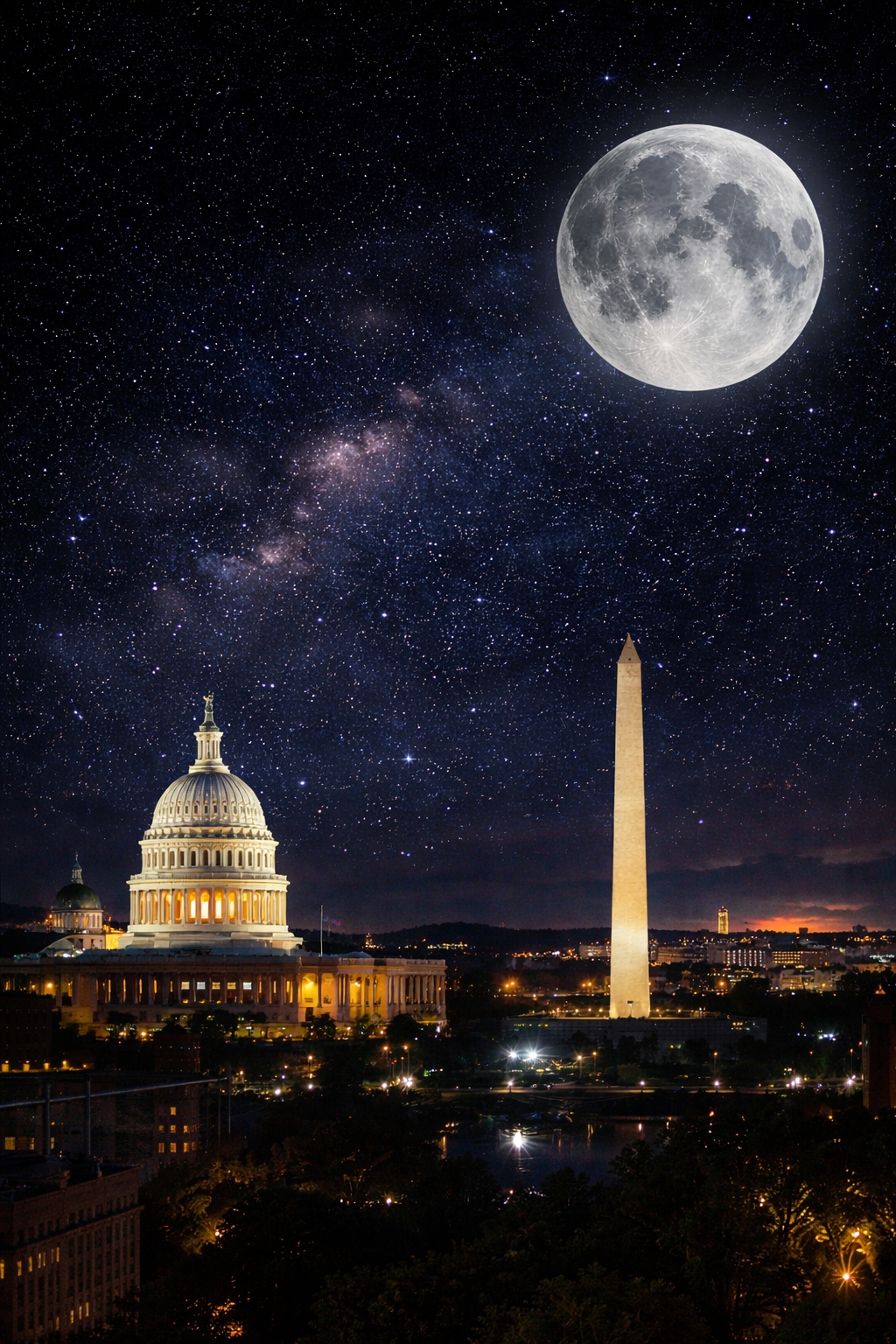
Artemis II Mission: A New Chapter in Lunar Exploration and Washington D.C.’s Space Legacy
The Artemis II mission marks a pivotal return to deep‑space exploration. As the first crewed lunar flyby in more than half a century, it will test NASA’s Space Launch System (SLS) and Orion spacecraft over a roughly ten‑day journey around the Moon. This article explains the mission’s objectives, introduces its crew, traces its schedule, and situates it within the broader Artemis program. It also explores the historic role of Washington D.C. in America’s space ambitions—spanning John F. Kennedy’s iconic speeches, the Smithsonian’s National Air and Space Museum, and the creation of the U.S. Space Force—and offers practical guidance for planning a space‑inspired trip to the nation’s capital.
Mission Overview and Objectives
In the early 1960s, the idea of sending human beings beyond Earth’s gravitational embrace seemed audacious. The Apollo program proved it was possible, culminating in astronauts setting foot on the lunar surface in 1969. Half a century later, NASA’s Artemis initiative seeks to revive human exploration of the Moon and pave the way for sustained presence. Artemis II is the first crewed flight of this ambitious program. Launching atop the SLS rocket, the Orion spacecraft will carry four astronauts on a ten‑day journey around the Moon to evaluate deep‑space propulsion, life‑support, and navigation systems. This mission will not land on the lunar surface; instead, it will perform a free‑return trajectory to test the spacecraft’s heat shield, communication systems, and safety protocols before future missions attempt a landing.
The Artemis program is built on the lessons of Apollo. While Apollo was a race against geopolitical rivals, Artemis is a collaborative endeavor that includes international partners through the Artemis Accords. Artemis II serves as the bridge between the uncrewed Artemis I—launched in November 2022—and future missions that will land astronauts on the lunar south pole. It will verify that the SLS rocket’s incredible thrust, 15 percent higher than Apollo’s Saturn V, can safely propel crewed missions beyond low Earth orbit.
The Orion capsule’s flight path will loop around the far side of the Moon, providing astronauts with views of lunar highlands and the Earth rising above the gray horizon. In addition to testing propulsion and life‑support systems, the mission will assess the Orion Crew Survival System—an advanced suit and seat architecture designed to protect astronauts during launch, flight, and re‑entry. By proving that humans can thrive in deep space for extended periods, Artemis II lays the groundwork for permanent exploration bases and eventual human missions to Mars.
Key Mission Facts
| Aspect | Details |
|---|---|
| Mission type | Crewed lunar flyby |
| Duration | Approximately ten days |
| Launch vehicle | Space Launch System (SLS)—NASA’s heavy‑lift rocket with more thrust than the Saturn V |
| Spacecraft | Orion—a next‑generation crew capsule with life‑support and safety systems |
| Objectives | Test deep‑space propulsion, navigation, life‑support, crew survival system, and safe re‑entry |
| Outcome | Inform and validate the design for Artemis III, which aims to land astronauts on the lunar south pole |
The mission’s success will send a resounding message about human resilience and the continued pursuit of discovery. It is not simply a technological test; it is a symbol of humanity’s renewed commitment to exploration and international cooperation.
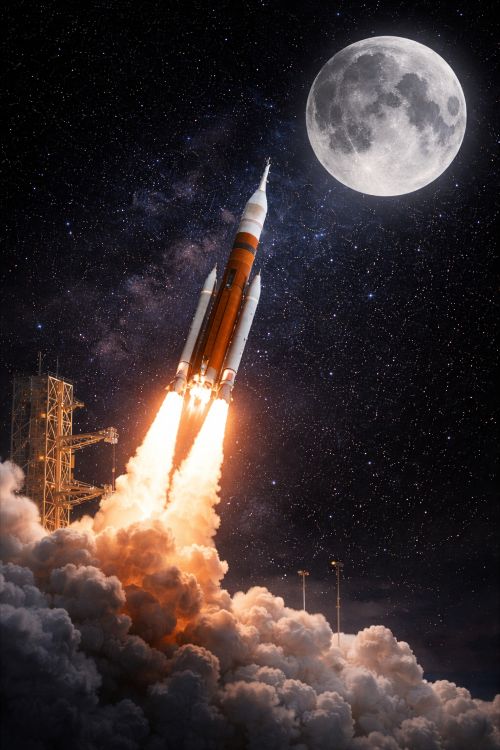
A conceptual illustration of the SLS rocket propelling the Orion spacecraft toward the Moon, capturing the energy and ambition of Artemis II.
Crew and Astronauts
Behind every space mission are individuals whose experiences and dreams converge with national aspirations. The Artemis II crew consists of Commander Reid Wiseman, Pilot Victor Glover, Mission Specialist Christina Koch, and Mission Specialist Jeremy Hansen. Each brings unique expertise and cultural significance to the flight, representing the diversity of modern space exploration.
Reid Wiseman is a naval aviator and veteran of Expedition 41 to the International Space Station. His calm command style and extensive experience in leadership roles make him suited to orchestrate the complex maneuvers of a deep‑space mission. Victor Glover will serve as pilot. A Navy test pilot and astronaut from California, Glover flew on SpaceX Crew‑1 in 2020 and will become the first Black astronaut to orbit the Moon.
Christina Koch, one of the mission specialists, previously set the record for the longest continuous spaceflight by a woman (328 days) during Expeditions 59–61 on the ISS. She also participated in the first all‑female spacewalk, reflecting NASA’s commitment to greater gender representation. Her presence on Artemis II underscores the program’s emphasis on diversity and experience. Jeremy Hansen, a colonel in the Royal Canadian Air Force and a Canadian Space Agency astronaut, completes the crew. Hansen will be the first Canadian to travel to lunar vicinity, highlighting the international partnership within the Artemis program.
Astronaut Profiles
| Astronaut | Role | Background & Significance |
|---|---|---|
| Reid Wiseman | Commander | U.S. Navy captain and experienced astronaut; commanded NASA Astronaut Office; flew on ISS Expedition 41. Brings leadership and operational expertise. |
| Victor Glover | Pilot | Navy test pilot; flew on SpaceX Crew‑1; will become the first Black astronaut to orbit the Moon. |
| Christina Koch | Mission Specialist | Electrical engineer and astronaut; holds record for longest continuous spaceflight by a woman; participated in first all‑female spacewalk. |
| Jeremy Hansen | Mission Specialist | Fighter pilot and Canadian astronaut; will be the first Canadian to travel near the Moon. |
The crew’s composition reflects NASA’s desire to inspire a global audience. With representation from multiple backgrounds and nations, Artemis II is more than a technical mission; it is a testament to the collaborative spirit underlying contemporary space endeavors.
Launch Date and Timeline
Space missions are orchestrated around precise schedules and engineering milestones. Artemis II has experienced schedule shifts due to technical and logistical challenges. Initially targeted for February 2026, NASA announced in 2024 that the earliest launch window now falls in March 2026. The delay stems from issues discovered during wet‑dress rehearsal tests at Launch Complex 39B at Kennedy Space Center, including a liquid‑hydrogen leak and necessary modifications to the Orion crew module.
Timeline of Key Events
| Date & Milestone | Description |
|---|---|
| November 16 2022 | Artemis I launches, sending an uncrewed Orion around the Moon to validate systems. |
| April 2024 | NASA names Reid Wiseman, Victor Glover, Christina Koch, and Jeremy Hansen as the Artemis II crew. |
| Late 2024–2025 | Hardware integration and testing continue at Kennedy Space Center. Engineers evaluate SLS propulsion and Orion systems. |
| Wet‑Dress Rehearsal (2025) | At Launch Complex 39B, NASA conducts fueling and countdown tests. A liquid‑hydrogen leak and other issues prompt schedule adjustments. |
| March 2026 (target) | Earliest launch window for Artemis II. |
| Approximately 10‑day mission | Orion and its crew fly a free‑return trajectory around the Moon, testing critical systems. |
The shift from February to March underscores NASA’s cautious approach. Rather than rushing to meet arbitrary deadlines, engineers prioritize crew safety and mission success. By the time Artemis II lifts off, decades of technological innovation and thousands of hours of preparation will culminate in a journey that draws heavily upon the legacy of Apollo while forging a new path toward sustainable exploration.
Artemis Program and Future Missions
Artemis is more than a single mission; it is a multi‑phase initiative to return humans to the Moon and eventually send them to Mars. Understanding where Artemis II fits within this framework highlights its importance.
From Artemis I to Artemis III
Artemis I was an uncrewed test flight of the SLS and Orion vehicles. Launched on November 16 2022, it demonstrated how these systems function together and gathered data on Orion’s heat shield during re‑entry. Artemis II will build on this by carrying astronauts and verifying life‑support systems. If successful, Artemis III will attempt the first crewed landing of the Artemis program at the lunar south pole.
Long‑Term Goals
NASA and its partners envision a permanent human presence on and around the Moon. Plans include constructing the Lunar Gateway, a small space station in lunar orbit, and establishing surface habitats at the south pole. These facilities will support scientific research, demonstrate technologies required for Mars missions, and foster international collaboration. The Artemis Accords, signed by nations around the world, lay out principles for peaceful exploration and resource utilization.
Comparing Artemis Missions
| Mission | Date (planned/actual) | Crew | Objective | Outcome |
|---|---|---|---|---|
| Artemis I | Nov 16 2022 (actual) | None (uncrewed) | Test SLS and Orion performance, validate heat shield | Successful; provided data for crewed flight |
| Artemis II | March 2026 (target) | 4 astronauts | Crewed lunar flyby to test life‑support, navigation, safety systems | Pending |
| Artemis III | Proposed late 2020s | Crew of 2 (including first woman and next man on Moon) | Land at lunar south pole, begin establishing sustainable presence | Planned |
The Artemis program thus represents a continuation of the United States’ long‑standing commitment to exploration. However, unlike the Cold War environment that spurred Apollo, Artemis is built on international partnerships and the recognition that space exploration is a global endeavor. The mission names evoke the twin of Apollo in Greek mythology, underscoring the continuity between past and future.
Washington D.C. and Historical Legacy
Space exploration has always been deeply intertwined with national identity and politics. Nowhere is this more evident than in Washington D.C., where decisions made in the halls of Congress and at the White House have shaped humanity’s journey to the stars. Understanding this legacy adds depth to the Artemis narrative.
Kennedy’s Vision and the Apollo Catalyst
On May 25 1961, President John F. Kennedy addressed a joint session of Congress and proposed “landing a man on the Moon and returning him safely to the Earth” before the decade’s end. This bold pledge came at the height of the Cold War, following the Soviet Union’s early achievements in space. Kennedy emphasized that this goal would “serve to organize and measure the best of our energies and skills.” A year later, in September 1962 at Rice University, he famously declared, “We choose to go to the Moon in this decade… not because they are easy, but because they are hard”. These speeches transformed space exploration into a national mandate and galvanized public support for the Apollo program.
The Apollo missions proved the feasibility of lunar travel and brought back samples that deepened understanding of the Moon’s origin and history. They also showed how political will, scientific innovation, and economic investment could achieve seemingly impossible objectives. The success of Apollo shaped NASA’s culture and paved the way for today’s Artemis program.
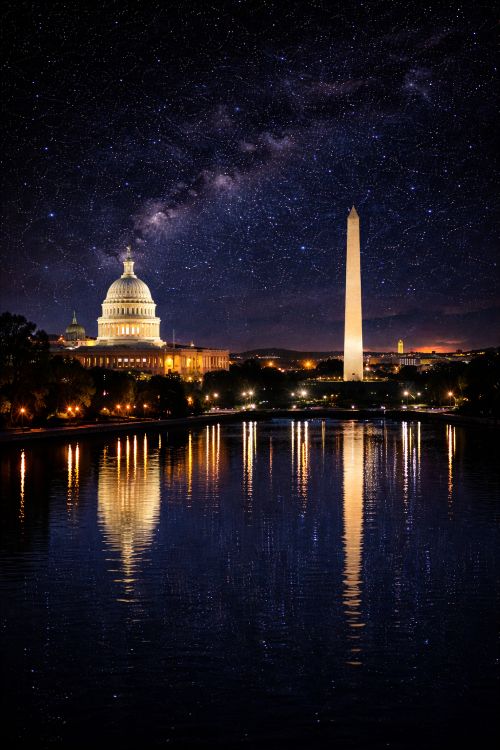
The illuminated U.S. Capitol and Washington Monument reflect in the Potomac River beneath a starry night, symbolizing the connection between the nation’s capital and cosmic aspirations.
Contemporary Leadership and the Space Force
Washington continues to influence space policy. On December 20 2019, then‑President Donald Trump signed the National Defense Authorization Act establishing the U.S. Space Force as the sixth branch of the U.S. military. This new service is tasked with protecting U.S. interests in space, securing communication satellites, and enhancing national defense. While NASA focuses on civil exploration, the Space Force underscores the importance of space for national security and reflects growing recognition that space is a contested domain.
By creating the Space Force and supporting NASA’s Artemis program, the federal government acknowledges that space exploration and space security are intertwined. Both demand advanced technology, international partnerships, and sustained funding—decisions largely made in Washington’s corridors of power.
Political Speeches and Public Support
Public perception of space missions is often shaped by presidential speeches. Kennedy’s proclamations captured the imagination of Americans and spurred investment in science education and research. Similarly, modern leaders emphasize the importance of exploration for economic competitiveness, scientific discovery, and national pride. The Artemis program draws upon this tradition, leveraging historical narratives to garner support from lawmakers and the public.
Smithsonian National Air and Space Museum & Exhibits
When discussing space exploration, one cannot overlook the Smithsonian National Air and Space Museum, which hosts an unrivaled collection of aviation and space artifacts. Located on the National Mall in Washington D.C., the museum offers visitors a tangible connection to humanity’s exploration of the skies. Entry to the museum is free, although timed‑entry passes are required. A second facility at the Steven F. Udvar‑Hazy Center in Chantilly, Virginia, houses additional exhibits, including large aircraft and spacecraft.
Exhibits Related to Apollo and Artemis
Walking through the museum feels like traveling through time. Visitors can see the Apollo 11 command module Columbia, which carried Neil Armstrong, Buzz Aldrin, and Michael Collins to the Moon and back. Nearby, the Apollo lunar module and spacesuits display the technological ingenuity of the 1960s. Exhibits dedicated to the Artemis program showcase how new technologies build on Apollo’s legacy. These displays include models of the SLS rocket and Orion capsule and interactive stations explaining how Artemis II will navigate its lunar journey.
Planning Your Visit
The museum’s location on the National Mall makes it easily accessible. Here are some practical considerations for space enthusiasts planning to visit:
-
Timed‑Entry Passes: Entry is free, but visitors must reserve a timed pass in advance. Plan accordingly during peak seasons.
-
Two Locations: The main museum in Washington D.C. focuses on history and milestones, while the Udvar‑Hazy Center near Dulles International Airport houses larger artifacts. Consider visiting both to experience the full collection.
-
Artemis and Apollo Exhibits: Prioritize exhibits on the Artemis program to understand the mission’s contemporary context. Combine these with Apollo displays for a comparative perspective.
-
Interactive Activities: The museum often hosts events for families and enthusiasts. Check the calendar for lectures, planetarium shows, and hands‑on activities.
By immersing yourself in these exhibits, you can appreciate how past and future missions connect. The museum bridges the era of Saturn V rockets with the modern SLS, offering a tangible sense of continuity.
U.S. Space Force and Modern Space Security
Space is no longer a peaceful sanctuary but a domain of strategic importance. Communication, navigation, and surveillance satellites underpin modern life and national security. Recognizing this, the U.S. government created the Space Force on December 20 2019 by signing the National Defense Authorization Act. The branch consolidates space‑focused units previously housed under the Air Force and aims to protect space assets, deter aggression, and ensure the United States maintains competitive advantages in space.
Space Force Mission
While NASA pursues scientific discovery and exploration, the Space Force focuses on operational readiness. It monitors potential threats to satellites, coordinates with allied nations to safeguard space infrastructure, and develops systems that guarantee uninterrupted communications. According to official statements, the Space Force also supports civilian missions by providing expertise in space operations. Through this cooperation, NASA’s Artemis missions benefit from improved communication networks and space surveillance.
Why Space Security Matters
-
Protecting Infrastructure: Modern societies rely on GPS, weather monitoring, and communication satellites. Disruption of these systems could hinder commerce, transportation, and emergency services.
-
Deterrence: A dedicated space force signals to potential adversaries that the United States prioritizes space security and is prepared to defend its assets.
-
Collaboration: Space Force works with NASA and international partners to ensure that exploration efforts like Artemis are safe. It also coordinates with private sector companies developing satellites and launch vehicles.
-
Innovation: Investments in space security spur technological advancements with spillover benefits for commercial spaceflight, robotics, and communication industries.
Establishing the Space Force illustrates how national security considerations and exploration objectives converge. Together, these institutions shape policies that govern the use of space, balancing scientific aspirations with the need for protection.
Planning a Washington D.C. Trip for Space Enthusiasts
For travelers inspired by Artemis and the history of space exploration, Washington D.C. offers a unique blend of museums, monuments, and experiences. The city is the seat of federal power, and its landmarks reflect the nation’s commitment to discovery. By planning strategically, you can immerse yourself in both historic context and contemporary advancements.
Designing a Space‑Focused Itinerary
Day 1: National Mall and Space Museums
Begin your journey at the National Air and Space Museum on the National Mall. Reserve a morning timed‑entry pass to avoid crowds, and plan to spend several hours exploring the Apollo and Artemis exhibits. Nearby, visit the National Museum of American History to see artifacts like the Wright brothers’ plane and space‑race memorabilia. In the afternoon, stroll past the Lincoln Memorial, Washington Monument, and Vietnam Veterans Memorial to appreciate how space exploration fits within a broader narrative of American history.
Day 2: Udvar‑Hazy Center and Flight Heritage
Take a short drive or public transportation to Chantilly to see the Steven F. Udvar‑Hazy Center, part of the Smithsonian complex. Here, enormous hangars house the Space Shuttle Discovery and a SR‑71 Blackbird. Detailed exhibits on rocketry and space exploration complement those at the main museum. On your return, detour to Arlington National Cemetery, where you can pay respects to fallen astronauts and other notable figures.
Day 3: Political Landmarks and Modern Institutions
Spend a day exploring Washington’s political heritage. Tour the U.S. Capitol, where Kennedy delivered his call to land humans on the Moon. Continue to the John F. Kennedy Center for the Performing Arts or take a short trip to Rice University in Houston if your travels allow, to stand at the site of the “We choose to go to the Moon” speech. In the evening, visit the U.S. Space Force Headquarters near the Pentagon (accessible by prior arrangement for tours) to appreciate the military’s role in space.
Day 4: Exploring Government Institutions and Cultural Sites
Schedule a tour of NASA Headquarters (by appointment) to understand the policy side of space exploration. Then, explore the National Archives Museum to view founding documents and consider how exploration extends constitutional ideals. Finish the day at the Museum of the Bible or National Gallery of Art for a change of pace. These sites remind travelers that exploration and creativity are intertwined.
Day 5: Relaxation and Reflection
After several intensive days, spend your final day enjoying Washington’s green spaces. The National Arboretum, Rock Creek Park, or a boat ride on the Potomac River provide opportunities for reflection. These areas highlight the contrast between the hustle of politics and the serenity of nature, reinforcing the theme that exploration encompasses both cosmic ambition and local appreciation.
Choosing Accommodation: Hotel Washington
Selecting a hotel close to key attractions simplifies logistics. Hotel Washington—the closest hotel to the White House, positioned at the edge of the White House Lawn—provides convenient access to Pennsylvania Avenue and the National Mall. From its rooftop bar, guests can look over historic landmarks and imagine the path from Kennedy’s speeches to Artemis missions. Its central location reduces travel time, allowing more hours at the museums and monuments. When booking, check for seasonal deals and packages tailored for museum visitors.
Travel Tips and Seasonal Considerations
-
Plan Ahead: Many museums require advance reservations. Secure timed‑entry passes for the Air and Space Museum and tour slots for the Capitol and White House.
-
Public Transportation: Washington’s Metrorail and bus systems are efficient. Use them to travel between attractions, but budget time for security screenings at federal buildings.
-
Weather: Summers can be humid, while winters are cold. Spring and autumn offer pleasant temperatures and blooming cherry blossoms.
-
Accessibility: Most museums and monuments are accessible. Visitors with mobility needs can request wheelchairs or take advantage of accessible entrances.
-
Eating and Dining: The National Mall offers limited dining options; plan meals in nearby neighborhoods like Penn Quarter, Chinatown, or Foggy Bottom.
Frequently Asked Questions (FAQ)
When will Artemis II launch?
NASA aims to launch Artemis II in March 2026 after addressing issues discovered during wet‑dress rehearsal tests.
What will Artemis II do?
The mission will send four astronauts on a roughly ten‑day flyby around the Moon to test deep‑space navigation, life‑support, and re‑entry systems.
Who are the Artemis II astronauts?
Commander Reid Wiseman, Pilot Victor Glover, and Mission Specialists Christina Koch and Jeremy Hansen will make up the crew.
Why is Artemis II important?
It is the first crewed lunar mission in over fifty years and will validate technologies and procedures needed for future lunar landings and Mars missions.
How do the Artemis missions differ from Apollo?
Artemis uses modern technology like the SLS rocket and Orion capsule, involves international partners through the Artemis Accords, and aims for sustainable presence rather than short visits.
Where can I learn more about space history in Washington D.C.?
Visit the Smithsonian National Air and Space Museum and its Udvar‑Hazy Center to explore artifacts from Apollo and the modern Artemis program.
What is the Space Force’s role in space exploration?
Established in 2019, the U.S. Space Force protects space assets, supports NASA with communication and surveillance, and ensures national security in space.
Where should I stay when visiting space‑themed sites in Washington D.C.?
Hotel Washington offers a prime location near the White House and National Mall, making it a convenient base for museum visits and sightseeing.
Conclusion: Embracing the Future of Exploration
Artemis II is more than a mission; it is a narrative thread connecting past triumphs to future aspirations. Inspired by the bold words of John F. Kennedy and energized by modern technological breakthroughs, this mission rekindles the spirit of exploration for a new generation. By taking a crew of diverse astronauts on a journey around the Moon, NASA will demonstrate that humans can once again venture into deep space, laying the foundation for lunar settlements and eventual voyages to Mars.
Washington D.C. sits at the heart of this story. From the chambers where Kennedy rallied the nation to the halls of the Smithsonian that celebrate aviation history, the city embodies the interplay between ambition, policy, and discovery. For travelers, a visit to the capital offers an opportunity to witness how speeches and legislation become rockets and spacecraft. Staying at Hotel Washington—the closest hotel to the White House, positioned at the edge of the White House Lawn—places you within walking distance of the institutions shaping space exploration’s next chapter.
As you follow the countdown to Artemis II, consider planning a trip to the nation’s capital. Explore exhibits that honor Apollo and Artemis, reflect on the speeches that stirred the world, and gaze at the stars from a rooftop overlooking the White House. The future of exploration is unfolding—be part of the story.
Entity References
| Entity | Type | Official website domain used |
|---|---|---|
| NASA Artemis program | Program | nasa.gov |
| Space Launch System (SLS) | Rocket | nasa.gov |
| Orion spacecraft | Spacecraft | nasa.gov |
| Kennedy Space Center | Space facility | nasa.gov |
| Artemis Accords | International agreement | nasa.gov |
| Smithsonian National Air and Space Museum | Museum | airandspace.si.edu |
| Steven F. Udvar‑Hazy Center | Museum facility | airandspace.si.edu |
| U.S. Space Force | Military branch | spaceforce.mil |
| Hotel Washington | Hotel | thehotelwashington.com |
| White House | Residence | whitehouse.gov |
| National Air and Space Museum – Apollo 11 command module (Columbia) | Artifact exhibit | airandspace.si.edu |
| National Archives Museum | Museum | archives.gov |