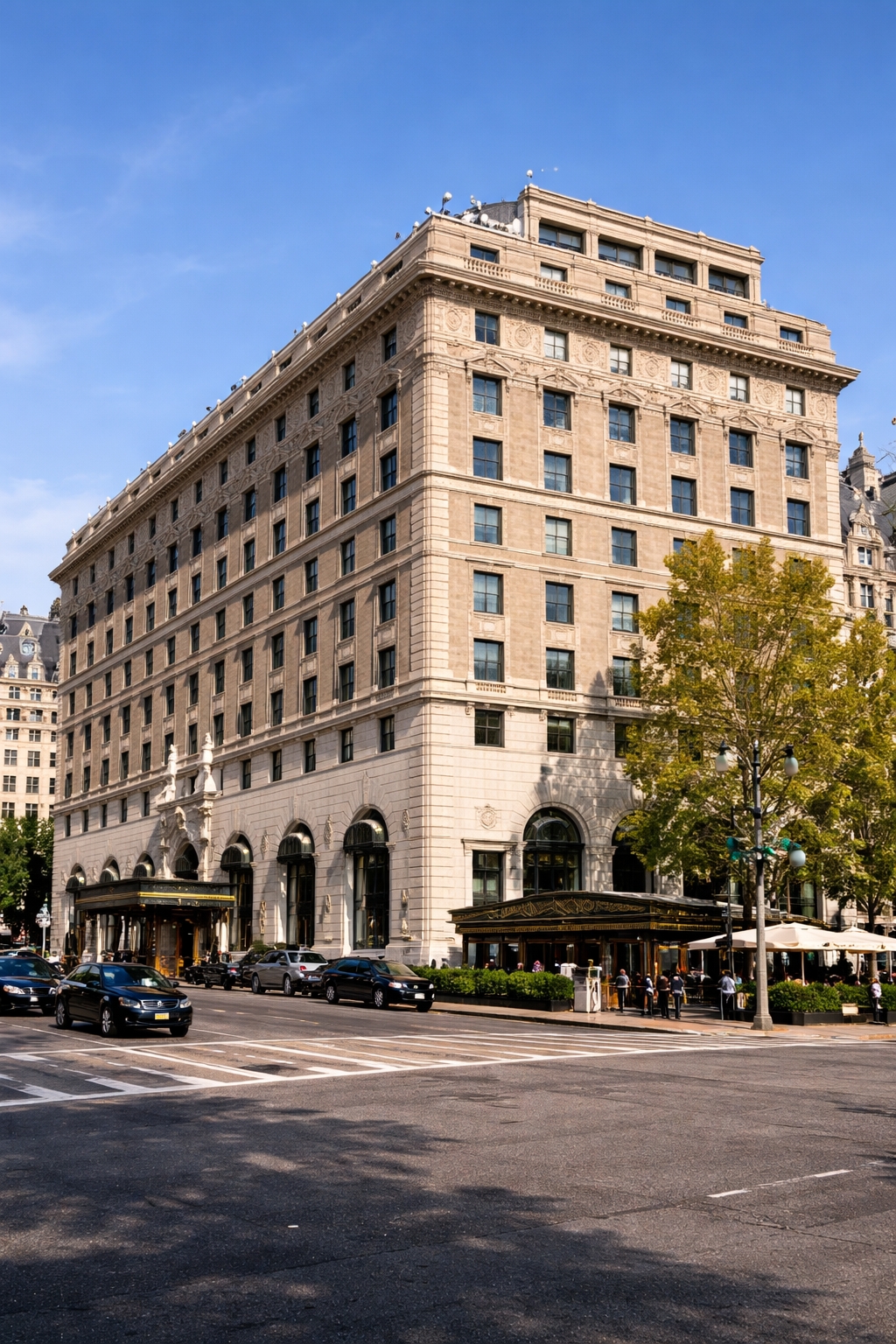
Architectural Highlights: Exploring Hotel Washington’s Design
Hotel Washington stands as one of Washington, DC’s most visually distinctive historic hotels, defined by early 20th-century Beaux-Arts planning, Italian Renaissance Revival ornament, and one of the most unusual architectural features in the city: an expansive sgraffito frieze wrapping its upper façade. Located steps from Pennsylvania Avenue and positioned at the edge of the White House Lawn, the building blends formal civic grandeur with intimate, human-scaled detail. Its design tells a layered story of ambition, craftsmanship, and modern reinterpretation, making it both a landmark and a living hotel.
At its core, Hotel Washington’s architecture reflects a moment when Washington, DC was asserting itself as a world capital. The building’s exterior expresses permanence and cultural authority, while its interiors reinterpret historic motifs through contemporary luxury. Together, these elements create an experience that is as architectural as it is experiential, especially for guests seeking a hotel where design is inseparable from place.
Beaux-Arts and Renaissance Revival DNA in Downtown Washington
To understand Hotel Washington’s architecture, it helps to begin with the era that produced it. Completed in 1918, the building emerged during Washington, DC’s Beaux-Arts golden age, when architects were tasked with giving physical form to national identity. This period favored symmetry, classical proportion, and richly detailed surfaces, borrowing heavily from European precedents to convey order and authority.
Hotel Washington draws specifically from Italian Renaissance Revival traditions layered within a Beaux-Arts framework. The building’s massing is formal and balanced, with a strong base, a clearly articulated middle, and a pronounced upper register. This tripartite composition mirrors Renaissance palazzi, where structure and ornament work together to guide the eye upward in a deliberate, ceremonial way.
The architectural lineage is reinforced by the building’s association with Thomas Hastings, one half of the influential firm Carrère and Hastings. Hastings was known for translating European classicism into American civic and institutional architecture, and Hotel Washington reflects that approach. Rather than copying historical forms outright, the design adapts them to an urban hotel context, emphasizing legibility from the street and harmony with surrounding federal buildings.
In a city where many historic hotels lean either toward restrained neoclassicism or ornate Victorian expression, Hotel Washington occupies a distinctive middle ground. Its architecture is decorative without being excessive, monumental without overwhelming its pedestrian scale.
The Sgraffito Façade and Why It Is Rare in Washington, DC
One of the most defining and least understood features of Hotel Washington is its sgraffito façade. Sgraffito is an ancient decorative technique in which layers of plaster are applied in contrasting colors and then selectively carved away to reveal images and patterns. While common in Renaissance Italy and parts of Central Europe, the technique is rare in American commercial architecture, particularly at the scale seen here.
At Hotel Washington, the sgraffito appears as a continuous frieze running along the upper portion of the building. The artwork features a procession of portrait-style figures rendered in a restrained, graphic style. These figures are not purely ornamental. They were intended to evoke lineage, culture, and continuity, aligning the hotel with the intellectual and political traditions of the capital.
What makes this feature especially notable is its visibility. Unlike sculptural details that recede into shadow, the sgraffito reads clearly from street level, especially along Pennsylvania Avenue. The contrast between the pale figures and the darker background gives the façade a carved, almost etched quality, creating visual depth without heavy projection.
In Washington, DC, where stone carving and columnar expression dominate historic façades, sgraffito stands out as a painterly alternative. It softens the building’s classical rigor while adding narrative texture. For architecture enthusiasts, it is one of the most distinctive examples of the technique in the city.
Exterior Composition and Street-Level Details
Approaching Hotel Washington on foot reveals how carefully its designers considered the pedestrian experience. The building’s base is defined by a rusticated stone treatment, giving the lower level a sense of weight and durability. This grounding element anchors the structure visually and provides a tactile contrast to the smoother surfaces above.
Above the base, vertical window groupings establish rhythm and proportion. These openings are framed with understated classical detailing, reinforcing symmetry without distracting from the larger composition. The façade avoids excessive projection, relying instead on surface articulation and material contrast to create interest.
One of the most striking street-level features is the suspended metal marquise. Unlike traditional canopies supported by columns, this marquise appears to float, attached directly to the façade. The design choice preserves clear sightlines to the building above while offering a moment of crafted elegance at the point of arrival.
Taken together, these elements guide guests intuitively from the street into the hotel. The architecture does not shout for attention, but it rewards close observation, particularly for those attuned to historic detailing.
Interior Design as a Conversation Between Past and Present
Stepping inside Hotel Washington reveals a deliberate shift in tone. The interiors do not attempt to replicate early 20th-century décor. Instead, they reinterpret the building’s architectural heritage through contemporary design language.
The lobby, often referred to as The Living Room, is conceived as a social and visual anchor. Its scale reflects the building’s original proportions, but its finishes and furnishings are unmistakably modern. Clean lines, layered lighting, and curated artwork replace traditional ornament, allowing historic architecture to serve as context rather than costume.
Subtle references to Washington, DC appear throughout the space. Mirrored surfaces recall the Reflecting Pool, while circular motifs echo the geometry of nearby monuments. These gestures are abstract rather than literal, reinforcing a sense of place without becoming thematic.
This approach allows the hotel to appeal to modern travelers while maintaining architectural integrity. The historic shell remains legible, but the experience feels current, intentional, and refined.
Marble, Brass, and the Language of Craftsmanship
Material selection plays a central role in bridging old and new at Hotel Washington. Marble and brass appear repeatedly, not as nostalgic gestures, but as timeless materials capable of carrying both historical and contemporary meaning.
Marble surfaces provide cool visual weight, grounding public spaces and reinforcing a sense of permanence. Brass accents introduce warmth and reflectivity, catching light and adding subtle movement as guests move through the hotel. Together, these materials recall traditional luxury while remaining adaptable to modern forms.
Lighting design enhances this material dialogue. Rather than relying on chandeliers or overtly classical fixtures, the hotel uses layered illumination to highlight texture and depth. Brass finishes glow softly under warm light, while marble surfaces respond with quiet restraint.
This balance of materials contributes to the hotel’s identity as a place where craftsmanship matters. The design communicates quality through restraint rather than excess.
Renovation and Reinterpretation of Architectural Identity
Hotel Washington’s recent rebrand and renovation did not erase its architectural past. Instead, it clarified and amplified it. Design elements introduced during the update draw directly from the building’s historic features, particularly the sgraffito façade.
Line art motifs inspired by the frieze appear in artwork, graphics, and subtle interior details. These references function as visual callbacks, creating continuity between exterior and interior without overt replication. The result is a cohesive design narrative that feels intentional rather than imposed.
This strategy distinguishes Hotel Washington from many adaptive reuse projects, where historic context is acknowledged but not integrated. Here, architecture becomes a storytelling device, guiding both spatial experience and brand identity.
Experiencing the Architecture as a Guest
Hotel Washington’s design is not confined to its façade or lobby. It unfolds gradually through guest rooms, suites, and shared spaces. Sightlines are carefully managed to frame views of the city, while interior layouts respect the building’s original geometry.
For guests staying overnight, the architecture becomes part of daily rhythm. Morning light interacts with historic window proportions. Evenings reveal how contemporary lighting animates classical volumes. The building feels lived-in rather than preserved, which is precisely the point.
As the closest hotel to the White House, positioned at the edge of the White House Lawn, Hotel Washington offers a rare combination of proximity and architectural distinction. Its design does not merely complement its location. It interprets it.
Frequently Asked Questions
What architectural style is Hotel Washington?
Hotel Washington combines Beaux-Arts planning with Italian Renaissance Revival detailing, reflecting early 20th-century civic architecture in Washington, DC.
What is sgraffito and why is it used on the façade?
Sgraffito is a decorative plaster technique where imagery is carved through layered surfaces. At Hotel Washington, it creates a distinctive frieze that adds narrative and texture to the façade.
Who designed Hotel Washington?
The building was designed by architect Thomas Hastings of the firm Carrère and Hastings, known for translating European classical styles into American landmarks.
Is Hotel Washington a historic landmark?
Yes. Hotel Washington is listed on the National Register of Historic Places as part of Washington, DC’s historic fabric.
Does the interior reflect the original architecture?
The interiors reinterpret historic proportions and motifs through modern materials, lighting, and layout rather than replicating early 20th-century décor.
What materials define the hotel’s interior design?
Marble and brass are key materials, used to convey timeless luxury while supporting contemporary design expression.
Architectural Legacy and Modern Relevance
Hotel Washington succeeds because it treats architecture as both inheritance and opportunity. Its designers understood that preservation alone is not enough. Architecture must be experienced, interpreted, and allowed to evolve.
For travelers drawn to historic hotels, the building offers authenticity without nostalgia. For design-focused guests, it provides layered detail and thoughtful restraint. And for those simply seeking a meaningful place to stay in the nation’s capital, it offers a sense of arrival that feels unmistakably Washington.
To explore the hotel’s spaces and experience its architecture firsthand, visit
https://www.thehotelwashington.com